PUBLISHER: Mordor Intelligence | PRODUCT CODE: 2113428

PUBLISHER: Mordor Intelligence | PRODUCT CODE: 2113428
United Kingdom Water Treatment Chemicals - Market Share Analysis, Industry Trends & Statistics, Growth Forecasts (2026 - 2031)
According to Mordor Intelligence, the United Kingdom water treatment chemicals market size was valued at USD 1.22 billion in 2025 and estimated to grow from USD 1.28 billion in 2026 to reach USD 1.66 billion by 2031, at a CAGR of 5.31% during the forecast period (2026-2031).
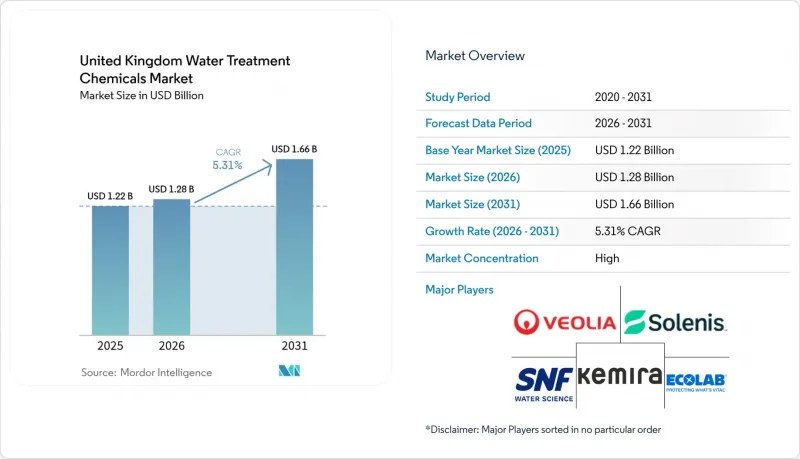
This report is Segmented by Product Type (Flocculants and Coagulants, Biocides and Disinfectants, Defoamers and Defoaming Agents, PH Adjusters and Softeners, and More), End-User Industry (Power, Oil and Gas, Chemical and Petrochemical, Mining and Mineral Processing, Municipal, Food and Beverage, Pulp and Paper, Others). The Market Forecasts are Provided in Terms of Value (USD).
United Kingdom Water Treatment Chemicals Market Trends and Insights
Stringent United Kingdom and European Union Wastewater Discharge Limits
Tighter UK and EU discharge thresholds elevate compliance costs and favor suppliers able to furnish exhaustive technical dossiers that satisfy both UK REACH and legacy EU criteria. The Environment Agency's validation stage for complex waste permits, effective June 2024, ratchets scrutiny, while the Drinking Water Inspectorate's incoming January 2025 PFAS ceiling of 0.1 µg/L adds fresh impetus for specialized oxidants and adsorbents. Water companies increasingly shortlist vendors on proof of PFAS removal efficacy and chlorate control, narrowing the competitive field. Industrial dischargers, especially pharmaceuticals and food processors, now seek turnkey chemical packages capable of meeting haloacetic-acid caps without process downtime. Consequently, the United Kingdom water treatment chemicals market witnesses a migration from commodity pricing to performance-assured contracts anchored in documented contaminant reduction.
Ageing Water Infrastructure Renewal Wave
Ofwat's AMP8 blueprint allocates GBP 104 billion (USD 132.1 billion) for network upgrades through 2030, ensuring a multi-year demand runway for corrosion inhibitors, scale suppressants, and coagulants. Victorian mains in London and Manchester necessitate higher-dosage protection chemistry, whereas newer Midlands plants incorporate energy-optimized formulations. Utilities weigh whole-life asset costs over upfront reagent price, spurring bids that bundle chemical supply with predictive maintenance sensors. Framework deals such as Thames Water's GBP 34 million procurement and Southern Water's GBP 104 million chemicals contract reinforce long-term volume visibility for incumbents in the United Kingdom water treatment chemicals market.
Hazardous-Chemical Phase-Outs
UK REACH alignment with EU substitution protocols accelerates the retirement of hydrazine oxygen scavengers and high-toxicity biocides. Plants face transitional inefficiencies as they validate alternative blends, temporarily dampening volume growth in the United Kingdom water treatment chemicals market. Suppliers investing in R&D for low-toxin corrosion inhibitors and PFAS-free surfactants offset revenue loss, but laggards reliant on legacy formulations risk share erosion. Certification backlogs add to near-term uncertainty.
Other drivers and restraints analyzed in the detailed report include:
- Mandatory Industrial-Water Reuse Targets
- Craft-Brewery Boom Driving Specialty Antifoams
- Volatile Petro-Feedstock Prices
For complete list of drivers and restraints, kindly check the Table Of Contents.
Segment Analysis
Flocculants and coagulants commanded 33.78% of the United Kingdom water treatment chemicals market share in 2025, underpinned by their indispensability in primary clarification and sludge dewatering. Kemira's twin capacity expansions-increasing Goole ferric output by 100,000 t/y and Ellesmere Port aluminum coagulants by 30,000 t/y-illustrate the economies of scale shaping this segment. The United Kingdom water treatment chemicals market size for flocculants is poised to climb steadily as AMP8 plants come online and industrial retrofits intensify.
Commodity status is rapidly giving way to formulation sophistication, with multi-functional blends integrating charge neutralization and odor control in one SKU. Meanwhile, biocides and disinfectants headline growth at a 5.72% CAGR, spurred by PFAS oxidation trials and tighter chlorate caps. Defoamers evolve from silicone-based to bio-derived variants to satisfy brewer sustainability pledges. Scale and corrosion inhibitors benefit from pipeline replacement, yet must pivot away from phosphonate chemistries facing eutrophication scrutiny. Suppliers able to validate green alternates capture share inside the technologically advancing United Kingdom water treatment chemicals market.
Complete Report Scope:
- By Product Type
- Flocculants and Coagulants
- Biocides and Disinfectants
- Defoamers and Defoaming Agents
- pH Adjusters and Softeners
- Scale and Corrosion Inhibitors
- Others
- By End-user Industry
- Power
- Oil and Gas
- Chemical and Petrochemical
- Mining and Mineral Processing
- Municipal
- Food and Beverage
- Pulp and Paper
- Others
List of Companies Covered in this Report:
- Accepta Water Treatment
- Aquatech
- Arkema
- B&V Chemicals
- BASF
- Dow
- Ecolab
- Ixom
- Kemira
- Kurita Water Industries Ltd.
- Lonza
- SNF
- Solenis
- Solvay
- SUEZ
- Veolia Water Solutions & Technologies
Additional Benefits:
- The market estimate (ME) sheet in Excel format
- 3 months of analyst support
TABLE OF CONTENTS
1 Introduction
- 1.1 Study Assumptions and Market Definition
- 1.2 Scope of the Study
2 Research Methodology
3 Executive Summary
4 Market Landscape
- 4.1 Market Overview
- 4.2 Market Drivers
- 4.2.1 Stringent United Kingdom and European Union wastewater discharge limits
- 4.2.2 Ageing water infrastructure renewal wave
- 4.2.3 Mandatory industrial-water reuse targets
- 4.2.4 Craft-brewery boom driving specialty antifoams
- 4.2.5 Digital dosing and real-time monitoring uptake
- 4.3 Market Restraints
- 4.3.1 Hazardous-chemical phase-outs (e.g., hydrazine)
- 4.3.2 Volatile petro-feedstock prices
- 4.3.3 Shift to physical disinfection (UV, ozone)
- 4.4 Value Chain Analysis
- 4.5 Porter's Five Forces Analysis
- 4.5.1 Bargaining Power of Suppliers
- 4.5.2 Bargaining Power of Buyers
- 4.5.3 Threat of New Entrants
- 4.5.4 Threat of Substitutes
- 4.5.5 Degree of Competition
5 Market Size and Growth Forecasts (Value)
- 5.1 By Product Type
- 5.1.1 Flocculants and Coagulants
- 5.1.2 Biocides and Disinfectants
- 5.1.3 Defoamers and Defoaming Agents
- 5.1.4 pH Adjusters and Softeners
- 5.1.5 Scale and Corrosion Inhibitors
- 5.1.6 Others
- 5.2 By End-user Industry
- 5.2.1 Power
- 5.2.2 Oil and Gas
- 5.2.3 Chemical and Petrochemical
- 5.2.4 Mining and Mineral Processing
- 5.2.5 Municipal
- 5.2.6 Food and Beverage
- 5.2.7 Pulp and Paper
- 5.2.8 Others
6 Competitive Landscape
- 6.1 Market Concentration
- 6.2 Strategic Moves
- 6.3 Market Share**/Ranking Analysis
- 6.4 Company Profiles {(includes Global level Overview, Market level overview, Core Segments, Financials as available, Strategic Information, Market Rank/Share for key companies, Products and Services, and Recent Developments)}
- 6.4.1 Accepta Water Treatment
- 6.4.2 Aquatech
- 6.4.3 Arkema
- 6.4.4 B&V Chemicals
- 6.4.5 BASF
- 6.4.6 Dow
- 6.4.7 Ecolab
- 6.4.8 Ixom
- 6.4.9 Kemira
- 6.4.10 Kurita Water Industries Ltd.
- 6.4.11 Lonza
- 6.4.12 SNF
- 6.4.13 Solenis
- 6.4.14 Solvay
- 6.4.15 SUEZ
- 6.4.16 Veolia Water Solutions & Technologies
7 Market Opportunities and Future Outlook
- 7.1 White-space and Unmet-need Assessment

