PUBLISHER: Mordor Intelligence | PRODUCT CODE: 2113549

PUBLISHER: Mordor Intelligence | PRODUCT CODE: 2113549
Middle-East And Africa Membrane Water Treatment Chemicals - Market Share Analysis, Industry Trends & Statistics, Growth Forecasts (2026 - 2031)
According to Mordor Intelligence, the middle east and Africa membrane water treatment chemicals market size in 2026 is estimated at USD 1.06 billion, growing from 2025 value of USD 0.96 billion with 2031 projections showing USD 1.78 billion, growing at 10.88% CAGR over 2026-2031.
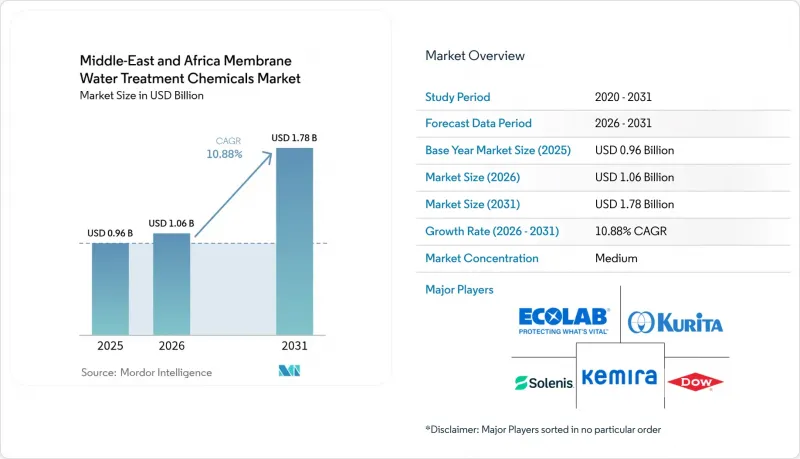
This report is Segmented by Chemical Type (Pre-Treatment, Biological Controllers, and Other Chemical Types), End-User Industry (Food and Beverage Processing, Healthcare, Municipal, and More), and Geography (Saudi Arabia, United Arab Emirates, Qatar, South Africa, Egypt, and Rest of Middle East and Africa). The Market Forecasts are Provided in Terms of Value (USD).
Middle-East And Africa Membrane Water Treatment Chemicals Market Trends and Insights
Growing Freshwater-Scarcity-Driven Desalination Build-Out
Chronic water stress has prompted governments to invest in large reverse-osmosis plants, making desalination the single largest growth engine for the membrane water treatment chemicals market. Saudi Arabia alone plans to add 8.4 million m3/day of new capacity by 2030, resulting in an annual demand of 12,000 tonnes for antiscalants and biocides. The Taweelah expansion in the United Arab Emirates adds 909,000 m3/day and relies on coagulant-flocculant sequences to cut turbidity below 0.5 NTU before membranes. Qatar's North Field LNG trains utilize polyaluminum chloride and cationic polymers to strip colloidal silica, which otherwise halves the membrane life. Contract structures have shifted toward 10- to 20-year chemical supply agreements that bundle dosing equipment and performance guarantees, locking in visibility for suppliers that can co-invest in inventory and field service. These developments embed the membrane water treatment chemicals market phrase deeply in operator procurement strategies.
Regulatory Push for Potable Reuse and Industrial Zero-Liquid-Discharge
New discharge rules now require utilities and industries to meet stringent quality targets that only membrane trains can achieve, thereby increasing chemical demand. Saudi Arabia requires effluent meant for irrigation to contain <1,500 mg/L TDS and <10 mg/L BOD, thresholds met through ultrafiltration or reverse osmosis preceded by robust biological control. The UAE's Federal Law 24 caps brine salinity at 70,000 mg/L and bans specific halogenated biocides in coastal zones, driving a switch to isothiazolinones that cost up to 30% more but degrade within 48 h. South Africa is piloting zero-liquid-discharge mandates in mining; membrane stages in these systems double antiscalant use because supersaturation spikes increase scaling propensity, as reported by. Project lenders now require ISO 14001-certified formulations, favoring suppliers with transparent safety data and documented biodegradability.
High Capital and Operating Costs of Membrane Plants
Upfront investment for reverse-osmosis or ultrafiltration facilities often deters utilities in price-sensitive regions, especially once chemical consumption is factored into life-cycle budgets. Municipalities in Egypt's Nile Delta and South Africa's Eastern Cape have postponed tenders because projected tariffs exceed affordable thresholds even with concessional finance. Petrochemical users transitioning to zero-liquid-discharge systems see water-treatment costs increase from USD 0.40/m3 for once-through cooling to USD 2.80/m3 for closed-loop membrane systems, compressing margins in commodity markets. Accelerated fouling increases the frequency of membrane replacement, doubling annualized capital-recovery charges when chemical dosing is sub-optimal.
Other drivers and restraints analyzed in the detailed report include:
- Rapid Municipal and Industrial Infrastructure Expansion
- Consolidation of GCC Hydrogen and Ammonia Projects Needing Ultrapure Water
- Tightening Discharge Rules for Hazardous Actives
For complete list of drivers and restraints, kindly check the Table Of Contents.
Segment Analysis
Pre-treatment products held 64.78% of 2025 revenue and are on track to grow 11.05% annually to 2031, sustaining clear leadership within the membrane water treatment chemicals market size for this category. Coagulants and flocculants agglomerate suspended solids to push turbidity below 1 NTU and maintain flux above 20 L/m2*h, while phosphonate antiscalants inhibit carbonate, sulfate, and silica precipitation even in Gulf seawater, where scaling potential is quadruple that of Atlantic sources. Biocides prevent biofilm formation, which would otherwise reduce permeability by 30% within weeks. Growth is amplified by the adoption of ultrafiltration ahead of reverse osmosis, adding a second layer of chemical demand.
Anticipated regulatory shifts toward biodegradable formulations may lift average selling prices 20-30%, but operators consider the premium justified because warranty terms void coverage if approved chemistries are not used. AI-based dosing platforms are increasingly bundling these pre-treatment chemicals within long-term service contracts, locking in volumes and thereby elevating switching costs. Biological controllers form a smaller yet rapidly expanding niche as membrane bioreactors scale up in municipal wastewater. Maintenance-oriented cleaners such as citric-acid and EDTA solutions restore flux during periodic clean-in-place procedures, ensuring that the membrane water treatment chemicals market remains structurally tied to robust pre-treatment regimes.
Complete Report Scope:
- By Chemical Type
- Pre-treatment
- Biological Controllers
- Other Chemical Types
- By End-user Industry
- Food and Beverage Processing
- Healthcare
- Municipal
- Chemicals (including Pulp and Paper)
- Power
- Others
- By Geography
- Saudi Arabia
- United Arab Emirates
- Qatar
- South Africa
- Egypt
- Rest of Middle East and Africa
List of Companies Covered in this Report:
- AES Arabia Ltd
- AXEON Water
- Dow
- Ecolab
- Genesys International
- Italmatch Chemicals SpA
- Kemira
- King Lee Technologies
- Kurita Water Industries Ltd
- Lenntech B.V.
- Solenis
- Solvay
- TORAY INDUSTRIES, INC.
- Veolia
Additional Benefits:
- The market estimate (ME) sheet in Excel format
- 3 months of analyst support
TABLE OF CONTENTS
1 Introduction
- 1.1 Study Assumptions & Market Definition
- 1.2 Scope of the Study
2 Research Methodology
3 Executive Summary
4 Market Landscape
- 4.1 Market Overview
- 4.2 Market Drivers
- 4.2.1 Growing freshwater-scarcity-driven desalination build-out
- 4.2.2 Regulatory push for potable reuse and industrial zero-liquid-discharge
- 4.2.3 Rapid municipal and industrial infrastructure expansion
- 4.2.4 Consolidation of GCC hydrogen and ammonia projects needing ultrapure water
- 4.2.5 AI-enabled chemical-dosing optimisation improving ROI
- 4.3 Market Restraints
- 4.3.1 High capital and operating cost of membrane plants
- 4.3.2 Tightening discharge rules for hazardous actives
- 4.3.3 Supply-chain shocks in specialty polymer/phosphonate inputs
- 4.4 Value Chain Analysis
- 4.5 Porter's Five Forces
- 4.5.1 Bargaining Power of Suppliers
- 4.5.2 Bargaining Power of Consumers
- 4.5.3 Threat of New Entrants
- 4.5.4 Threat of Substitute Products & Services
- 4.5.5 Degree of Competition
5 Market Size & Growth Forecasts (Value)
- 5.1 By Chemical Type
- 5.1.1 Pre-treatment
- 5.1.2 Biological Controllers
- 5.1.3 Other Chemical Types
- 5.2 By End-user Industry
- 5.2.1 Food and Beverage Processing
- 5.2.2 Healthcare
- 5.2.3 Municipal
- 5.2.4 Chemicals (including Pulp and Paper)
- 5.2.5 Power
- 5.2.6 Others
- 5.3 By Geography
- 5.3.1 Saudi Arabia
- 5.3.2 United Arab Emirates
- 5.3.3 Qatar
- 5.3.4 South Africa
- 5.3.5 Egypt
- 5.3.6 Rest of Middle East and Africa
6 Competitive Landscape
- 6.1 Market Concentration
- 6.2 Strategic Moves
- 6.3 Market Share (%)/ Ranking Analysis
- 6.4 Company Profiles (includes Global level Overview, Market level overview, Core Segments, Financials, Strategic Info, Market Rank/Share, Products & Services, Recent Developments)
- 6.4.1 AES Arabia Ltd
- 6.4.2 AXEON Water
- 6.4.3 Dow
- 6.4.4 Ecolab
- 6.4.5 Genesys International
- 6.4.6 Italmatch Chemicals SpA
- 6.4.7 Kemira
- 6.4.8 King Lee Technologies
- 6.4.9 Kurita Water Industries Ltd
- 6.4.10 Lenntech B.V.
- 6.4.11 Solenis
- 6.4.12 Solvay
- 6.4.13 TORAY INDUSTRIES, INC.
- 6.4.14 Veolia
7 Market Opportunities and Future Outlook
- 7.1 White-space and Unmet-need Assessment

