PUBLISHER: Mordor Intelligence | PRODUCT CODE: 2120605

PUBLISHER: Mordor Intelligence | PRODUCT CODE: 2120605
Europe Water Treatment Chemicals - Market Share Analysis, Industry Trends & Statistics, Growth Forecasts (2026 - 2031)
According to Mordor Intelligence, the european water treatment chemicals market size is expected to grow from USD 5.67 billion in 2025 to USD 6.01 billion in 2026 and is forecast to reach USD 8.08 billion by 2031 at 6.08% CAGR over 2026-2031.
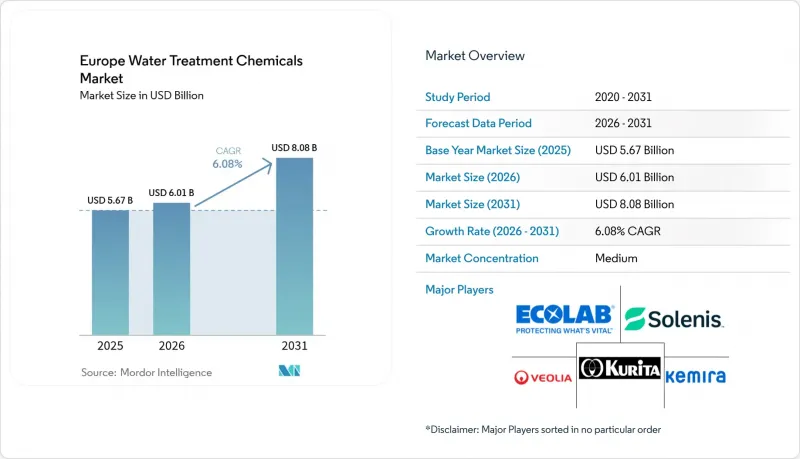
This report is Segmented by Product Type (Biocides and Disinfectants, Coagulants and Flocculants, Corrosion and Scale Inhibitors, and More), End-User Industry (Commercial and Institutional, Power Generation, and More), and Geography (Germany, United Kingdom, France, Italy, Spain, NORDIC Countries, and Rest of Europe). The Market Forecasts are Provided in Terms of Value (USD).
Europe Water Treatment Chemicals Market Trends and Insights
Stringent EU Discharge and Reuse Regulations
In 2024, EU infringement actions against Belgium, Cyprus, and the Netherlands introduced daily fines for non-compliance with designated sensitive areas, prompting the rapid retrofitting of tertiary phosphorus removal stages that consume 20-40 mg/L of aluminum or iron coagulants. In a bid to enhance water quality for the Paris Olympics, a project allocated a significant portion of its budget solely to coagulants. Directive 2024/1083 broadens the tertiary mandate to every agglomeration with a population equivalent of more than 10,000 by 2035, doubling the number of facilities that must dose polyaluminum chloride or ferric salts. National agencies, such as Germany's Umweltbundesamt and Spain's river-basin authorities, enforce Water Framework targets, thereby accelerating long-term contracts for performance-guaranteed chemical supply.
EU Water Framework Directive Enforcement and Penalties
Germany allocated grants to enhance various plants, with a focus on removing nutrients and micropollutants. Meanwhile, Directive 2024/1203 categorizes illegal discharges as criminal offenses, with potential imprisonment. In response, utilities are securing multi-year contracts with suppliers to ensure the quality of effluent. In Spain, authorities levied fines in 2024, but violations dropped, thanks to the use of real-time phosphorus analyzers for automated coagulant dosing. The upcoming 2027 review is anticipated to halve nitrogen caps, boosting the demand for supplemental carbon sources and pH adjusters throughout Europe.
Hazardous Nature and Handling of Hydrazine Derivatives
Utilities, facing the Category 1B carcinogen classification of hydrazine under ECHA rules, are compelled to implement closed-loop dosing, vapor containment, and real-time leak detection. These measures inflate capital costs significantly. In 2024, Germany logged numerous incidents of exposure. As insurance premiums surge, smaller operators are gravitating towards pricier yet safer alternatives, such as carbohydrazide or tannin scavengers. Despite the shift, high-pressure boilers operating above 100 bar continue to rely on hydrazine for swift oxygen removal, underscoring the challenges of a complete transition in power and district heating networks.
Other drivers and restraints analyzed in the detailed report include:
- Industrial Decarbonization Boosting Process-Water Demand
- Municipal Infrastructure Upgrades (AMP8, Cohesion Fund)
- Raw-Material Price Volatility (Alum, Caustic, Acrylamide)
For complete list of drivers and restraints, kindly check the Table Of Contents.
Segment Analysis
Coagulants and flocculants start from a smaller 2024 base but outpace the broader European water treatment chemicals market at a 7.05% CAGR through 2031, as Directive 2024/1083 doubles the number of facilities that must remove phosphorus to 10 mg/L. Stockholm's Henriksdal plant reduced sludge and improved capture by switching to polyaluminum chloride, a trend now spreading across cold-climate utilities. Ferric salts gain share in coastal desalination pretreatment due to their superior removal of organics, as evidenced by the Barcelona Llobregat project, which documented a lower membrane-fouling rate after adopting ferric sulfate. Defoamers, pH adjusters, and disinfectants serve narrower niches but grow steadily in food-contact and paper-recycling loops. Corrosion and scale inhibitors are still the largest segment of the European water treatment chemicals market in 2025, accounting for 28.35%. However, nuclear shutdowns and phosphonate restrictions are expected to depress growth, partially offset by inhibitor packages tailored for hydrogen electrolysers. Phosphonate-free polyaspartate blends launched by LANXESS illustrate industry adaptation even at a 10% efficacy trade-off.
Second-order dynamics reveal differential regulatory exposure. The EU Biocidal Products Regulation extended approval timelines for new disinfectants to 36 months, delaying revenue from novel actives. Conversely, niche oxygen scavengers such as erythorbate accelerate in district-heating circuits tolerant of slower kinetics. The European water treatment chemicals market, therefore, tilts toward formulations with demonstrable compliance advantages, even when price premiums reach double digits.
Complete Report Scope:
- By Product Type
- Biocides and Disinfectants
- Coagulants and Flocculants
- Corrosion and Scale Inhibitors
- Defoamer and Defoaming Agent
- pH Adjuster and Softener
- Other Product Types
- By End-user Industry
- Commercial and Institutional
- Power Generation
- Chemical Manufacturing
- Mining and Mineral Processing
- Municipal
- Other End-user Industries
- By Geography
- Germany
- United Kingdom
- France
- Italy
- Spain
- NORDIC Countries
- Rest of Europe
List of Companies Covered in this Report:
- Aqualia
- Arkema
- BioWater Technology AS
- Brenntag SE
- Buckman
- Dow
- Ecolab
- Feralco AB
- Italmatch Chemicals S.p.A.
- Kemira
- Kurita Water Industries Ltd.
- LANXESS
- Nouryon
- SNF
- Solenis
- Veolia
Additional Benefits:
- The market estimate (ME) sheet in Excel format
- 3 months of analyst support
TABLE OF CONTENTS
1 Introduction
- 1.1 Study Assumptions and Market Definition
- 1.2 Scope of the Study
2 Research Methodology
3 Executive Summary
4 Market Landscape
- 4.1 Market Overview
- 4.2 Market Drivers
- 4.2.1 Stringent EU discharge and reuse regulations
- 4.2.2 EU Water Framework Directive enforcement and penalties
- 4.2.3 Industrial decarbonization boosting process-water demand
- 4.2.4 Municipal infrastructure upgrades (AMP8, Cohesion Fund)
- 4.2.5 Ultra-pure water for green-hydrogen electrolysers
- 4.3 Market Restraints
- 4.3.1 Hazardous nature and handling of hydrazine derivatives
- 4.3.2 Raw-material price volatility (alum, caustic, acrylamide)
- 4.3.3 Extended-Producer-Responsibility costs for quaternary treatment
- 4.4 Value Chain Analysis
- 4.5 Porter's Five Forces
- 4.5.1 Threat of New Entrants
- 4.5.2 Bargaining Power of Suppliers
- 4.5.3 Bargaining Power of Buyers
- 4.5.4 Threat of Substitutes
- 4.5.5 Competitive Rivalry
5 Market Size and Growth Forecasts (Value)
- 5.1 By Product Type
- 5.1.1 Biocides and Disinfectants
- 5.1.2 Coagulants and Flocculants
- 5.1.3 Corrosion and Scale Inhibitors
- 5.1.4 Defoamer and Defoaming Agent
- 5.1.5 pH Adjuster and Softener
- 5.1.6 Other Product Types
- 5.2 By End-user Industry
- 5.2.1 Commercial and Institutional
- 5.2.2 Power Generation
- 5.2.3 Chemical Manufacturing
- 5.2.4 Mining and Mineral Processing
- 5.2.5 Municipal
- 5.2.6 Other End-user Industries
- 5.3 By Geography
- 5.3.1 Germany
- 5.3.2 United Kingdom
- 5.3.3 France
- 5.3.4 Italy
- 5.3.5 Spain
- 5.3.6 NORDIC Countries
- 5.3.7 Rest of Europe
6 Competitive Landscape
- 6.1 Market Concentration
- 6.2 Strategic Moves
- 6.3 Market Share (%)/Ranking Analysis
- 6.4 Company Profiles (includes Global level Overview, Market level overview, Core Segments, Financials as available, Strategic Information, Market Rank/Share for key companies, Products and Services, and Recent Developments)
- 6.4.1 Aqualia
- 6.4.2 Arkema
- 6.4.3 BioWater Technology AS
- 6.4.4 Brenntag SE
- 6.4.5 Buckman
- 6.4.6 Dow
- 6.4.7 Ecolab
- 6.4.8 Feralco AB
- 6.4.9 Italmatch Chemicals S.p.A.
- 6.4.10 Kemira
- 6.4.11 Kurita Water Industries Ltd.
- 6.4.12 LANXESS
- 6.4.13 Nouryon
- 6.4.14 SNF
- 6.4.15 Solenis
- 6.4.16 Veolia
7 Market Opportunities and Future Outlook
- 7.1 White-space and Unmet-need Assessment

