PUBLISHER: Mordor Intelligence | PRODUCT CODE: 2114130

PUBLISHER: Mordor Intelligence | PRODUCT CODE: 2114130
North America Glucagon-like Peptide-1 Agonists - Market Share Analysis, Industry Trends & Statistics, Growth Forecasts (2026 - 2031)
According to Mordor Intelligence, the North America glucagon-like peptide-1 agonists market size is projected to be USD 28.66 billion in 2025, USD 32.43 billion in 2026, and reach USD 60.12 billion by 2031, growing at a CAGR of 13.14% from 2026 to 2031.
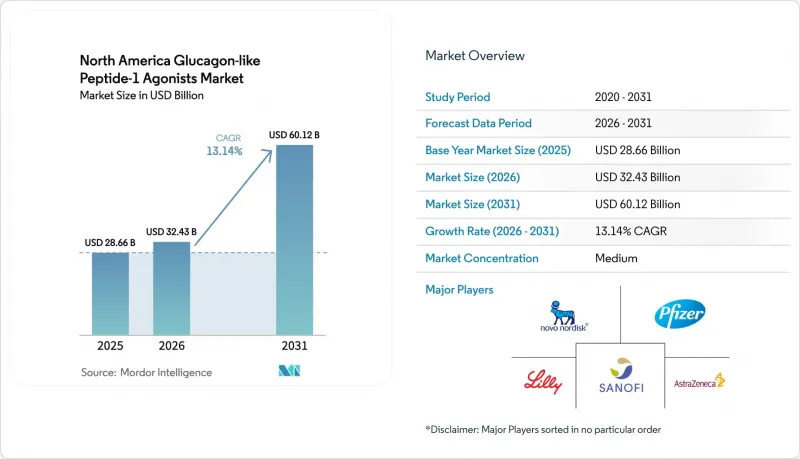
This report is Segmented Into Drugs (Ozempic, Wegovy, and More), Route of Administration (Subcutaneous Injectable and Oral), Indication (Type-2 Diabetes Mellitus, and More), Distribution Channel (Hospital Pharmacies, and More), and Country (United States, Canada, and Mexico). The Market Forecasts are Provided in Terms of Value (USD).
North America Glucagon-like Peptide-1 Agonists Market Trends and Insights
Type-2 Diabetes Prevalence Escalation
The Centers for Disease Control and Prevention documented 38.4 million Americans living with diabetes in 2024, of whom up to 95% have type 2 diabetes. Rising adolescent incidence extends lifetime drug utilization horizons, creating multi-decade revenue streams. The American Diabetes Association's 2025 standards place GLP-1 receptor agonists immediately after metformin for high-risk patients, expanding the eligible pool by roughly 12 million adults . Canada shows a parallel rise, with 11.9 million citizens affected by diabetes or pre-diabetes in 2024. Younger onset increases cardiovascular risk over time, which strengthens the clinical argument for early incretin therapy. Together, these epidemiologic shifts add positive pressure to prescription growth through 2031.
Obesity-Focused Label Expansions and Coverage Gains
The FDA cleared semaglutide for cardiovascular risk reduction in March 2024, which unlocked Medicare Part D coverage because the drug now treats a covered cardiovascular condition rather than obesity alone. In November 2024, the Centers for Medicare & Medicaid Services proposed rules that would extend anti-obesity drug benefits to 7.4 million beneficiaries, opening an untapped payer segment . Commercial insurers follow a mixed strategy: some demand 12-week lifestyle documentation, whereas others waive step therapy after high-risk scores are confirmed. Employer self-insured plans adopt GLP-1 carve-outs, attracted by modeled 120% returns on investment tied to absenteeism reductions. Expanded benefits sharpen demand visibility and enhance revenue predictability for manufacturers.
Drug Cost and Payer Prior-Authorization Hurdles
Wholesale acquisition prices range between USD 935 and USD 1,349 per month in 2026, positioning GLP-1 agonists among the most expensive chronic-care therapies in North America. Pharmacy benefit managers apply layered prior-authorization checks that verify lifestyle modification, body-mass index thresholds, and comorbidity profiles, adding an average 15-day delay to therapy initiation. Prime Therapeutics reported initial denial rates of 42% for GLP-1 requests in 2024, although two-thirds were overturned on appeal with added documentation. High-deductible health plans expose commercially insured patients to USD 150-300 monthly out-of-pocket costs, driving abandonment rates above 30% at first fill. As more outcomes data affirm broader benefits, payers may soften criteria, but cost friction remains the near-term speed limit on market growth.
Other drivers and restraints analyzed in the detailed report include:
- Cardiometabolic Outcome-Based Guideline Inclusion
- Tele-Prescription and DTC Platforms Accelerate Uptake
- Periodic API and Pen-Device Shortages
For complete list of drivers and restraints, kindly check the Table Of Contents.
Segment Analysis
The North America Glucagon-like Peptide-1 agonists market size for Mounjaro is poised to expand at a 16.87% CAGR, fueled by 22.5% mean weight reduction in SURMOUNT-1 and superior glycemic control relative to semaglutide. Ozempic kept a 49.8% North America Glucagon-like Peptide-1 agonists market share in 2025 because of its first-mover advantage and positive cardiovascular data from the SELECT trial. Wegovy and Zepbound drew 18% combined revenue in 2025, their growth grounded in fresh cardioprotective labeling and pending Medicare coverage finalization. Rybelsus caters to needle-averse patients, though its fasting rule curbs adherence; orforglipron seeks to remove that barrier when submitted for approval in 2026.
Pipeline candidates are re-shaping competitive contours. Cagrisema, the semaglutide-cagrilintide fixed-ratio mix, reported 27.1% weight loss in REDEFINE-2, while survodutide and retatrutide advance multi-agonist strategies. Trulicity, once a category mainstay, is slipping under patent-expiry shadow as biosimilars queue for 2027. Legacy options such as liraglutide and exenatide are eroding at 6% annually as prescribers pivot to weekly agents with stronger cardiometabolic evidence.
Subcutaneous injectables command 85.6% of prescriptions due to weekly dosing and well-documented cardiovascular and renal outcomes. Their user-friendly pens, concealed needles, and auto-injector designs help blunt needle aversion. Semaglutide also demonstrated a 24% reduction in kidney disease progression in the FLOW study, reinforcing clinician confidence.
Oral formulations grow at a 14.65% CAGR as patients seek needle-free options. Rybelsus posted USD 1.9 billion global sales in 2024, and its October 2025 cardiovascular indication approval heightened primary-care adoption. The North America Glucagon-like Peptide-1 agonists market size for oral agents is expected to accelerate once orforglipron reaches the market. Patient-preference surveys reveal that 40% of eligible individuals refused injections in favor of tablets when equally effective choices exist. As adherence obstacles, namely, fasting requirements, are ironed out, oral uptake will chip away at injectable dominance.
Complete Report Scope:
- By Drug
- Ozempic
- Wegovy
- Mounjaro
- Zepbound
- Rybelsus
- Trulicity
- Orforglipron
- Cagrisema
- Survodutide
- Others
- By Route of Administration
- Sub-cutaneous Injectable
- Oral Tablet
- By Indication
- Type-2 Diabetes Mellitus
- Obesity & Weight-Management
- Cardiovascular Risk Reduction (ASCVD)
- By Distribution Channel
- Hospital Pharmacies
- Retail & Chain Pharmacies
- Online / Direct-to-Consumer Platforms
- By Country
- United States
- Canada
- Mexico
List of Companies Covered in this Report:
- Adocia SA
- Amgen
- AstraZeneca
- Boehringer Ingelheim
- Biocon Ltd
- Eli Lilly and Company
- Hanmi Pharmaceutical Co. Ltd.
- Innovent Biologics Inc.
- Altimmune Inc
- Merck
- Novo Nordisk
- Pfizer
- Rhythm Pharmaceuticals Inc.
- Roche
- Sanofi
- Takeda Pharmaceuticals
- Samsung Bioepis
- Viking Therapeutics Inc.
- Xeris Biopharma Holdings Inc.
- Zealand Pharma
Additional Benefits:
- The market estimate (ME) sheet in Excel format
- 3 months of analyst support
TABLE OF CONTENTS
1 Introduction
- 1.1 Study Assumptions & Market Definition
- 1.2 Scope of the Study
2 Research Methodology
3 Executive Summary
4 Market Landscape
- 4.1 Market Overview
- 4.2 Market Drivers
- 4.2.1 Type-2 Diabetes Prevalence Escalation
- 4.2.2 Obesity-Focused Label Expansions & Coverage Gains
- 4.2.3 Cardiometabolic Outcome-Based Guideline Inclusion
- 4.2.4 Tele-Prescription & DTC Platforms Accelerate Uptake
- 4.2.5 Employer-Funded Benefit Designs for Productivity Savings
- 4.2.6 Near-Shoring of Fill-Finish Capacity Across Mexico
- 4.3 Market Restraints
- 4.3.1 Drug Cost & Payer Prior-Authorization Hurdles
- 4.3.2 Periodic API/Pen-Device Shortages
- 4.3.3 Tighter Policing of Off-Label Cosmetic Use
- 4.3.4 Pipeline Oral Incretin Mimetics Substitute Threat
- 4.4 Supply-Chain Analysis
- 4.5 Regulatory Landscape
- 4.6 Technological Outlook
- 4.7 Porter's Five Forces
- 4.7.1 Bargaining Power of Suppliers
- 4.7.2 Bargaining Power of Consumers
- 4.7.3 Threat of New Entrants
- 4.7.4 Threat of Substitutes
- 4.7.5 Intensity of Competitive Rivalry
5 Market Size & Growth Forecasts (Value, USD)
- 5.1 By Drug
- 5.1.1 Ozempic
- 5.1.2 Wegovy
- 5.1.3 Mounjaro
- 5.1.4 Zepbound
- 5.1.5 Rybelsus
- 5.1.6 Trulicity
- 5.1.7 Orforglipron
- 5.1.8 Cagrisema
- 5.1.9 Survodutide
- 5.1.10 Others
- 5.2 By Route of Administration
- 5.2.1 Sub-cutaneous Injectable
- 5.2.2 Oral Tablet
- 5.3 By Indication
- 5.3.1 Type-2 Diabetes Mellitus
- 5.3.2 Obesity & Weight-Management
- 5.3.3 Cardiovascular Risk Reduction (ASCVD)
- 5.4 By Distribution Channel
- 5.4.1 Hospital Pharmacies
- 5.4.2 Retail & Chain Pharmacies
- 5.4.3 Online / Direct-to-Consumer Platforms
- 5.5 By Country
- 5.5.1 United States
- 5.5.2 Canada
- 5.5.3 Mexico
6 Competitive Landscape
- 6.1 Market Concentration
- 6.2 Market Share Analysis
- 6.3 Company Profiles (includes Global-level Overview, Market-level Overview, Core Segments, Financials, Strategic Information, Market Rank/Share, Products & Services, Recent Developments)
- 6.3.1 Adocia SA
- 6.3.2 Amgen Inc.
- 6.3.3 AstraZeneca plc
- 6.3.4 Boehringer Ingelheim GmbH
- 6.3.5 Biocon Ltd
- 6.3.6 Eli Lilly and Company
- 6.3.7 Hanmi Pharmaceutical Co. Ltd.
- 6.3.8 Innovent Biologics Inc.
- 6.3.9 Altimmune Inc
- 6.3.10 Merck & Co., Inc.
- 6.3.11 Novo Nordisk A/S
- 6.3.12 Pfizer Inc.
- 6.3.13 Rhythm Pharmaceuticals Inc.
- 6.3.14 Roche Holding AG
- 6.3.15 Sanofi S.A.
- 6.3.16 Takeda Pharmaceutical Co. Ltd.
- 6.3.17 Samsung Bioepis
- 6.3.18 Viking Therapeutics Inc.
- 6.3.19 Xeris Biopharma Holdings Inc.
- 6.3.20 Zealand Pharma A/S
7 Market Opportunities & Future Outlook
- 7.1 White-space & Unmet-Need Assessment

