PUBLISHER: Mordor Intelligence | PRODUCT CODE: 2119673

PUBLISHER: Mordor Intelligence | PRODUCT CODE: 2119673
China Diabetes Care Drugs And Devices - Market Share Analysis, Industry Trends & Statistics, Growth Forecasts (2026 - 2031)
According to Mordor Intelligence, China diabetes care drugs and devices market size in 2026 is estimated at USD 9.48 billion, growing from 2025 value of USD 8.98 billion with 2031 projections showing USD 12.41 billion, growing at 5.53% CAGR over 2026-2031.
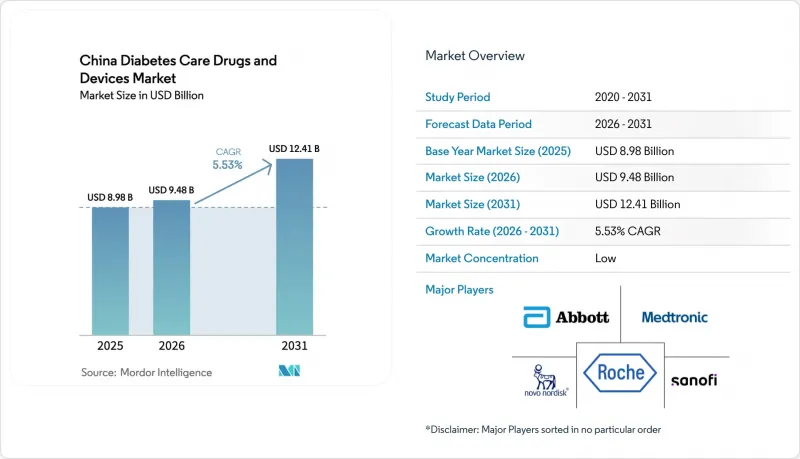
This report is Segmented by Product Type (Devices [Monitoring Devices, and More] and Drugs [Insulin Drugs, and More]), Diabetes Type (Type 1 Diabetes and Type 2 Diabetes), Age Group (Adult, Geriatric, and More), and Distribution Channel (Offline and Online). The Market and Forecasts are Provided in Terms of Value (USD).
China Diabetes Care Drugs And Devices Market Trends and Insights
Growing Diabetes Prevalence & Ageing Population
China's estimated 15.88% adult diabetes prevalence translates into 140-233 million patients, a figure that strains conventional care pathways. An ageing society compounds complexity: more than 200 million citizens are now >= 65 years old, a cohort that exhibits higher insulin resistance and poly-comorbidity . Elderly patients require assistive technologies and simplified regimens, spurring demand for connected monitoring devices that reduce clinic visits. Without systemic interventions, prevalence could hit 29.1% by 2050, but evidence suggests targeted digital solutions could halve that escalation. Rising expenditure-USD 165.3 billion in direct diabetes outlays-heightens urgency for scalable, tech-enabled models that the China diabetes care drugs and devices market is beginning to provide.
Government Reimbursement Expansion for Innovative Therapies
Annual National Reimbursement Drug List (NRDL) negotiations added 117 molecules in 2024, cutting prices by 61.7% yet safeguarding developer incentives via volume commitments. Inclusion of 15 orphan drugs in 2025 indicates broader coverage for complex diabetic complications. A dual-channel system now permits premium drugs outside hospital formularies, though navigation across basic and commercial insurance tiers remains intricate. Commercial health insurance, sized at RMB 900 billion, is emerging as a bridge for therapies still absent from NRDL coverage boundaries. NVBP insulin procurement trimmed daily insulin cost from 1.63 to 0.68 local daily wages, proving that affordability and quality need not be mutually exclusive .
NRDL Price Erosion for Insulin & Devices
Median insulin price cuts of 42.08% have democratized access but tightened margins, forcing multinationals to reconfigure China portfolios for lower price points yet uncompromised quality. Device makers now face similar procurement rounds, raising questions about capital recovery for R&D-heavy platforms such as patch pumps. Premium products can still enter via commercial insurance, but multi-tier reimbursement navigation delays uptake and complicates marketing. Companies are responding with China-specific SKUs and local manufacturing footprints to keep costs aligned with tender ceilings.
Other drivers and restraints analyzed in the detailed report include:
- Rising Adoption of CGM & Insulin Pump Technology
- WeChat-Based Digital Adherence Platforms
- Low Insulin-Pump Penetration & Education Gaps
For complete list of drivers and restraints, kindly check the Table Of Contents.
Segment Analysis
The pharmaceutical segment captured 62.85% of 2025 revenue, confirming its primacy in the China diabetes care drugs and devices market. Yet device revenue is projected to rise faster at a 6.28% CAGR as patients and physicians converge on continuous glucose monitoring and automated delivery systems. CGM adoption has broadened from clinical users to wellness enthusiasts, while insulin pumps progress toward hybrid closed-loop integration.
Monitoring equipment maintains volume leadership; self-monitoring blood glucose meters dominate unit sales but face commodity pricing, whereas CGMs command premium price bands for real-time data feeds. Insulin innovations such as once-weekly Ico Insulin, cleared in 2024, illustrate convergence between long-acting drugs and device ecosystems. GLP-1 injectables, leveraging dual diabetes-obesity indications, are the fastest-growing non-insulin category, supported by strategic licensing moves worth over USD 2 billion each from Novo Nordisk and Merck. This cross-pollination indicates the China diabetes care drugs and devices market size for devices is escalating in tandem with next-generation pharmacotherapy.
Type 2 remains the volume anchor with 90.55% of 2025 revenue, driven by sedentary lifestyles and dietary transitions. Digital platforms now merge lifestyle coaching with medication adherence, expanding preventive care access across every tier-city cohort. Continuous remote coaching programs have improved HbA1c control, reinforcing device and drug adherence concurrently.
Type 1 revenue, though smaller, is forecast to grow 6.31% annually, lifted by better diagnostics and broader adult onset recognition. Clinical trials show pump therapy lowers HbA1c to 7.19% compared with 7.71% for multiple injections, underscoring superior glycemic stability. Premium per-patient spending means this cohort drives technological alpha for the China diabetes care drugs and devices market size, with spill-over benefits for type 2 care via shared CGM platforms.
Complete Report Scope:
- By Product Type
- Devices
- Monitoring Devices
- Self-Monitoring Blood Glucose Meters
- Continuous Glucose Monitoring Systems
- Management Devices
- Monitoring Devices
- Drugs
- Oral Anti-Diabetic Drugs
- Insulin Drugs
- Non-Insulin Injectables
- Combination Drugs
- Devices
- By Diabetes Type
- Type 1 Diabetes
- Type 2 Diabetes
- By Age Group
- Adult
- Geriatric
- Pediatric
- By Distribution Channel
- Offline
- Online
List of Companies Covered in this Report:
- Abbott Laboratories
- Medtronic
- Novo Nordisk
- Sanofi
- Eli Lilly and Company
- Roche
- Dexcom
- Insulet
- Tandem Diabetes Care
- Ypsomed
- AstraZeneca
- Pfizer
- MicroTech Medical
- Sinocare
- Lepu Medical
- Hengrui Medicine
- Innovent Biologics
- CSPC Pharmaceutical
- MicroPort
- Mindray Bio-Medical
- Yuwell Medical
- Terumo
- Arkray
Additional Benefits:
- The market estimate (ME) sheet in Excel format
- 3 months of analyst support
TABLE OF CONTENTS
1 Introduction
- 1.1 Study Assumptions & Market Definition
- 1.2 Scope of the Study
2 Research Methodology
3 Executive Summary
4 Market Landscape
- 4.1 Market Overview
- 4.2 Market Drivers
- 4.2.1 Growing diabetes prevalence & ageing population
- 4.2.2 Government reimbursement expansion for innovative therapies
- 4.2.3 Rising adoption of CGM & insulin pump technology
- 4.2.4 WeChat-based digital adherence platforms
- 4.2.5 Domestic GLP-1 capacity surge & patent cliffs
- 4.2.6 Tier-2/3-city retail-pharmacy expansion
- 4.3 Market Restraints
- 4.3.1 NRDL price erosion for insulin & devices
- 4.3.2 Low insulin-pump penetration & education gaps
- 4.3.3 Data-privacy limits on cloud CGM data
- 4.3.4 Sensor-chip supply-chain volatility
- 4.4 Regulatory Landscape
- 4.5 Technological Outlook
- 4.6 Porters Five Forces Analysis
- 4.6.1 Bargaining Power of Suppliers
- 4.6.2 Bargaining Power of Buyers
- 4.6.3 Threat of New Entrants
- 4.6.4 Threat of Substitutes
- 4.6.5 Intensity of Competitive Rivalry
5 Market Size & Growth Forecasts (Market Value, USD)
- 5.1 By Product Type
- 5.1.1 Devices
- 5.1.1.1 Monitoring Devices
- 5.1.1.1.1 Self-Monitoring Blood Glucose Meters
- 5.1.1.1.2 Continuous Glucose Monitoring Systems
- 5.1.1.2 Management Devices
- 5.1.1.1 Monitoring Devices
- 5.1.2 Drugs
- 5.1.2.1 Oral Anti-Diabetic Drugs
- 5.1.2.2 Insulin Drugs
- 5.1.2.3 Non-Insulin Injectables
- 5.1.2.4 Combination Drugs
- 5.1.1 Devices
- 5.2 By Diabetes Type
- 5.2.1 Type 1 Diabetes
- 5.2.2 Type 2 Diabetes
- 5.3 By Age Group
- 5.3.1 Adult
- 5.3.2 Geriatric
- 5.3.3 Pediatric
- 5.4 By Distribution Channel
- 5.4.1 Offline
- 5.4.2 Online
6 Competitive Landscape
- 6.1 Market Concentration
- 6.2 Market Share Analysis
- 6.3 Company Profiles (includes Global level Overview, Market level overview, Core Segments, Financials as available, Strategic Information, Market Rank/Share for key companies, Products & Services, and Recent Developments)
- 6.3.1 Abbott
- 6.3.2 Medtronic
- 6.3.3 Novo Nordisk
- 6.3.4 Sanofi
- 6.3.5 Eli Lilly
- 6.3.6 Roche
- 6.3.7 Dexcom
- 6.3.8 Insulet
- 6.3.9 Tandem Diabetes Care
- 6.3.10 Ypsomed
- 6.3.11 AstraZeneca
- 6.3.12 Pfizer
- 6.3.13 MicroTech Medical
- 6.3.14 Sinocare
- 6.3.15 Lepu Medical
- 6.3.16 Hengrui Medicine
- 6.3.17 Innovent Biologics
- 6.3.18 CSPC Pharmaceutical
- 6.3.19 MicroPort Scientific
- 6.3.20 Mindray Bio-Medical
- 6.3.21 Yuwell Medical
- 6.3.22 Terumo
- 6.3.23 ARKRAY
7 Market Opportunities & Future Outlook
- 7.1 White-space & Unmet-Need Assessment

