PUBLISHER: Mordor Intelligence | PRODUCT CODE: 2119812

PUBLISHER: Mordor Intelligence | PRODUCT CODE: 2119812
Weight Loss Diabetes Drug - Market Share Analysis, Industry Trends & Statistics, Growth Forecasts (2026 - 2031)
According to Mordor Intelligence, the weight loss diabetes drug market size is expected to grow from USD 35.62 billion in 2025 to USD 37.48 billion in 2026 and is forecast to reach USD 48.27 billion by 2031 at 5.21% CAGR over 2026-2031.
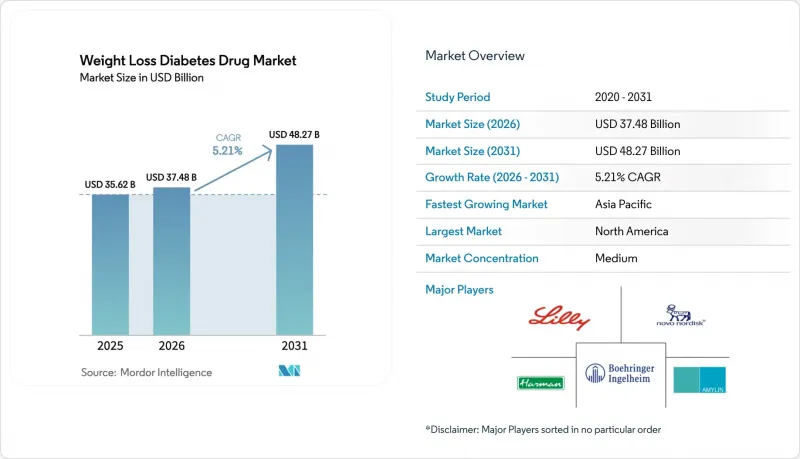
This report is Segmented by Drug (Trulicity, Victoza, Ozempic, and More), Mechanism of Action (GLP-1 Receptor Agonists, Dual GIP/GLP-1 Agonists, and More), Route of Administration (Injectable, Oral), Distribution Channel (Hospital Pharmacies, and More), and Geography (North America, Europe, Asia-Pacific, Middle East & Africa, South America). The Market Forecasts are Provided in Terms of Value (USD).
Global Weight Loss Diabetes Drug Market Trends and Insights
Rising Obesity-Diabetes Comorbidity
Escalating obesity rates now exceed 40% among U.S. adults and intersect with an estimated 88 million individuals living with prediabetes . GLP-1 therapies uniquely tackle both conditions, delivering the 20.2% weight loss observed with tirzepatide compared with 13.7% for semaglutide in pivotal trials. Payers recognize the long-term cost offsets of early metabolic intervention, prompting broader benefit coverage across employer and commercial plans. Clinicians increasingly prescribe GLP-1 agents as first-line therapy for metabolic syndrome, driving prescription growth beyond traditional diabetes confines. The resulting demand underpins the near-term expansion of the GLP-1 diabetes drugs market even as pricing pressure intensifies.
Breakthrough GLP-1 & Dual Agonist Efficacy
Superior outcomes from dual agonists such as tirzepatide reinforce a shift toward multi-target innovation. Head-to-head data show HbA1c reductions of 2.0-2.3 percentage points versus 1.6-1.9 points for single-receptor comparators . Chinese developers add further momentum; Gan & Lee's GZR18 produced up to 2.32 point HbA1c declines alongside greater weight loss than Ozempic. Pipeline triple agonists targeting GLP-1, GIP, and glucagon reveal early metabolic gains that could reset therapeutic benchmarks after 2027. These efficacy advantages support premium pricing, fortify physician confidence, and propel the GLP-1 diabetes drugs market toward higher competitive complexity.
High Therapy Cost & Patchy Reimbursement
Monthly therapy costs ranging from USD 1,000 to USD 1,600 restrict access outside affluent economies. Medicare excludes weight loss indications, while U.S. Medicaid coverage variegates by state, causing marked uptake disparity. In emerging markets reimbursement gaps curb initial prescriptions despite rising prevalence, capping near-term volumes. Employer cost controls intensify: 78% already impose prior authorizations or step therapy. Without broad financing reforms, price sensitivity will temper the otherwise strong GLP-1 diabetes drugs market growth trajectory.
Other drivers and restraints analyzed in the detailed report include:
- Faster Regulatory Approvals & Label Expansions
- Employer-Driven GLP-1 Coverage Carve-Outs
- Ongoing GLP-1 Supply Constraints
For complete list of drivers and restraints, kindly check the Table Of Contents.
Segment Analysis
The GLP-1 diabetes drugs market size for brand-level competition shows Ozempic at USD 11.36 billion revenue in 2025, translating to a 31.88% GLP-1 diabetes drugs market share. Mounjaro follows with lower absolute sales but a leading 5.86% CAGR outlook to 2031 on the strength of dual-receptor efficacy. Physicians continue prescribing Trulicity due to familiarity, yet payer formularies increasingly pivot to Mounjaro as outcomes data accumulate. Victoza's first generic entry in 2024 depresses branded volume though maintains relevance among patients intolerant to newer agents. Saxenda's growth remains constrained by weight-loss coverage gaps despite clinical benefits. Emerging Chinese molecules such as GZR18 promise to disrupt incumbents by pairing high efficacy with aggressive pricing, reinforcing global competition and fostering broader access.
Early adoption curves from 2020-2024 highlight Ozempic's rapid climb, but forecast dynamics favor dual and triple agonists. The GLP-1 diabetes drugs market consequently balances mature blockbuster sustainability against next-wave innovation cycles. As Mounjaro collects longer safety datasets and real-world evidence, formulary positions may shift, accelerating its share gain at Ozempic's expense. Generic liraglutide also nudges pricing downward in older patient cohorts, broadening entry points but pressuring originator margins.
Single-target GLP-1 receptor agonists generated USD 29.07 billion in 2025, preserving 81.62% share of the GLP-1 diabetes drugs market size. However, dual GIP/GLP-1 agonists, though still small by value, deliver 6.02% CAGR and anchor most late-stage pipelines. Clinical enthusiasm stems from superior HbA1c and weight reductions that boost adherence and extend dosing intervals. Triple agonists enter mid-stage trials with potential to broaden metabolic benefits, including lipid lowering and energy expenditure increases. SGLT-2 inhibitors retain adjunctive roles, often combined for cardiorenal protection, while amylin analogues remain niche given specificity to postprandial control.
Market evolution underscores the strategy shift from marginal formulation tweaks to receptor-synergistic breakthroughs. As multi-agonists secure approvals, reimbursement authorities may reward stronger risk-reduction profiles, underpinning sustained GLP-1 diabetes drugs market expansion in the latter half of the decade.
Complete Report Scope:
- By Drug
- Trulicity
- Victoza
- Ozempic
- Saxenda
- Mounjaro
- Others
- By Mechanism of Action
- GLP-1 Receptor Agonists
- Dual GIP/GLP-1 Agonists
- SGLT-2 Inhibitors
- Amylin Analogues
- By Route of Administration
- Injectable
- Oral
- By Distribution Channel
- Hospital Pharmacies
- Retail & Community Pharmacies
- Online/Tele-pharmacies
- By Geography
- North America
- United States
- Canada
- Mexico
- Europe
- Germany
- United Kingdom
- France
- Italy
- Spain
- Rest of Europe
- Asia-Pacific
- China
- Japan
- India
- Australia
- South Korea
- Rest of Asia-Pacific
- Middle East & Africa
- GCC
- South Africa
- Rest of Middle East & Africa
- South America
- Brazil
- Argentina
- Rest of South America
- North America
Geography Analysis
North America produced USD 15.33 billion sales in 2025, equal to 43.02% of the GLP-1 diabetes drugs market. Employer-led carve-outs accelerate uptake, while the FDA fast-tracks new indications, sustaining premium prices despite payer controls. Canada mirrors U.S. prescription momentum though reimburses more conservatively, whereas Mexico's private sector drives growth as public funding remains fragmented. Telehealth prescribing proliferates, particularly within the United States, where LillyDirect and Teladoc alliances expand reach beyond brick-and-mortar settings.
Asia-Pacific represents the fastest-growing territory with 7.52% CAGR. China spearheads progress through regulatory modernization that backs domestic candidates like GZR18, amplifying competitive pricing. India's diabetes burden sparks parallel growth with expected CAGR of 24.7% to 2034 per government data, supported by expanding manufacturing infrastructure. Mature markets such as Japan and South Korea adopt newer molecules quickly due to universal coverage systems, while Australia leverages a progressive Pharmaceutical Benefits Scheme to list breakthrough therapies soon after approval.
Europe contributes steady incremental gains. Germany, United Kingdom, and France comprise the lion's share, leveraging robust diabetes management programs. The European Medicines Agency's speedier reviews narrow the historical gap with the FDA, encouraging synchronized launches. Southern European countries, including Italy and Spain, amplify demand as public systems widen obesity coverage. The rest of Europe market benefits from structural funds bolstering cold-chain capacity, facilitating broader therapy availability and propelling the GLP-1 diabetes drugs market regionwide.
- Novo Nordisk
- Eli Lilly and Company
- Boehringer Ingelheim
- AstraZeneca
- Sanofi
- Pfizer
- Amgen
- Viking Therapeutics
- Innovent Biologics
- Zealand Pharma
- Roche
- Merck
- GlaxoSmithKline
- Hanmi Pharm
- LG Chem
- Jiangsu Hansoh
- Bayer
- Novartis
- Harman Finochem
- Amylin Pharmaceuticals
Additional Benefits:
- The market estimate (ME) sheet in Excel format
- 3 months of analyst support
TABLE OF CONTENTS
1 Introduction
- 1.1 Study Assumptions & Market Definition
- 1.2 Scope of the Study
2 Research Methodology
3 Executive Summary
4 Market Landscape
- 4.1 Market Overview
- 4.2 Market Drivers
- 4.2.1 Rising Obesity-Diabetes Comorbidity
- 4.2.2 Breakthrough Glp-1 & Dual Agonist Efficacy
- 4.2.3 Faster Regulatory Approvals & Label Expansions
- 4.2.4 Employer-Driven Glp-1 Coverage Carve-Outs
- 4.2.5 Telehealth-Enabled D2C Prescribing Surge
- 4.2.6 Chinese Long-Acting Innovation Driving Price Resets
- 4.3 Market Restraints
- 4.3.1 High Therapy Cost & Patchy Reimbursement
- 4.3.2 Ongoing Glp-1 Supply Constraints
- 4.3.3 Intensified Safety-Signal Surveillance (E.G., Sarcopenia)
- 4.3.4 Proliferation Of Compounded Generics Eroding Asps
- 4.4 Value / Supply-Chain Analysis
- 4.5 Regulatory Landscape
- 4.6 Technological Outlook
- 4.7 Porter's Five Forces Analysis
- 4.7.1 Bargaining Power of Suppliers
- 4.7.2 Bargaining Power of Consumers
- 4.7.3 Threat of New Entrants
- 4.7.4 Threat of Substitutes
- 4.7.5 Intensity of Rivalry
5 Market Size & Growth Forecasts (Value, USD Bn)
- 5.1 By Drug
- 5.1.1 Trulicity
- 5.1.2 Victoza
- 5.1.3 Ozempic
- 5.1.4 Saxenda
- 5.1.5 Mounjaro
- 5.1.6 Others
- 5.2 By Mechanism of Action
- 5.2.1 GLP-1 Receptor Agonists
- 5.2.2 Dual GIP/GLP-1 Agonists
- 5.2.3 SGLT-2 Inhibitors
- 5.2.4 Amylin Analogues
- 5.3 By Route of Administration
- 5.3.1 Injectable
- 5.3.2 Oral
- 5.4 By Distribution Channel
- 5.4.1 Hospital Pharmacies
- 5.4.2 Retail & Community Pharmacies
- 5.4.3 Online/Tele-pharmacies
- 5.5 By Geography
- 5.5.1 North America
- 5.5.1.1 United States
- 5.5.1.2 Canada
- 5.5.1.3 Mexico
- 5.5.2 Europe
- 5.5.2.1 Germany
- 5.5.2.2 United Kingdom
- 5.5.2.3 France
- 5.5.2.4 Italy
- 5.5.2.5 Spain
- 5.5.2.6 Rest of Europe
- 5.5.3 Asia-Pacific
- 5.5.3.1 China
- 5.5.3.2 Japan
- 5.5.3.3 India
- 5.5.3.4 Australia
- 5.5.3.5 South Korea
- 5.5.3.6 Rest of Asia-Pacific
- 5.5.4 Middle East & Africa
- 5.5.4.1 GCC
- 5.5.4.2 South Africa
- 5.5.4.3 Rest of Middle East & Africa
- 5.5.5 South America
- 5.5.5.1 Brazil
- 5.5.5.2 Argentina
- 5.5.5.3 Rest of South America
- 5.5.1 North America
6 Competitive Landscape
- 6.1 Market Concentration
- 6.2 Market Share Analysis
- 6.3 Company Profiles (includes Global-level Overview, Market-level Overview, Core Segments, Financials as available, Strategic Information, Market Rank/Share, Products & Services, Recent Developments)
- 6.3.1 Novo Nordisk
- 6.3.2 Eli Lilly
- 6.3.3 Boehringer Ingelheim
- 6.3.4 AstraZeneca
- 6.3.5 Sanofi
- 6.3.6 Pfizer
- 6.3.7 Amgen
- 6.3.8 Viking Therapeutics
- 6.3.9 Innovent Biologics
- 6.3.10 Zealand Pharma
- 6.3.11 Roche
- 6.3.12 Merck KGaA
- 6.3.13 GSK
- 6.3.14 Hanmi Pharm
- 6.3.15 LG Chem
- 6.3.16 Jiangsu Hansoh
- 6.3.17 Bayer
- 6.3.18 Novartis
- 6.3.19 Harman Finochem
- 6.3.20 Amylin Pharmaceuticals
7 Market Opportunities & Future Outlook
- 7.1 White-space & Unmet-need Assessment

