PUBLISHER: Mordor Intelligence | PRODUCT CODE: 2119634

PUBLISHER: Mordor Intelligence | PRODUCT CODE: 2119634
Thailand Oral Anti-Diabetic Drug - Market Share Analysis, Industry Trends & Statistics, Growth Forecasts (2026 - 2031)
According to Mordor Intelligence, the Thailand oral anti-diabetic drug market size was valued at USD 110.92 million in 2025 and estimated to grow from USD 115.12 million in 2026 to reach USD 138.44 million by 2031, at a CAGR of 3.79% during the forecast period (2026-2031).
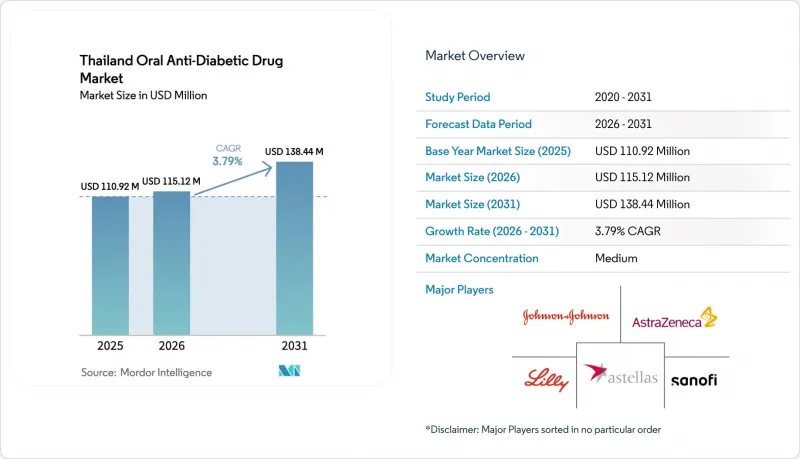
This report is Segmented by Drug Class (Biguanides, Sulfonylureas, Meglitinides, Thiazolidinediones, and More), Age Group (Adults, Pediatric, Geriatric), Diabetes Type (Type 1 Diabetes, Type 2 Diabetes), and Distribution Channel (Hospital Pharmacies, Retail Pharmacies, Online Pharmacies). The Market Forecasts are Provided in Terms of Value (USD).
Thailand Oral Anti-Diabetic Drug Market Trends and Insights
Aging-Population Driven T2DM Prevalence Uptick
Twenty percent of Thais are already over 60 years, and epidemiological surveys confirm that age beyond 50 correlates strongly with impaired fasting glucose and insulin resistance . Pharmaceutical firms therefore prioritize extended-release biguanides and lower-dose SGLT-2 inhibitor combinations that reduce pill burden while improving kidney and cardiovascular outcomes. Geriatric-focused dosing schedules lower hypoglycemia risk and are increasingly embedded in hospital formularies that serve Bangkok megahospital networks and emerging provincial centres.
Universal Coverage Scheme Drug Reimbursement Expansion
The 2024 pivot from "Treating All Diseases" to "Treatment Anywhere" connects 5,000 public health units through shared electronic records. Broader reimbursement for novel molecules narrows urban-rural treatment gaps, lifts physician willingness to prescribe SGLT-2 inhibitors, and underpins adherence programs delivered via tele-consults and remote monitoring. Pharmaceutical companies leverage this framework to negotiate outcomes-based agreements that reward real-world HbA1c improvements and hospitalization avoidance.
HTA-Driven Price Caps For Novel Molecules
Thai FDA appraisal panels demand robust cost-effectiveness dossiers before listing SGLT-2 or GLP-1 agents on the National Essential Medicines List. Ceiling prices agreed in 2025 slash launch premiums by as much as 30%, challenging innovators to bundle clinical-monitoring apps and nurse-led coaching to maintain value perception.
Other drivers and restraints analyzed in the detailed report include:
- Cardiovascular-Outcome Data Favouring SGLT-2 & GLP-1 Classes
- Rapid Retail-Pharmacy Channel Growth in Provincial Cities
- High Generic Penetration Squeezing Branded Margins
For complete list of drivers and restraints, kindly check the Table Of Contents.
Segment Analysis
Biguanides retained a 38.35% lead in 2025, underscoring metformin's entrenched first-line status within the Thailand oral anti-diabetic drug market. SGLT-2 inhibitors, however, post a 4.42% CAGR to 2031 as cardiology societies endorse their reno-protective credentials. Utilization accelerates in urban tertiary hospitals where integrated cardio-metabolic clinics track eGFR decline and upgrade therapy proactively. Sulfonylureas decline amid hypoglycemia concerns, while DPP-4 inhibitors plateau as a tolerable but less cardio-centric option.
Clinical audit data show that SGLT-2 addition trimmed HbA1c by 1.1 percentage points and reduced annual hospitalization by 12% against a conventional biguanide-sulfonylurea backbone. These gains justify higher daily therapy costs and reinforce listing decisions across private insurer formularies. Consequently, the Thailand oral anti-diabetic drug market size for SGLT-2 therapies is forecast to climb from USD 28.74 million in 2026 to USD 35.68 million in 2031, while the class's Thailand oral anti-diabetic drug market share edges up by 230 basis points.
Adults generated 66.02% of 2025 revenues, yet the 60+ cohort expands fastest at 4.45% CAGR. Polypharmacy risk management guides prescribers toward once-daily fixed combinations that fuse metformin with SGLT-2 inhibitors or DPP-4 inhibitors, shrink pill burden, and mitigate renal strain.
Digital nutrition counseling offered through universal-coverage portals tailors meal plans for older adults, refining glycemic control and moderating weight. Consequently, the Thailand oral anti-diabetic drug market size attributable to geriatric users is expected to rise from USD 37.55 million in 2026 to USD 46.72 million in 2031. Pilot adherence programs in Chiang Mai and Khon Kaen achieve 15 percentage-point improvements, signalling considerable upside if replicated nationwide.
Complete Report Scope:
- By Drug Class
- Biguanides
- Sulfonylureas
- Meglitinides
- Thiazolidinediones
- Alpha-Glucosidase Inhibitors
- DPP-4 Inhibitors
- SGLT-2 Inhibitors
- Others
- By Age Group
- Adults
- Pediatric
- Geriatric
- By Diabetes Type
- Type 1 Diabetes
- Type 2 Diabetes
- By Distribution Channel
- Hospital Pharmacies
- Retail Pharmacies
- Online Pharmacies
List of Companies Covered in this Report:
- Merck
- AstraZeneca
- Boehringer Ingelheim
- Novo Nordisk
- Takeda Pharmaceuticals
- Eli Lilly and Company
- Johnson & Johnson
- Astellas Pharma
- Pfizer
- Bristol-Myers Squibb
- Sanofi
- Novartis
- Berlin Pharma
- Siam Bheasach
- Zuellig Pharma
Additional Benefits:
- The market estimate (ME) sheet in Excel format
- 3 months of analyst support
TABLE OF CONTENTS
1 Introduction
- 1.1 Study Assumptions & Market Definition
- 1.2 Scope of the Study
2 Research Methodology
3 Executive Summary
4 Market Landscape
- 4.1 Market Overview
- 4.2 Market Drivers
- 4.2.1 Ageing-Population?Driven T2DM Prevalence Uptick
- 4.2.2 Universal Coverage Scheme Drug Reimbursement Expansion
- 4.2.3 Cardiovascular-Outcome Data Favouring SGLT-2 & GLP-1 Classes
- 4.2.4 Rapid Retail-Pharmacy Channel Growth In Provincial Cities
- 4.2.5 E-Commerce Pharmacies & Tele-Consult Start-Ups For Chronic Care
- 4.2.6 Local Contract-Manufacturing Cost Advantage For Generics
- 4.3 Market Restraints
- 4.3.1 HTA-Driven Price Caps For Novel Molecules
- 4.3.2 High Generic Penetration Squeezing Branded Margins
- 4.3.3 Persistently Low Medication-Adherence Rates Outside Bangkok
- 4.3.4 Rising Incidence Of Skin & Urogenital ADR-Related Recalls
- 4.4 Regulatory Landscape
- 4.5 Porters Five Forces Analysis
- 4.5.1 Bargaining Power of Suppliers
- 4.5.2 Bargaining Power of Consumers
- 4.5.3 Threat of New Entrants
- 4.5.4 Threat of Substitute Products & Services
- 4.5.5 Intensity of Competitive Rivalry
5 Market Size & Growth Forecasts (Value, USD)
- 5.1 By Drug Class
- 5.1.1 Biguanides
- 5.1.2 Sulfonylureas
- 5.1.3 Meglitinides
- 5.1.4 Thiazolidinediones
- 5.1.5 Alpha-Glucosidase Inhibitors
- 5.1.6 DPP-4 Inhibitors
- 5.1.7 SGLT-2 Inhibitors
- 5.1.8 Others
- 5.2 By Age Group
- 5.2.1 Adults
- 5.2.2 Pediatric
- 5.2.3 Geriatric
- 5.3 By Diabetes Type
- 5.3.1 Type 1 Diabetes
- 5.3.2 Type 2 Diabetes
- 5.4 By Distribution Channel
- 5.4.1 Hospital Pharmacies
- 5.4.2 Retail Pharmacies
- 5.4.3 Online Pharmacies
6 Competitive Landscape
- 6.1 Market Concentration
- 6.2 Market Share Analysis
- 6.3 Company Profiles (includes Global level Overview, Market level overview, Core Segments, Financials as available, Strategic Information, Market Rank/Share for key companies, Products & Services, and Recent Developments)
- 6.3.1 Merck & Co.
- 6.3.2 AstraZeneca
- 6.3.3 Boehringer Ingelheim
- 6.3.4 Novo Nordisk
- 6.3.5 Takeda
- 6.3.6 Eli Lilly
- 6.3.7 Johnson and Johnson
- 6.3.8 Astellas Pharma
- 6.3.9 Pfizer
- 6.3.10 Bristol Myers Squibb
- 6.3.11 Sanofi
- 6.3.12 Novartis
- 6.3.13 Berlin Pharma
- 6.3.14 Siam Bheasach
- 6.3.15 Zuellig Pharma
7 Market Opportunities & Future Outlook
- 7.1 White-space & Unmet-Need Assessment

