PUBLISHER: Mordor Intelligence | PRODUCT CODE: 2117331

PUBLISHER: Mordor Intelligence | PRODUCT CODE: 2117331
Europe Oral Anti-Diabetic Drug - Market Share Analysis, Industry Trends & Statistics, Growth Forecasts (2026 - 2031)
According to Mordor Intelligence, the Europe oral anti-diabetic drug market size was valued at USD 7.61 billion in 2025 and estimated to grow from USD 7.86 billion in 2026 to reach USD 9.2 billion by 2031, at a CAGR of 3.22% during the forecast period (2026-2031).
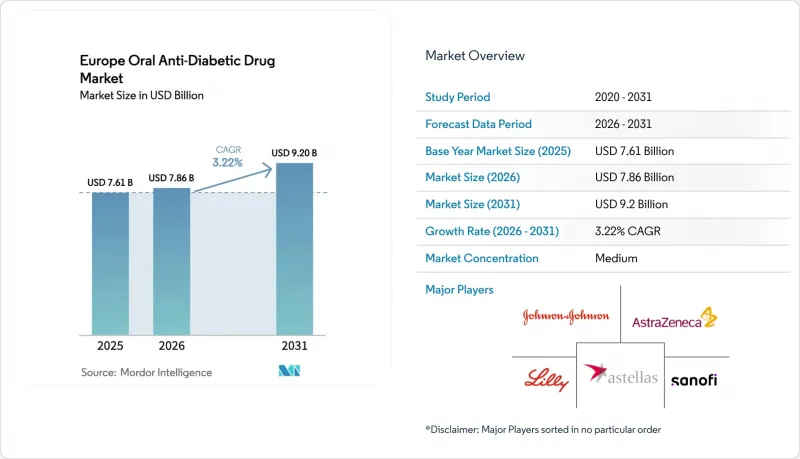
This report is Segmented by Drug Class (Biguanides, Sulfonylureas, Meglitinides, and More), Age Group (Adults, Pediatric, Geriatric), Diabetes Type (Type 1 Diabetes, Type 2 Diabetes), Distribution Channel (Hospital Pharmacies, Retail Pharmacies, Online Pharmacies), and Geography (Germany, United Kingdom, France, Italy, and More). The Market Forecasts are Provided in Terms of Value (USD).
Europe Oral Anti-Diabetic Drug Market Trends and Insights
Escalating Prevalence of Type-2 Diabetes & Obesity
Population ageing and lifestyle changes keep the absolute number of diabetic adults climbing despite public-health efforts. The International Diabetes Federation projects 784 million global cases by 2045, a figure that underpins long-run volume growth for every therapeutic class . Recent Italian market data showed annual GLP-1 spending of EUR 26 billion in 2024, with private out-of-pocket purchases doubling as patients pursue advanced options. Similar momentum appeared in Portugal where sales neared EUR 20 million in early 2025 even without reimbursement. Spain's weight-management segment rose 65% to EUR 484 million in 2024, underscoring unmet demand that transcends traditional payer funding. Collectively, these country snapshots illustrate how obesity trends directly expand the Europe oral anti-diabetic drug market.
EU-Wide Cardio-Renal Label Expansions for the SGLT-2 Class
The European Commission's 2024 approval of empagliflozin (Jardiance) for chronic kidney disease reframed SGLT-2 inhibitors as cardio-metabolic agents rather than glucose-lowering drugs alone . With an estimated 47 million Europeans living with CKD, the addressable pool widened materially. Jardiance generated EUR 7.4 billion in 2023 revenue, reflecting 31% annual growth. Meta-analyses confirm superior reductions in HbA1c, BMI and systolic blood pressure relative to DPP-4 inhibitors, while also cutting hospitalisation for heart failure. These multidimensional benefits strengthen clinician confidence and elevate the Europe oral anti-diabetic drug market growth path.
High List Prices of Novel Incretin & SGLT-2 Therapies
Annual acquisition costs for GLP-1 agents can exceed USD 16,000, challenging public budgets already stretched by multiple sclerosis, oncology and rare-disease drugs. Germany excludes weight-loss indications from statutory reimbursement, while France removed Wegovy from its positive list in late 2023 following incremental-benefit review. The United Kingdom limits access to specialist obesity clinics pending full NICE roll-out. Although cardiovascular-outcomes evidence continues to accumulate, payer hesitancy persists. Roughly 76 million obese but non-diabetic adults across the EU-5 therefore remain priced out of therapy, constraining upside for the Europe oral anti-diabetic drug market.
Other drivers and restraints analyzed in the detailed report include:
- Uptake of Oral GLP-1 (Semaglutide/Rybelsus)
- E-Prescription Mandates Accelerating E-Pharmacy Channels
- Safety Signals: SGLT-2-Induced Euglycaemic DKA Cases
For complete list of drivers and restraints, kindly check the Table Of Contents.
Segment Analysis
Biguanides continued to command 38.05% of 2025 prescriptions, anchoring first-line therapy due to low cost and extensive familiarity. However, SGLT-2 inhibitors delivered the fastest 3.72% CAGR toward 2031 as multidimensional cardio-renal benefits drive physician preference. Sulfonylurea use declined sharply in parts of Southern Europe, mirroring global de-adoption trends linked to hypoglycaemia risk. DPP-4 inhibitors maintained a steady but unremarkable footprint, chiefly in patients unsuitable for SGLT-2 or GLP-1 agents.
The "others" bucket, including dual GIP/GLP-1 agonists such as tirzepatide, shows high clinical promise following network meta-analyses that reported a 2.24% HbA1c decline. Alpha-glucosidase inhibitors and thiazolidinediones now occupy niche roles, reserved for specific intolerance scenarios. Across this landscape, the Europe oral anti-diabetic drug market size allotted to innovation-driven classes keeps expanding, even as metformin retains volume leadership. Declining sulfonylurea demand exemplifies how guideline shifts and outcome data continuously reshape the Europe oral anti-diabetic drug market.
Adults accounted for 66.35% of 2025 utilisation, reflecting the core working-age burden of type 2 diabetes. Yet the geriatric segment exhibited a 3.86% CAGR, powered by refined guidelines that advocate complication-oriented treatment regardless of chronological age. Swiss registry data highlight persistently sub-optimal control rates among seniors, underscoring the need for agents with low hypoglycaemia risk. SGLT-2 inhibitors and GLP-1 receptor agonists meet that requirement but necessitate vigilant renal-function monitoring.
Portuguese community studies revealed 97.7% adherence in older adults yet low achievement of blood-pressure and fasting-glucose targets, signalling unmet multidimensional needs. Digital therapeutics show promise: AI-driven "digital twin" models cut medication requirements by 74% while preserving glycaemia. These trends collectively elevate the Europe oral anti-diabetic drug market size associated with the geriatric cohort. Paediatric prescriptions remain modest, limited chiefly to metformin in adolescents experiencing insulin resistance.
Complete Report Scope:
- By Drug Class
- Biguanides
- Sulfonylureas
- Meglitinides
- Thiazolidinediones
- Alpha-Glucosidase Inhibitors
- DPP-4 Inhibitors
- SGLT-2 Inhibitors
- Others
- By Age Group
- Adults
- Pediatric
- Geriatric
- By Diabetes Type
- Type 1 Diabetes
- Type 2 Diabetes
- By Distribution Channel
- Hospital Pharmacies
- Retail Pharmacies
- Online Pharmacies
- By Geography
- Germany
- United Kingdom
- France
- Italy
- Spain
- Rest of Europe
List of Companies Covered in this Report:
- Novo Nordisk
- Eli Lilly and Company
- Boehringer Ingelheim
- AstraZeneca
- Johnson & Johnson
- Merck
- Sanofi
- Takeda Pharmaceuticals
- Pfizer
- Bristol-Myers Squibb
- Astellas Pharma
- Novartis
- Teva Pharmaceutical Industries
- Viatris
- Sun Pharmaceuticals Industries
- Recordati
- Servier
- Lupin
- Zentiva
Additional Benefits:
- The market estimate (ME) sheet in Excel format
- 3 months of analyst support
TABLE OF CONTENTS
1 Introduction
- 1.1 Study Assumptions & Market Definition
- 1.2 Scope of the Study
2 Research Methodology
3 Executive Summary
4 Market Landscape
- 4.1 Market Overview
- 4.2 Market Drivers
- 4.2.1 Escalating Prevalence of Type-2 Diabetes & Obesity
- 4.2.2 EU-Wide Cardio-Renal Label Expansions For SGLT-2 Class
- 4.2.3 Uptake Of Oral GLP-1 (Semaglutide/Rybelsus)
- 4.2.4 E-Prescription Mandates Accelerating E-Pharmacy Channels
- 4.2.5 Upcoming Patent Cliffs Unlocking Low-Cost Generics
- 4.2.6 AI-Driven Poly-Pharmacy Optimisation in Primary Care
- 4.3 Market Restraints
- 4.3.1 High List Prices of Novel Incretin & SGLT-2 Therapies
- 4.3.2 Safety Signals: SGLT-2-Induced Euglycaemic DKA Cases
- 4.3.3 API Supply-Chain Fragility Within Europe & India
- 4.3.4 Therapeutic Inertia Among General Practitioners
- 4.4 Regulatory Landscape
- 4.5 Porters Five Forces Analysis
- 4.5.1 Bargaining Power of Suppliers
- 4.5.2 Bargaining Power of Consumers
- 4.5.3 Threat of New Entrants
- 4.5.4 Threat of Substitute Products and Services
- 4.5.5 Intensity of Competitive Rivalry
5 Market Size & Growth Forecasts (Value, USD)
- 5.1 By Drug Class
- 5.1.1 Biguanides
- 5.1.2 Sulfonylureas
- 5.1.3 Meglitinides
- 5.1.4 Thiazolidinediones
- 5.1.5 Alpha-Glucosidase Inhibitors
- 5.1.6 DPP-4 Inhibitors
- 5.1.7 SGLT-2 Inhibitors
- 5.1.8 Others
- 5.2 By Age Group
- 5.2.1 Adults
- 5.2.2 Pediatric
- 5.2.3 Geriatric
- 5.3 By Diabetes Type
- 5.3.1 Type 1 Diabetes
- 5.3.2 Type 2 Diabetes
- 5.4 By Distribution Channel
- 5.4.1 Hospital Pharmacies
- 5.4.2 Retail Pharmacies
- 5.4.3 Online Pharmacies
- 5.5 By Geography
- 5.5.1 Germany
- 5.5.2 United Kingdom
- 5.5.3 France
- 5.5.4 Italy
- 5.5.5 Spain
- 5.5.6 Rest of Europe
6 Competitive Landscape
- 6.1 Market Concentration
- 6.2 Market Share Analysis
- 6.3 Company Profiles (includes Global level Overview, Market level overview, Core Segments, Financials as available, Strategic Information, Market Rank/Share for key companies, Products & Services, and Recent Developments)
- 6.3.1 Novo Nordisk
- 6.3.2 Eli Lilly
- 6.3.3 Boehringer Ingelheim
- 6.3.4 AstraZeneca
- 6.3.5 Johnson & Johnson
- 6.3.6 Merck & Co.
- 6.3.7 Sanofi
- 6.3.8 Takeda
- 6.3.9 Pfizer
- 6.3.10 Bristol Myers Squibb
- 6.3.11 Astellas Pharma
- 6.3.12 Novartis
- 6.3.13 Teva Pharmaceuticals
- 6.3.14 Viatris
- 6.3.15 Sun Pharma
- 6.3.16 Recordati
- 6.3.17 Servier
- 6.3.18 Lupin
- 6.3.19 Zentiva
7 Market Opportunities & Future Outlook
- 7.1 White-space & Unmet-Need Assessment

