PUBLISHER: Mordor Intelligence | PRODUCT CODE: 2114271

PUBLISHER: Mordor Intelligence | PRODUCT CODE: 2114271
South America Agricultural Sprayers - Market Share Analysis, Industry Trends & Statistics, Growth Forecasts (2026 - 2031)
According to Mordor Intelligence, the South America agricultural sprayers market size is expected to grow from USD 0.86 billion in 2025 to USD 0.91 billion in 2026 and is forecast to reach USD 1.23 billion by 2031 at 6.10% CAGR over 2026-2031.
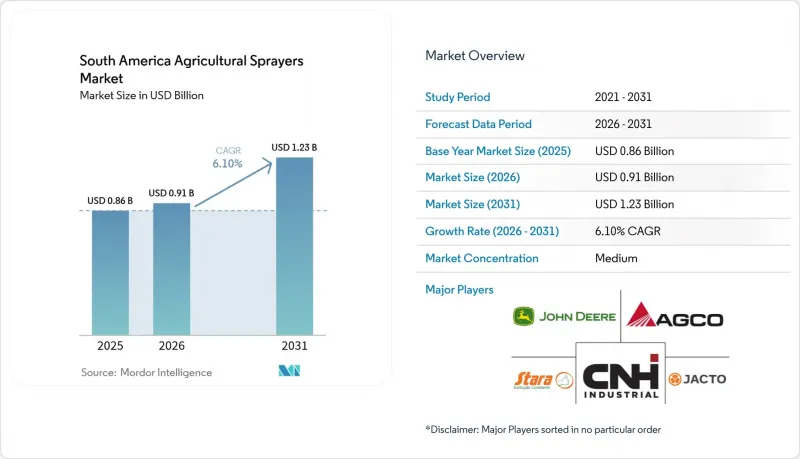
This report is Segmented by Source of Power (Manual, Battery-Operated, Solar, and Fuel-Operated), by Usage (Field Sprayers, Orchard Sprayers, and Gardening Sprayers), by Mode of Capacity (Ultra-Low Volume, Low Volume, and High Volume), and by Geography (Brazil, Argentina, and the Rest of South America). The Market Forecasts are Provided in Terms of Value (USD).
South America Agricultural Sprayers Market Trends and Insights
Shrinking Rural Labor Pool
South America's agricultural labor force continues to decline as younger generations move to urban areas and older farmers retire, creating a shortage of skilled operators for complex spraying operations. This workforce reduction has led to increased wages and shorter spraying windows, compelling growers to invest in self-propelled or autonomous machines for extended, efficient operations. Robotic systems that combine scouting and spraying functions are increasing in adoption, offering reduced input costs. Brazil leads the region in agricultural automation, with Argentina following closely. This shift in the regional workforce continues to drive growth in the agricultural sprayers market across South America.
Expansion of Soybean Acreage and Agrochemical Intensity
The rapid expansion of soybean cultivation in South America has intensified the need for crop protection equipment. The presence of diseases such as Asian Soybean Rust requires multiple applications during growing seasons, making efficient and timely spraying crucial. Farmers managing larger fields with limited operational windows are investing in high-capacity sprayers to increase coverage rates. Precision spraying technologies have gained adoption as farmers seek to control costs amid variable commodity prices. These systems enhance application accuracy while reducing waste. The combination of increased acreage and agrochemical requirements continues to support market growth for agricultural sprayers in the region.
Volatile Farm Income Tied to Soft-commodity Prices
Fluctuating commodity prices affect farm income across South America, creating uncertainty in agricultural equipment investments. Rising global grain stockpiles often lead to price decreases, reducing farmers' margins for machinery upgrades. This financial pressure results in delayed purchases, loan restructuring, and limited credit access for new sprayers. Market momentum can stall even during periods of strong demand due to revenue volatility. These cyclical downturns affect the agricultural sprayers market's growth, making it dependent on commodity trends and rural producers' financial stability.
Other drivers and restraints analyzed in the detailed report include:
- Government Subsidies for Crop-protection Mechanization
- Adoption of GPS-guided Precision Spraying
- High Upfront Cost of Self-propelled Units
For complete list of drivers and restraints, kindly check the Table Of Contents.
Segment Analysis
Fuel-operated equipment retained 45.62% of the South American agricultural sprayers market share in 2025 because diesel technology offers ample power density and rapid refueling over thousands of hectares of soy and corn. The South American agricultural sprayers market size for battery models, however, is climbing at 7.34% CAGR as large growers test solar-charged fleets to cut fuel costs and qualify for low-carbon premiums.
Autonomous battery sprayers slash herbicide bills and mitigate operator shortages, sharpening their payback profile despite higher acquisition costs. Solar support trailers from Jacto and field-scale charging hubs are addressing range concerns. Manual and solar units still fill niche needs among smallholders or protected-crop growers, but are gradually conceding share to powered alternatives. The power-source mix illustrates the South American agricultural sprayers market evolution toward greener, data-ready solutions.
Complete Report Scope:
- By Source of Power
- Manual
- Battery-operated
- Solar
- Fuel-operated
- By Usage
- Field Sprayers
- Orchard Sprayers
- Gardening Sprayers
- By Mode of Capacity
- Ultra-Low Volume
- Low Volume
- High Volume
- By Geography
- Brazil
- Argentina
- Rest of South America
List of Companies Covered in this Report:
- Deere & Company
- AGCO Corporation
- CNH Industrial N.V.
- Mahindra & Mahindra Limited
- Jacto S.A.
- Stara S/A
- LS Mtron Ltd.
- Sonalika International Tractors Ltd. (ITL)
- Kubota Corporation
- Bucher Industries AG (KUHN Group)
- EXEL Industries SA
- Guarany Industria Ltda.
- Implementos Agricolas Jan S.A.
- Baldan Implementos Agricolas S/A
- Andreas STIHL AG & Co. KG
Additional Benefits:
- The market estimate (ME) sheet in Excel format
- 3 months of analyst support
TABLE OF CONTENTS
1 Introduction
- 1.1 Study Assumptions and Market Definition
- 1.2 Scope of the Study
2 Research Methodology
3 Executive Summary
4 Market Landscape
- 4.1 Market Overview
- 4.2 Market Drivers
- 4.2.1 Shrinking Rural Labor Pool
- 4.2.2 Expansion of Soybean Acreage and Agrochemical Intensity
- 4.2.3 Government Subsidies for Crop-protection Mechanization
- 4.2.4 Adoption of GPS-guided Precision Spraying
- 4.2.5 Climate-linked Pests and Diseases Pressure Spikes
- 4.2.6 Carbon-credit Premiums for Input-efficient Farms
- 4.3 Market Restraints
- 4.3.1 Volatile Farm Income Tied to Soft-commodity Prices
- 4.3.2 High Upfront Cost of Self-propelled Units
- 4.3.3 Patchy Rural Broadband Hampers Telematics
- 4.3.4 Fuel Price Inflation Raising Operating Costs
- 4.4 Regulatory Landscape
- 4.5 Technological Outlook
- 4.6 Porter's Five Forces Analysis
- 4.6.1 Bargaining Power of Suppliers
- 4.6.2 Bargaining Power of Buyers
- 4.6.3 Threat of New Entrants
- 4.6.4 Threat of Substitute Products
- 4.6.5 Intensity of Competitive Rivalry
5 Market Size and Growth Forecasts (Value)
- 5.1 By Source of Power
- 5.1.1 Manual
- 5.1.2 Battery-operated
- 5.1.3 Solar
- 5.1.4 Fuel-operated
- 5.2 By Usage
- 5.2.1 Field Sprayers
- 5.2.2 Orchard Sprayers
- 5.2.3 Gardening Sprayers
- 5.3 By Mode of Capacity
- 5.3.1 Ultra-Low Volume
- 5.3.2 Low Volume
- 5.3.3 High Volume
- 5.4 By Geography
- 5.4.1 Brazil
- 5.4.2 Argentina
- 5.4.3 Rest of South America
6 Competitive Landscape
- 6.1 Market Concentration
- 6.2 Strategic Moves
- 6.3 Market Share Analysis
- 6.4 Company Profiles (Includes Global Level Overview, Market Level Overview, Core Segments, Financials as Available, Strategic Information, Market Rank/Share for Key Companies, Products and Services, and Recent Developments)
- 6.4.1 Deere & Company
- 6.4.2 AGCO Corporation
- 6.4.3 CNH Industrial N.V.
- 6.4.4 Mahindra & Mahindra Limited
- 6.4.5 Jacto S.A.
- 6.4.6 Stara S/A
- 6.4.7 LS Mtron Ltd.
- 6.4.8 Sonalika International Tractors Ltd. (ITL)
- 6.4.9 Kubota Corporation
- 6.4.10 Bucher Industries AG (KUHN Group)
- 6.4.11 EXEL Industries SA
- 6.4.12 Guarany Industria Ltda.
- 6.4.13 Implementos Agricolas Jan S.A.
- 6.4.14 Baldan Implementos Agricolas S/A
- 6.4.15 Andreas STIHL AG & Co. KG
7 Market Opportunities and Future Outlook

