PUBLISHER: Global Market Insights Inc. | PRODUCT CODE: 2061370

PUBLISHER: Global Market Insights Inc. | PRODUCT CODE: 2061370
Agricultural Sprayers Market Opportunity, Growth Drivers, Industry Trend Analysis, and Forecast 2026 - 2035
The Global Agricultural Sprayers Market was valued at USD 5.2 billion in 2025 and is estimated to grow at a CAGR of 7.2% to reach USD 10.4 billion by 2035.
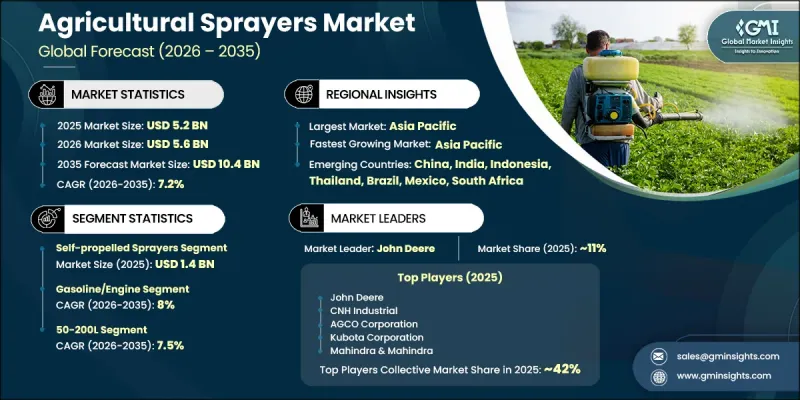
Market growth is supported by the rising adoption of precision agriculture practices and the increasing emphasis on efficient crop protection methods. Spraying technologies are gaining widespread acceptance as they improve application accuracy, reduce operational time, and minimize chemical wastage across crop protection, fertilization, and pest control activities. Agricultural sprayers have become an essential component of modern farming systems, particularly as efficient crop protection plays a critical role in sustaining agricultural productivity and ensuring food security across developing regions such as Africa, Asia Pacific, and Latin America. Government support programs promoting farm mechanization and financial incentives for agricultural equipment adoption are also accelerating market expansion. In addition, rising global population levels and increasing food demand are further intensifying the need for higher agricultural output. Agricultural sprayers offer cost-efficient solutions for small and medium-scale farmers by improving productivity while maintaining affordability. The availability of multiple sprayer formats, ranging from portable units to advanced self-propelled systems, is enabling farmers to transition from manual application methods to more technologically advanced farming practices.
| Market Scope | |
|---|---|
| Start Year | 2025 |
| Forecast Year | 2026-2035 |
| Start Value | $5.2 Billion |
| Forecast Value | $10.4 Billion |
| CAGR | 7.2% |
The self-propelled sprayers segment accounted for 26.6% share in 2025, reaching a value of USD 1.4 billion, and is expected to grow at a CAGR of 6.6% from 2026 to 2035. This segment holds a strong position due to its suitability for large-scale agricultural operations. These machines are equipped with integrated chassis systems, high-capacity tanks, wide spray booms, and precision farming technologies such as GPS-based navigation and variable rate application systems. Large commercial farms prefer self-propelled sprayers as they enhance operational efficiency, reduce soil compaction compared to tractor-mounted alternatives, and operate independently without reliance on additional farm machinery.
The 50-200L segment held 29.2% share in 2025 and is projected to grow at a CAGR of 7.5% from 2026 to 2035. This segment leads due to the high concentration of small and medium-scale farms globally, especially across Asia Pacific, Africa, and Latin America, where average landholding sizes remain relatively limited. Equipment within the low-volume category, including handheld, knapsack, and compact mounted sprayers, is widely adopted due to its affordability and practicality. These systems are well-suited for farmers requiring efficient yet cost-effective solutions for routine spraying operations.
U.S. Agricultural Sprayers Market reached USD 1.3 billion in 2025 and is expected to grow at a CAGR of 6.9% from 2026 to 2035. Market expansion is driven by large-scale commercial farming operations, expansive average farm sizes, and strong adoption of precision agriculture technologies. Demand remains high across grain production, specialty crops, and horticulture. Farmers are increasingly investing in self-propelled sprayers equipped with advanced systems such as GPS guidance, variable rate technology, and automated boom controls. The growing integration of sensors and data-driven farming solutions is further supporting demand for technologically advanced spraying equipment.
Major players operating in the Global Agricultural Sprayers Industry include John Deere, CNH Industrial, AGCO Corporation, Kubota Corporation, Mahindra & Mahindra, Bucher Industries (Kuhn Group), CLAAS KGaA, New Holland Agriculture, Massey Ferguson, Valtra, Horsch Maschinen, Jacto, DJI Agriculture, XAG Co., Ltd., Excel Industries, Alamo Group, SDF Group, TAFE Motors & Tractors, Changfa Agricultural Equipment, Lovol Heavy Industries, Yamaha Motor Co., and YTO Group. Companies in the agricultural sprayers market are focusing on strengthening precision agriculture capabilities by integrating GPS, sensor-based systems, and variable rate technology into their product offerings. Manufacturers are investing in automation and smart spraying solutions that enhance accuracy and reduce chemical usage. Expansion of electric and hybrid sprayer models is supporting sustainability goals and lowering operating costs. Firms are also improving durability and machine efficiency to suit diverse farm sizes and climatic conditions. Strategic collaborations with agricultural cooperatives and distribution networks are helping expand market reach. In addition, companies are emphasizing after-sales service, training programs, and digital farm management integration to enhance customer retention.
Table of Contents
Chapter 1 Methodology and Scope
- 1.1 Market scope and definition
- 1.2 Research design
- 1.2.1 Research approach
- 1.2.2 Data collection methods
- 1.3 Data mining sources
- 1.3.1 Global
- 1.3.2 Regional/Country
- 1.4 Base estimates and calculations
- 1.4.1 Base year calculation
- 1.4.2 Key trends for market estimation
- 1.5 Primary research and validation
- 1.5.1 Primary sources
- 1.6 Forecast model
- 1.7 Research assumptions and limitations
Chapter 2 Executive Summary
- 2.1 Industry 360° synopsis
- 2.2 Key market trends
- 2.2.1 Regional
- 2.2.2 Product Type
- 2.2.3 Power Source
- 2.2.4 Technology
- 2.2.5 Capacity
- 2.2.6 Usage
- 2.2.7 Crop Type
- 2.2.8 End User
- 2.2.9 Distribution Channel
Chapter 3 Industry Insights
- 3.1 Industry ecosystem analysis
- 3.1.1 Supplier landscape
- 3.1.2 Profit margin
- 3.1.3 Value addition at each stage
- 3.1.4 Factor affecting the value chain
- 3.2 Industry impact forces
- 3.2.1 Growth drivers
- 3.2.2 Industry pitfalls & challenges
- 3.2.3 Opportunities
- 3.3 Growth potential analysis
- 3.3.1 Price volatility and market unpredictability
- 3.3.2 Quality assurance and equipment reliability concerns
- 3.4 Future market trends
- 3.5 Technology and innovation landscape
- 3.5.1 Current technological trends
- 3.5.2 Emerging technologies
- 3.6 Pricing Analysis (Driven by Primary Research)
- 3.6.1 Historical Price Trend Analysis (Driven by Primary Research)
- 3.6.2 Pricing Strategy by Player Type (Premium/Value/Cost-plus) (Driven by Primary Research)
- 3.6.3 Average Selling Price by Product Type & Capacity
- 3.7 Regulatory landscape
- 3.7.1 Standards and compliance requirements
- 3.7.2 Regional regulatory frameworks
- 3.7.3 Certification standards
- 3.8 Porter’s analysis
- 3.9 PESTEL analysis
- 3.10 Trade Data Analysis (Driven by Paid Database)
- 3.10.1 Import/Export Volume & Value Trends (Driven by Primary Research)
- 3.10.2 Key Trade Corridors & Tariff Impact (Driven by Primary Research)
- 3.10.3 HS Code Classification & Trade Flow Analysis
- 3.11 Impact of AI & Generative AI on the Market
- 3.11.1 AI-Driven Disruption of Traditional Spraying Methods
- 3.11.2 GenAI Use Cases & Adoption Roadmap by Farm Size
- 3.11.3 Risks, Limitations & Regulatory Considerations for AI-Enabled Sprayers
- 3.12 Capacity & Production Landscape (Driven by Primary Research)
- 3.12.1 Installed Manufacturing Capacity by Region & Key Producer (Driven by Primary Research)
- 3.12.2 Capacity Utilization Rates & Expansion Pipelines (Driven by Primary Research)
Chapter 4 Competitive Landscape, 2025
- 4.1 Introduction
- 4.2 Company market share analysis
- 4.2.1 By region
- 4.2.1.1 North America
- 4.2.1.2 Europe
- 4.2.1.3 Asia Pacific
- 4.2.1.4 Latin America
- 4.2.1.5 Middle East and Africa
- 4.2.1 By region
- 4.3 Company matrix analysis
- 4.4 Competitive analysis of major market players
- 4.5 Competitive positioning matrix
- 4.6 Key developments
- 4.6.1 Mergers & acquisitions
- 4.6.2 Partnerships & collaborations
- 4.6.3 New product launches
- 4.6.4 Expansion plans
Chapter 5 Market Estimates & Forecast, By Product Type, 2022 - 2035, (USD Billion) (Thousand Units)
- 5.1 Key trends
- 5.2 Handheld sprayer
- 5.3 Knapsack sprayer
- 5.4 Trailed sprayer
- 5.5 Mounted sprayer
- 5.6 Self-propelled sprayer
- 5.7 Aerial sprayer
- 5.8 Others
Chapter 6 Market Estimates & Forecast, By Power Source, 2022 - 2035, (USD Billion) (Thousand Units)
- 6.1 Key trends
- 6.2 Battery
- 6.3 Gasoline/Engine
Chapter 7 Market Estimates & Forecast, By Technology, 2022 - 2035, (USD Billion) (Thousand Units)
- 7.1 Key trends
- 7.2 Hydraulic nozzles
- 7.3 Air-assisted electrostatic
- 7.4 Ultra-Low Volume (ULV) spraying
- 7.5 Precision spraying
- 7.6 Others
Chapter 8 Market Estimates & Forecast, By Capacity, 2022 - 2035, (USD Billion) (Thousand Units)
- 8.1 Key trends
- 8.2 Below 50L
- 8.3 50-200L
- 8.4 200-500 L
- 8.5 Above 500L
Chapter 9 Market Estimates & Forecast, By Usage, 2022 - 2035, (USD Billion) (Thousand Units)
- 9.1 Key trends
- 9.2 Insecticides/Pesticides
- 9.3 Herbicides
- 9.4 Fungicides
- 9.5 Fertilizers
Chapter 10 Market Estimates & Forecast, By Crop Type, 2022 - 2035, (USD Billion) (Thousand Units)
- 10.1 Key trends
- 10.2 Cereals & Grains
- 10.3 Oilseeds & Pulses
- 10.4 Fruits & Flowers
- 10.5 Stem & Tubers
- 10.6 Other (Plantation Crops, Forestry, etc.)
Chapter 11 Market Estimates & Forecast, By End User, 2022 - 2035, (USD Billion) (Thousand Units)
- 11.1 Key trends
- 11.2 Small Farmers
- 11.3 Medium Farmers
- 11.4 Large Farms
- 11.5 Institutions & Commercial Farms
Chapter 12 Market Estimates & Forecast, By Distribution Channel, 2022 - 2035, (USD Billion) (Thousand Units)
- 12.1 Key trends
- 12.2 Online
- 12.3 Offline
Chapter 13 Market Estimates and Forecast, By Region, 2022 - 2035 (USD Billion) (Thousand Units)
- 13.1 Key trends
- 13.2 North America
- 13.2.1 U.S.
- 13.2.2 Canada
- 13.3 Europe
- 13.3.1 Germany
- 13.3.2 UK
- 13.3.3 France
- 13.3.4 Italy
- 13.3.5 Spain
- 13.4 Asia Pacific
- 13.4.1 China
- 13.4.2 Japan
- 13.4.3 India
- 13.4.4 Australia
- 13.4.5 South Korea
- 13.5 Latin America
- 13.5.1 Brazil
- 13.5.2 Mexico
- 13.5.3 Argentina
- 13.6 Middle East and Africa
- 13.6.1 South Africa
- 13.6.2 Saudi Arabia
- 13.6.3 UAE
Chapter 14 Company Profiles
- 14.1 Top Global Player
- 14.1.1 John Deere
- 14.1.2 CNH Industrial
- 14.1.3 Kubota Corporation
- 14.1.4 AGCO Corporation
- 14.1.5 Mahindra & Mahindra
- 14.1.6 Claas Group
- 14.1.7 Bucher Industries (Kuhn Group)
- 14.2 Regional Player
- 14.2.1 Jacto
- 14.2.2 Excel Industries
- 14.2.3 Horsch Maschinen
- 14.2.4 Changfa Agricultural Equipment
- 14.2.5 TAFE Motors & Tractors
- 14.3 Emerging Players
- 14.3.1 DJI Agriculture
- 14.3.2 XAG Co., Ltd.
- 14.3.3 Yamaha Motor Co. (Agriculture Division)
- 14.3.4 Alamo Group
- 14.3.5 SDF Group
- 14.3.6 New Holland Agriculture
- 14.3.7 Massey Ferguson
- 14.3.8 Valtra
- 14.3.9 YTO Group
- 14.3.10 Lovol Heavy Industries

