PUBLISHER: Mordor Intelligence | PRODUCT CODE: 2114369

PUBLISHER: Mordor Intelligence | PRODUCT CODE: 2114369
India Health And Medical Insurance - Market Share Analysis, Industry Trends & Statistics, Growth Forecasts (2026 - 2031)
According to Mordor Intelligence, the India health and medical insurance market size in terms of gross written premiums value is expected to grow from USD 15.46 billion in 2026 to USD 22.86 billion by 2031, at a CAGR of 8.13% during the forecast period (2026-2031).
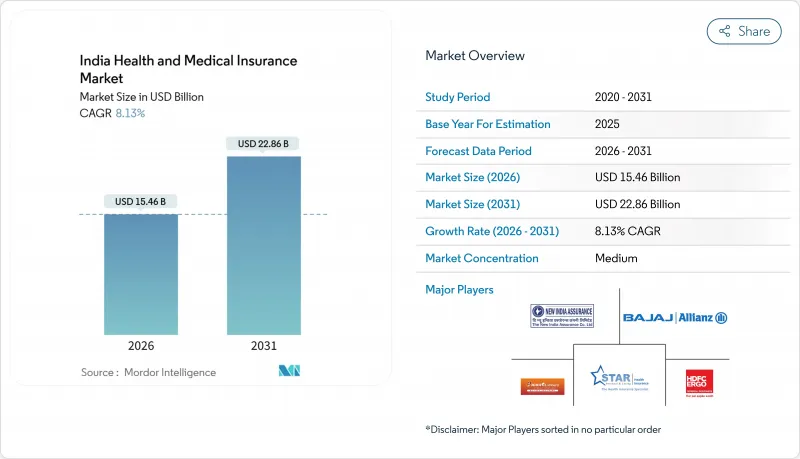
This report is Segmented by Policy Type (Individual Health Insurance, Family Floater & Group Health, and More), Coverage Type (In-Patient Hospitalization, Out-Patient & Day-Care, and More), Demographic (0-18, 19-45 Years, and More), Provider Type (Public, Private Sector, and More), Distribution Channel (Agents & Brokers, and More), and Region. The Market Forecasts are Provided in Value (USD).
India Health And Medical Insurance Market Trends and Insights
Rising Healthcare Costs Elevating Demand for Financial Protection
Medical inflation and rising specialization in tertiary care have increased the financial burden on households, strengthening the role of indemnity health insurance as a risk management tool. Industry analyses point to cost escalation risks in India's health system, which continues to shift treatment volumes toward higher-acuity settings and newer clinical technologies that carry premium price points. The regulator's tighter service standards for cashless authorization windows improve predictability at admission and discharge, which reduces friction for policyholders and hospitals. Digital identity and claims rail deployment across the public health stack, including ABHA and the NHCX, enables standardized data flows that support faster adjudication and fewer documentation errors. Urban and peri-urban consumers are responding by selecting higher sum-insured slabs and renewing coverage consistently, particularly in segments sensitive to out-patient spending and elective procedures. The India health and medical insurance market is therefore supported by a structural shift toward pre-emptive financial protection as healthcare costs trend higher.
Government Programmes and Tax Incentives
Ayushman Bharat has scaled hospital coverage for eligible families at the national level and has broadened access by onboarding additional states and beneficiaries across income groups. The program's digital rails, including the claims exchange and health IDs, create end-to-end traceability and provide the underpinnings for faster benefit realization in network hospitals across India. Parallel to public coverage expansion, regulator-led reforms have eased age restrictions, streamlined pre-existing disease waiting periods, and set service-level expectations that improve consumer confidence in private health insurance. The move toward Goods and Services Tax (GST) relief on select retail health policies reduced the all-in cost of coverage for many households, and insurers have communicated the direct pass-through of savings on policy pricing since the change took effect in September 2025. Collectively, these policy actions stimulate demand and help the India health and medical insurance market sustain growth across both group and retail products.
Other drivers and restraints analyzed in the detailed report include:
- Growing Middle-Class Income and Health-Risk Awareness
- Digital Distribution Platforms Expanding Reach
- Low Rural Penetration and Trust Deficit
- High Claim Ratios and Medical Inflation Pressure
For complete list of drivers and restraints, kindly check the Table Of Contents.
Segment Analysis
Family floater and group health policies held the largest portfolio position with 43.63% of the India health and medical insurance market share in 2025, reflecting employer program breadth and household preference for shared-sum cover in urban centres. Employer-driven programs offer a base layer of protection that often becomes the springboard for retail top-ups among working-age families. The India health and medical insurance market has also seen greater interest in catastrophic-risk riders and lump-sum critical illness benefits that complement indemnity structures. This is consistent with rising awareness of lifetime costs associated with severe conditions, where a one-time payout can stabilize finances beyond hospitalization expenses. The resulting mix supports risk pooling at scale while improving flexibility for buyers seeking both day-to-day value and protection against high-severity events.
Critical illness cover is the fastest-growing policy type at a projected 17.50% CAGR from 2026 to 2031 as attention shifts to catastrophic events and income protection. Senior citizen plan uptake improved after the elimination of upper age limits for entry and the streamlining of pre-existing disease waiting periods, which has broadened access for older adults. The India health and medical insurance market is also seeing a steady pickup in top-up and super top-up adoption because these options expand coverage economically when the base policy is in place. Modular product design with customizable riders is resonating with younger cohorts who expect flexible benefits that align with their evolving life and health stages. Insurers continue to refresh policy constructs to balance affordability, coverage depth, and claim service under tighter service-level standards.
Inpatient hospitalization remained the coverage foundation with a 58.12% share in 2025, which reflects how policyholders value financial protection for high-acuity events. Standardized pre-authorization and discharge authorization service levels, set by the regulator, have improved timeliness for cashless care and enhanced predictability for beneficiaries and providers. The India health and medical insurance market continues to embed pre- and post-hospitalization features, room rent rules, and bundled services that together reduce out-of-pocket volatility. As care models evolve, carriers are integrating hospital and home-care capabilities to serve short-stay and step-down needs where clinically appropriate. Over time, this helps align indemnity features with modern clinical pathways while protecting policyholders from cost spikes.
Outpatient and day-care coverage is the fastest-growing benefit set at a projected 18.34% CAGR from 2026 to 2031 as consumers seek day-to-day value and earlier intervention options. Digital health touchpoints such as teleconsultation and e-pharmacy are now common in plan designs, and they support better care continuity at lower cost. The NHCX is architected to cut claim processing costs by standardizing payloads on Fast Healthcare Interoperability Resources (FHIR) and routing claims digitally, which improves feasibility for scaled OPD automation. The India health and medical insurance market is therefore moving toward more frequent-use benefits while preserving strong hospitalization coverage for high-severity events. This combination improves both perceived value and risk management outcomes for employers and retail buyers.
Complete Report Scope:
- By Policy Type
- Individual Health Insurance
- Family Floater and Group Health Insurance
- Senior Citizen Plans
- Critical Illness Cover
- Top-Up & Super Top-Up
- By Coverage Type
- In-patient Hospitalization
- Out-patient & Day-care (OPD)
- Domiciliary Treatment
- Maternity & Newborn Cover
- Alternative Treatments (AYUSH)
- By Demographic (Age Group)
- 0-18 Years
- 19-45 Years
- 46-60 Years
- >= 61 Years
- By Provider Type
- Public Sector Insurers
- Private Sector Insurers
- Stand-alone Health Insurers
- By Distribution Channel
- Agents & Brokers
- Bancassurance
- Digital / Online
- Direct Sales
- Corporate Sales (Group Policies)
- By Region
- North India
- South India
- East India
- West India
List of Companies Covered in this Report:
- New India Assurance Co. Ltd.
- Star Health and Allied Insurance Co. Ltd.
- ICICI Lombard General Insurance Co. Ltd.
- HDFC ERGO General Insurance Co. Ltd.
- Bajaj Allianz General Insurance Co. Ltd.
- Care Health Insurance Ltd.
- Aditya Birla Health Insurance Co. Ltd.
- ManipalCigna Health Insurance Co. Ltd.
- National Insurance Co. Ltd.
- United India Insurance Co. Ltd.
- Oriental Insurance Co. Ltd.
- SBI General Insurance Co. Ltd.
- Reliance General Insurance Co. Ltd.
- TATA AIG General Insurance Co. Ltd.
- Future Generali India Insurance Co. Ltd.
- Acko General Insurance Ltd.
- Go Digit Insurance Ltd.
- Niva Bupa Health Insurance
- Kotak Mahindra General Insurance Co. Ltd.
- Galaxy Health Insurance Co. Ltd.
Additional Benefits:
- The market estimate (ME) sheet in Excel format
- 3 months of analyst support
TABLE OF CONTENTS
1 Introduction
- 1.1 Study Assumptions & Market Definition
- 1.2 Scope of the Study
2 Research Methodology
3 Executive Summary
4 Market Landscape
- 4.1 Market Overview
- 4.2 Market Drivers
- 4.2.1 Rising healthcare costs elevating demand for financial protection
- 4.2.2 Government programmes (e.g., Ayushman Bharat) & tax incentives
- 4.2.3 Growing middle-class income & health-risk awareness
- 4.2.4 Digital distribution platforms expanding reach
- 4.2.5 Uptake of OPD & wellness add-ons for customer retention
- 4.2.6 Wearable-driven dynamic pricing by insurtech entrants
- 4.3 Market Restraints
- 4.3.1 Low rural penetration & trust deficit
- 4.3.2 High claim ratios and medical inflation pressure
- 4.3.3 Complex policy wording causing mis-selling concerns
- 4.3.4 Data-privacy worries around health analytics
- 4.4 Value / Supply-Chain Analysis
- 4.5 Regulatory Landscape
- 4.6 Technological Outlook
- 4.7 Porter's Five Forces Analysis
- 4.7.1 Threat of New Entrants
- 4.7.2 Bargaining Power of Buyers
- 4.7.3 Bargaining Power of Suppliers
- 4.7.4 Threat of Substitutes
- 4.7.5 Competitive Rivalry
5 Market Size & Growth Forecasts
- 5.1 By Policy Type
- 5.1.1 Individual Health Insurance
- 5.1.2 Family Floater and Group Health Insurance
- 5.1.3 Senior Citizen Plans
- 5.1.4 Critical Illness Cover
- 5.1.5 Top-Up & Super Top-Up
- 5.2 By Coverage Type
- 5.2.1 In-patient Hospitalization
- 5.2.2 Out-patient & Day-care (OPD)
- 5.2.3 Domiciliary Treatment
- 5.2.4 Maternity & Newborn Cover
- 5.2.5 Alternative Treatments (AYUSH)
- 5.3 By Demographic (Age Group)
- 5.3.1 0-18 Years
- 5.3.2 19-45 Years
- 5.3.3 46-60 Years
- 5.3.4 >= 61 Years
- 5.4 By Provider Type
- 5.4.1 Public Sector Insurers
- 5.4.2 Private Sector Insurers
- 5.4.3 Stand-alone Health Insurers
- 5.5 By Distribution Channel
- 5.5.1 Agents & Brokers
- 5.5.2 Bancassurance
- 5.5.3 Digital / Online
- 5.5.4 Direct Sales
- 5.5.5 Corporate Sales (Group Policies)
- 5.6 By Region
- 5.6.1 North India
- 5.6.2 South India
- 5.6.3 East India
- 5.6.4 West India
6 Competitive Landscape
- 6.1 Market Concentration
- 6.2 Strategic Moves
- 6.3 Market Share Analysis
- 6.4 Company Profiles (includes Global level Overview, Market level overview, Core Segments, Financials as available, Strategic Information, Market Rank/Share for key companies, Products & Services, and Recent Developments)
- 6.4.1 New India Assurance Co. Ltd.
- 6.4.2 Star Health and Allied Insurance Co. Ltd.
- 6.4.3 ICICI Lombard General Insurance Co. Ltd.
- 6.4.4 HDFC ERGO General Insurance Co. Ltd.
- 6.4.5 Bajaj Allianz General Insurance Co. Ltd.
- 6.4.6 Care Health Insurance Ltd.
- 6.4.7 Aditya Birla Health Insurance Co. Ltd.
- 6.4.8 ManipalCigna Health Insurance Co. Ltd.
- 6.4.9 National Insurance Co. Ltd.
- 6.4.10 United India Insurance Co. Ltd.
- 6.4.11 Oriental Insurance Co. Ltd.
- 6.4.12 SBI General Insurance Co. Ltd.
- 6.4.13 Reliance General Insurance Co. Ltd.
- 6.4.14 TATA AIG General Insurance Co. Ltd.
- 6.4.15 Future Generali India Insurance Co. Ltd.
- 6.4.16 Acko General Insurance Ltd.
- 6.4.17 Go Digit Insurance Ltd.
- 6.4.18 Niva Bupa Health Insurance
- 6.4.19 Kotak Mahindra General Insurance Co. Ltd.
- 6.4.20 Galaxy Health Insurance Co. Ltd.
7 Market Opportunities & Future Outlook
- 7.1 White-space & Unmet-Need Assessment

