PUBLISHER: Mordor Intelligence | PRODUCT CODE: 2187312

PUBLISHER: Mordor Intelligence | PRODUCT CODE: 2187312
Indonesia Health and Medical Insurance - Market Share Analysis, Industry Trends & Statistics, Growth Forecasts (2027 - 2032)
According to Mordor Intelligence, the Indonesia health and medical insurance market size is expected to increase from USD 1.77 billion in 2026 to USD 1.9 billion in 2027 and reach USD 2.77 billion by 2032, growing at a CAGR of 7.85% over 2027-2032.
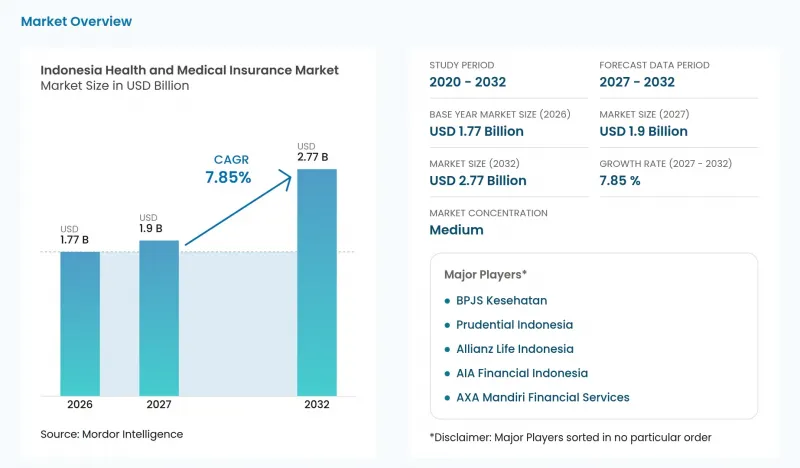
This report is segmented by Insurance Product Type (Public / Social Security Schemes and Private Medical Insurance), Distribution Channel (Brokers / Agents, Banks, Other Channels, and Direct-to-Consumer), and End-user Segment (Individuals / Households, Large Corporates, and SMEs). The market forecasts are provided in terms of value (USD), based on availability.
Indonesia Health and Medical Insurance Market Trends and Insights
Near-universal JKN coverage expansion
Recurring JKN contributions link participants' financing decisions with the public scheme's ability to sustain insured care. A BPJS Kesehatan Medan branch official reported approximately 284.5 million JKN participants nationally as of August 31, 2026, representing more than 98% of Indonesia's population. At NADI JKN's August 4, 2026 launch, BPJS Kesehatan reported 3,000 online motorcycle driver partners had joined its contribution-savings program, with daily, weekly, or monthly schedules. BPJS Kesehatan administers the program with GoTo as its partner, and deductions depend on participants agreeing to the applicable terms. Selectable saving intervals can make a recurring contribution easier to organize, connecting a broad registration base with a practical financing mechanism. At near-universal registration, contribution continuity becomes a route to deeper public insurance financing that does not depend on large increases in first-time enrollment.
Rising middle-class demand for private top-up plans
Private top-up coverage becomes more usable when its additional benefits can work alongside a household's existing JKN protection. In 2026, BPJS Kesehatan signed coordination agreements with 18 supplemental health insurers, bringing its reported partner count to 31. Eligibility requires active JKN and supplemental policies, with care delivered at a facility contracted with both parties. That structure makes the overlap between payer networks commercially important because a wider private benefit promise needs an accessible route to coordinated treatment. The coordinated service depends on keeping both memberships active through a claim, making ongoing eligibility as important as initial policy acquisition. For households choosing a top-up, overlap with their intended treatment facility is more consequential than the number of insurers participating nationally.
JKN funding deficits posing risks to provider reimbursements
A gap between JKN contributions and benefit payments makes provider reimbursement capacity dependent on financing beyond collected premiums. BPJS Kesehatan reported an approximate IDR 14 trillion (USD 770 million) cash-flow deficit through September 2026, comparing premiums collected with healthcare benefits paid. For participating health facilities, that imbalance creates payment risk when considering how much additional insured care to accommodate. The constraint can therefore weaken the commercial link between broad enrollment and providers' willingness to expand insured services. In September 2026, the government planned additional IDR 20 trillion (USD 1.1 billion) for October and November to support BPJS Kesehatan's hospital claim payments. Additional funding can support payments, but expanding care commitments requires financing that can keep pace with benefit costs.
Other drivers and restraints analyzed in the detailed report include:
- Double-digit medical-cost inflation boosting employer group cover
- Stricter OJK conduct rules raising consumer confidence
- Accelerating medical inflation squeezing insurer margins
For complete list of drivers and restraints, kindly check the Table Of Contents.
Segment Analysis
Public and social security schemes accounted for a 71.21% share of the Indonesia health and medical insurance market size in 2026. Indonesia's National Social Security Council (DJSN) reported an 80.25% participant activity rate within JKN as of June 30, 2026. BPJS Kesehatan also reported 725.3 million healthcare visits through JKN in 2025. For this largest segment, the activity rate separates registration from the eligibility that makes a healthcare encounter insurable. The service volume makes JKN commercially significant to providers through recurring treatment, while inactive registrations represent potential demand that requires restored eligibility.
Private medical insurance (PMI) is forecast to be the fastest-growing segment, at a CAGR of 9.4% during 2027-2032. Health-insurance premium income in Indonesia's life-insurance industry rose 12.04% in the first half of 2026 from the same period of 2025. AAJI also reported 2.08 million group health-claim beneficiaries among life insurers in January-June 2026, up 6.4% from the same period of 2025. The growing group claims population gives that premium expansion an operating counterpart, making capacity to administer covered treatment relevant to private insurers' growth as well as their ability to sell protection.
Complete Report Scope:
- By Insurance Product Type
- Private Medical Insurance (PMI)
- Individual Policy Coverage
- Group Policy Coverage
- Public / Social Security Schemes
- Private Medical Insurance (PMI)
- By Distribution Channel
- Brokers / Agents
- Banks (Bancassurance)
- Direct-to-Consumer
- Other Channels (Affinity, Associations, etc.)
- By End-user Segment
- Individuals / Households
- SMEs
- Large Corporates
List of Companies Covered in this Report:
- BPJS Kesehatan
- Prudential Indonesia
- Allianz Life Indonesia
- AIA Financial Indonesia
- AXA Mandiri Financial Services
- BRI Life
- Sun Life
- Sequis Life
- Manulife Indonesia
- Zurich Topas Life
- FWD Insurance Indonesia
- MSIG Life
- Panin Dai-ichi Life
- Generali Indonesia
- Astra Life
- AdMedika (TPA)
- Lifepal (Insurtech)
- Halodoc Insurance
- Qoala
- PasarPolis
Additional Benefits:
- The market estimate (ME) sheet in Excel format
- 3 months of analyst support
TABLE OF CONTENTS
1 INTRODUCTION
- 1.1 Study Assumptions and Market Definition
- 1.2 Scope of the Study
2 RESEARCH METHODOLOGY
3 EXECUTIVE SUMMARY
4 MARKET LANDSCAPE
- 4.1 Market Overview
- 4.2 Market Drivers
- 4.2.1 Near-universal JKN coverage expansion
- 4.2.2 Rising middle-class demand for private top-up plans
- 4.2.3 Double-digit medical-cost inflation boosting employer group cover
- 4.2.4 Stricter OJK conduct rules raising consumer confidence
- 4.2.5 Digital bank and e-wallet distribution unlocking micro-insurance
- 4.2.6 2025 government-funded annual check-ups creating new risk pools
- 4.3 Market Restraints
- 4.3.1 JKN funding deficits posing risks to provider reimbursements
- 4.3.2 Accelerating medical inflation squeezing insurer margins
- 4.3.3 Data-localization and PDP law compliance costs
- 4.3.4 Low health-insurance literacy in rural provinces
- 4.4 Industry Value Chain Analysis
- 4.5 Regulatory Landscape
- 4.6 Technological Outlook
- 4.7 Porter's Five Forces Analysis
- 4.7.1 Threat of New Entrants
- 4.7.2 Bargaining Power of Suppliers
- 4.7.3 Bargaining Power of Buyers
- 4.7.4 Threat of Substitutes
- 4.7.5 Competitive Rivalry
5 MARKET SIZE AND GROWTH FORECASTS (VALUE)
- 5.1 By Insurance Product Type
- 5.1.1 Private Medical Insurance (PMI)
- 5.1.1.1 Individual Policy Coverage
- 5.1.1.2 Group Policy Coverage
- 5.1.2 Public / Social Security Schemes
- 5.1.1 Private Medical Insurance (PMI)
- 5.2 By Distribution Channel
- 5.2.1 Brokers / Agents
- 5.2.2 Banks (Bancassurance)
- 5.2.3 Direct-to-Consumer
- 5.2.4 Other Channels (Affinity, Associations, etc.)
- 5.3 By End-user Segment
- 5.3.1 Individuals / Households
- 5.3.2 SMEs
- 5.3.3 Large Corporates
6 COMPETITIVE LANDSCAPE
- 6.1 Market Concentration
- 6.2 Strategic Moves
- 6.3 Market Share Analysis
- 6.4 Company Profiles (includes Global level Overview, Market level overview, Core Segments, Financials as available, Strategic Information, Market Rank/Share for key companies, Products and Services, and Recent Developments)
- 6.4.1 BPJS Kesehatan
- 6.4.2 Prudential Indonesia
- 6.4.3 Allianz Life Indonesia
- 6.4.4 AIA Financial Indonesia
- 6.4.5 AXA Mandiri Financial Services
- 6.4.6 BRI Life
- 6.4.7 Sun Life
- 6.4.8 Sequis Life
- 6.4.9 Manulife Indonesia
- 6.4.10 Zurich Topas Life
- 6.4.11 FWD Insurance Indonesia
- 6.4.12 MSIG Life
- 6.4.13 Panin Dai-ichi Life
- 6.4.14 Generali Indonesia
- 6.4.15 Astra Life
- 6.4.16 AdMedika (TPA)
- 6.4.17 Lifepal (Insurtech)
- 6.4.18 Halodoc Insurance
- 6.4.19 Qoala
- 6.4.20 PasarPolis
7 MARKET OPPORTUNITIES AND FUTURE OUTLOOK
- 7.1 White-Space and Unmet-Need Assessment

