PUBLISHER: Mordor Intelligence | PRODUCT CODE: 2114372

PUBLISHER: Mordor Intelligence | PRODUCT CODE: 2114372
India Home Textile - Market Share Analysis, Industry Trends & Statistics, Growth Forecasts (2026 - 2031)
According to Mordor Intelligence, the India home textile market size was valued at USD 11.18 billion in 2025 and is estimated to grow from USD 11.91 billion in 2026 to reach USD 16.76 billion by 2031, at a CAGR of 7.08% during the forecast period (2026-2031).
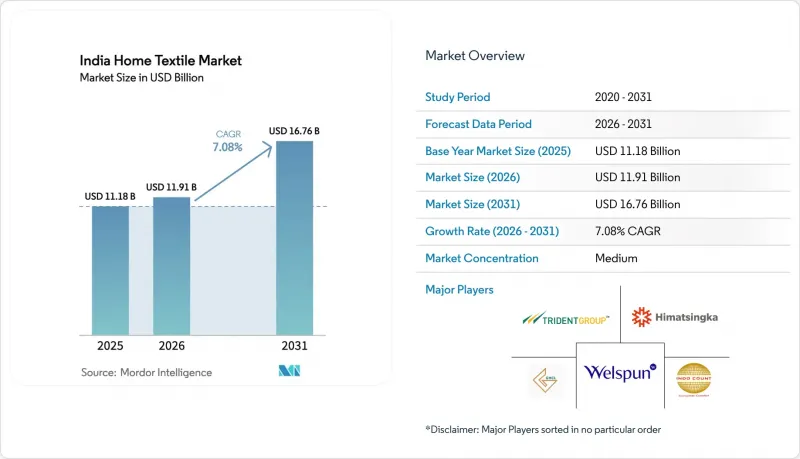
This report is Segmented by Application (Bed Linen, Bath Linen, Kitchen Linen, and More), Material (Cotton, Linen, Synthetic Fibres, Other Materials), End-User (Residential, Commercial), Distribution Channel (Offline, Online), and Geography (North, West, South, East India). The Market Forecasts are Provided in Terms of Value (USD).
India Home Textile Market Trends and Insights
Rising middle-class spending power and rapid urban migration
Per-capita net national income advanced to FY24 at INR 188,892 and projected to rise further to INR 205,324 for FY25. Urban households now allocate 4.2% of monthly spending to home furnishings versus 3.1% in 2020, and the Ministry of Housing projects urbanization will hit 40% by 2030, adding 60 million households. Branded products steadily replace unbranded bazaar offerings as first-time buyers migrate toward higher thread counts and durable finishes, shrinking the replacement cycle for bed linen from five to three years. Domestic retailers confirm that premium cotton and blended fabrics now attract consumers from middle-income bands seeking elevated aesthetics and hygiene benefits. This demand recalibration incentivizes mills to run finer cotton counts and invest in automated quality checks to maintain consistent texture and colorfastness.
Accelerating e-commerce adoption and omnichannel retail expansion
Online home-textile sales crossed INR 8,500 crore (USD 993.7 million) in 2024, realizing a 28% year-on-year increase as unified payments surpassed 131 billion transactions, lowering checkout friction. Amazon and Flipkart added more than 50,000 SKUs from 1,200 sellers, using dynamic pricing to lift average order value by 18%. Welspun India's direct-to-consumer portal synchronizes inventory across 200 stores to support same-day pickup, trimming cart abandonment by 15%. Quick-commerce platforms now deliver towels and sheets in 10 minutes across Bengaluru, Mumbai, and Delhi, compressing replenishment cycles and forcing incumbents to rethink last-mile strategies. These tech-enabled channels provide real-time demand signals that help mills adjust loom schedules and reduce finished-goods inventory.
Volatile cotton prices and broader raw-material inflation squeezing margins
Cotton prices spiked to INR 62,000 (USD 724.8) per candy in March 2024, an 18% rise since December 2023. The minimum support price for medium-staple cotton increased to INR 7,020 (USD 82.1) per quintal for the 2024-25 season, squeezing gross margins by up to 300 basis points. Polyester staple fiber averaged INR 95 (USD 1.11) per kilogram in 2024, a 12% year-on-year hike that compounded cost pressure. To mitigate volatility, manufacturers shift toward 60% cotton-40% polyester blends that reduce raw-material expenses by roughly 15%. Futures hedging and longer-term contracts offer partial insulation but remain underutilized among SMEs.
Other drivers and restraints analyzed in the detailed report include:
- "China + 1" sourcing shift boosting India's export orders from US & EU buyers
- PLI scheme and PM-MITRA mega textile parks lowering capital intensity
- Uncertain tariffs and trade policies in key Western markets clouding export flows
For complete list of drivers and restraints, kindly check the Table Of Contents.
Segment Analysis
The India home textile market by application was led by bed linen, accounting for 53.77% of the total market share in 2025. This was driven by strong replacement demand from urban households, stable export orders to the United States and European Union retailers, and a preference for premium products with higher thread counts. Hospitality chains boosted demand by shortening replacement cycles, while government initiatives like the One District One Product scheme promoted unique hand-loom designs.
Bed linen is projected to be the fastest-growing segment during 2026 - 2031, with a CAGR of 8.21%. Growth will be supported by increased adoption of branded labels among middle-income households, digital campaigns highlighting sustainability, and the expansion of direct-to-consumer channels. These factors ensure bed linen remains a key market segment and a primary growth driver across residential and hospitality applications.
Cotton accounted for 66.25% of the India home textile market size by material in 2025, driven by strong domestic production and consumer preference for its affordability and versatility. It remains central to domestic and export demand, supported by modernization under the Technology Upgradation Fund Scheme, enabling mills to produce finer counts. Synthetic fibers cater to price-sensitive households, while premiumization in bed and bath categories reinforces cotton's dominance.
Materials like wool, hemp, silk, jute, and bamboo are projected to grow at a CAGR of 10.29% during 2026 - 2031. Growth is fueled by rising sustainability awareness, water scarcity driving demand for linen alternatives, and the premium appeal of hemp and jute in urban markets. Bamboo viscose, marketed as bamboo linen, is gaining traction for its silky texture and biodegradability, while recycled polyester appeals to eco-conscious consumers. These niche fibers are diversifying the market and aligning with global sustainability trends.
Complete Report Scope:
- By Application
- Bed Linen
- Bath Linen
- Kitchen Linen
- Upholstery
- Carpets & Area Rugs
- By Material
- Cotton
- Linen
- Synthetic Fibres
- Other Materials (Wool, Hemp, Silk, Jute, Bamboo)
- By End-User
- Residential
- Commercial
- By Distribution Channel
- Offline
- Mass Merchandisers (Hypermarkets/Supermarkets)
- Home Centers
- Specialty Stores
- Other Distribution Channels
- Online
- Offline
- By Region
- North India
- West India
- South India
- East India
List of Companies Covered in this Report:
- Welspun India Ltd.
- Trident Group
- Indo Count Industries Ltd.
- Himatsingka Seide Ltd.
- GHCL Ltd.
- The Bombay Dyeing & Mfg. Co. Ltd.
- Raymond Home (Raymond Ltd.)
- Alok Industries Ltd.
- Dicitex Furnishings
- Creative Portico (Pvt.) Ltd.
- Fabindia Overseas Pvt. Ltd.
- Maspar Industries Pvt. Ltd.
- Spread Home Products Pvt. Ltd.
- Vardhman Textiles Ltd.
- Arvind Ltd. (Arvind Home)
- Swayam India
- Sarita Handa Exports Pvt. Ltd.
- IKEA India
- KPR Mill Ltd
- D'Decor Home Fabrics Pvt. Ltd.
Additional Benefits:
- The market estimate (ME) sheet in Excel format
- 3 months of analyst support
TABLE OF CONTENTS
1 Introduction
- 1.1 Study Assumptions & Market Definition
- 1.2 Scope of the Study
2 Research Methodology
3 Executive Summary
4 Market Landscape
- 4.1 Market Overview
- 4.2 Market Drivers
- 4.2.1 Rising middle-class spending power and rapid urban migration
- 4.2.2 Accelerating e-commerce adoption and omnichannel retail expansion
- 4.2.3 "China + 1" sourcing shift boosting India's export orders from US & EU buyers
- 4.2.4 PLI scheme and PM-MITRA mega textile parks lowering capital intensity
- 4.2.5 Eco-friendly & smart-textile innovations lifting average selling prices
- 4.2.6 Rapid hotel and serviced-apartment expansion swelling institutional linen demand
- 4.3 Market Restraints
- 4.3.1 Volatile cotton prices and broader raw-material inflation squeezing margins
- 4.3.2 Uncertain tariffs and trade policies in key Western markets clouding export flows
- 4.3.3 Highly fragmented domestic supplier base causing inconsistent product quality
- 4.3.4 Stricter BIS quality norms elevating compliance costs for small manufacturers
- 4.4 Industry Value Chain Analysis
- 4.5 Porter's Five Forces Analysis
- 4.5.1 Threat of New Entrants
- 4.5.2 Bargaining Power of Suppliers
- 4.5.3 Bargaining Power of Buyers
- 4.5.4 Threat of Substitutes
- 4.5.5 Industry Rivalry
- 4.6 Insights into the Latest Trends and Innovations in the Market
- 4.7 Insights on Recent Developments (New Product Launches, Strategic Initiatives, Investments, Partnerships, JVs, Expansion, M&As, etc.) in the Market
5 Market Size & Growth Forecasts (Value in USD)
- 5.1 By Application
- 5.1.1 Bed Linen
- 5.1.2 Bath Linen
- 5.1.3 Kitchen Linen
- 5.1.4 Upholstery
- 5.1.5 Carpets & Area Rugs
- 5.2 By Material
- 5.2.1 Cotton
- 5.2.2 Linen
- 5.2.3 Synthetic Fibres
- 5.2.4 Other Materials (Wool, Hemp, Silk, Jute, Bamboo)
- 5.3 By End-User
- 5.3.1 Residential
- 5.3.2 Commercial
- 5.4 By Distribution Channel
- 5.4.1 Offline
- 5.4.1.1 Mass Merchandisers (Hypermarkets/Supermarkets)
- 5.4.1.2 Home Centers
- 5.4.1.3 Specialty Stores
- 5.4.1.4 Other Distribution Channels
- 5.4.2 Online
- 5.4.1 Offline
- 5.5 By Region
- 5.5.1 North India
- 5.5.2 West India
- 5.5.3 South India
- 5.5.4 East India
6 Competitive Landscape
- 6.1 Market Concentration
- 6.2 Strategic Moves
- 6.3 Market Share Analysis
- 6.4 Company Profiles (includes Global level Overview, Market level overview, Core Segments, Financials as available, Strategic Information, Market Rank/Share for key companies, Products & Services, and Recent Developments)
- 6.4.1 Welspun India Ltd.
- 6.4.2 Trident Group
- 6.4.3 Indo Count Industries Ltd.
- 6.4.4 Himatsingka Seide Ltd.
- 6.4.5 GHCL Ltd.
- 6.4.6 The Bombay Dyeing & Mfg. Co. Ltd.
- 6.4.7 Raymond Home (Raymond Ltd.)
- 6.4.8 Alok Industries Ltd.
- 6.4.9 Dicitex Furnishings
- 6.4.10 Creative Portico (Pvt.) Ltd.
- 6.4.11 Fabindia Overseas Pvt. Ltd.
- 6.4.12 Maspar Industries Pvt. Ltd.
- 6.4.13 Spread Home Products Pvt. Ltd.
- 6.4.14 Vardhman Textiles Ltd.
- 6.4.15 Arvind Ltd. (Arvind Home)
- 6.4.16 Swayam India
- 6.4.17 Sarita Handa Exports Pvt. Ltd.
- 6.4.18 IKEA India
- 6.4.19 KPR Mill Ltd
- 6.4.20 D'Decor Home Fabrics Pvt. Ltd.
7 Market Opportunities & Future Outlook
- 7.1 Sustainability certifications (GOTS, OEKO-TEX) unlocking premium export segments

