PUBLISHER: Mordor Intelligence | PRODUCT CODE: 2115230

PUBLISHER: Mordor Intelligence | PRODUCT CODE: 2115230
Germany Home Textile - Market Share Analysis, Industry Trends & Statistics, Growth Forecasts (2026 - 2031)
According to Mordor Intelligence, the Germany home textile market size is expected to grow from USD 6.61 billion in 2025 to USD 6.87 billion in 2026 and is forecast to reach USD 8.3 billion by 2031 at 3.87% CAGR over 2026-2031.
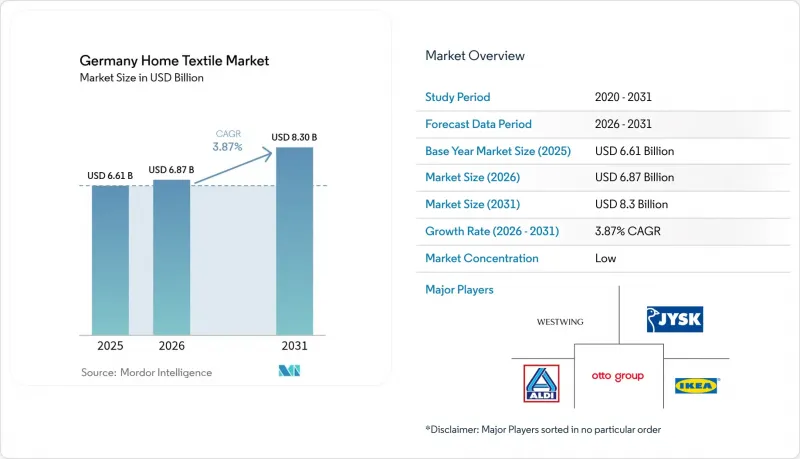
This report is Segmented by Application (Bed Linen, Bath Linen, Kitchen Linen, Upholstery, Carpets & Area Rugs), Material (Cotton, Linen, Synthetic Fibres, Other Materials), End-User (Residential, Commercial), Distribution Channel (B2C/Retail Channels, B2B/Direct From Manufacturers), and Geography (North Germany, South Germany, and More). The Market Forecasts are Provided in Terms of Value (USD).
Germany Home Textile Market Trends and Insights
E-commerce Penetration & Omnichannel Retail Acceleration
Germany's high-speed connectivity and mature logistics network allow retailers to serve almost every household within two days, a capability that underpins the Germany home textile market's rising online conversion ratio. Weekly online shopping now involves 39% of adults, and furniture-focused portals report double-digit traffic spikes after livestream product launches . Brick-and-click formats prove effective because shoppers prefer to compare textile hand-feel in stores yet check colorways or stock online, pushing chains to fund RFID-enabled showrooms that sync inventories in real time. Larger players absorb the tech outlay; small manufacturers without fulfillment software face visibility setbacks. As digital engagement broadens, differentiated storytelling around sustainable sourcing and smart-home integration keeps margins from eroding in a competitive pricing climate.
Government-backed Energy-saving Subsidies for Smart/Shading Textiles
Building regulations that mandate tighter energy envelopes encourage homeowners to add motorized blinds and thermally efficient draperies eligible for BEG rebates. BAFA reports that applications for shading system subsidies climbed 18% year over year, a trend that diverts spending toward value-added window coverings Source: BAFA, "Guidelines for Energy-Efficient Building Subsidies," bafa.de. Textile mills partner with motor drives and sensor firms, embedding conductive yarns to enable automatic daylight adjustment. Because these products qualify for both energy and ESG labels, retailers can justify premiums even during broader cost-of-living strains. The alignment with Germany's 2045 carbon-neutrality target assures long-running support, creating a structural lift for the Germany home textile market beyond normal replacement cycles.
Volatile Cotton & Energy Prices Pressuring Manufacturer Margins
Spot cotton quotations swung 28% within six months of 2024, forcing mills to juggle hedging and surcharges that retailers often resist . Germany's electricity tariffs, still among Europe's highest, add another squeeze, especially for energy-heavy weaving and finishing lines. Producers accelerate photovoltaic rooftop projects and heat-recovery systems to blunt cost spikes, yet payback stretches beyond SME cash tolerances. Some resort to near-shoring in Czechia or Turkiye, altering supply chain geography and diluting domestic value capture for the Germany home textile market. Until input volatility stabilizes, mid-tier brands may trim SKU diversity to conserve working capital.
Other drivers and restraints analyzed in the detailed report include:
- Hospitality & Serviced-apartment Pipeline Rebound
- Sustainability-driven Demand for Certified Organic & Recycled Fibres
- Weak Consumer Furniture Spend Amid Cost-of-living Squeeze
For complete list of drivers and restraints, kindly check the Table Of Contents.
Segment Analysis
Bed linen retained leadership with 35.02% of Germany home textile market share in 2025, underpinning category stability through its essential-purchase status and wide price ladder. High-thread-count cotton and linen blends dominate premium tiers, while private-label microfiber sets cater to budget shoppers. Seasonal color refreshes and bundled pillowcase promotions sustain repeat sales, yet competitive saturation limits price hikes, prompting brands to upsell coordinated comforters and protectors.
Bath linen, meanwhile, is projected to expand at a 4.48% CAGR through 2031, the fastest among applications. German consumers equate plush towels and robes with wellness, and antimicrobial, quick-dry technologies justify double-digit price premiums. Online searches for "bamboo bath towel" climbed 23% between Q4 2024 and Q2 2025, signifying substitution potential. Hotels adopt heavier-grammage robes that endure 250 wash cycles, broadening commercial volume. Together, these dynamics keep both leading and fastest-growing segments pivotal to the Germany home textile market size trajectory.
Cotton supplied 52.12% of the Germany home textile market size in 2025, yet modal, hemp, and recycled polyester fabrics collectively register greater momentum. Fiber innovators promote TENCEL(TM) Lyocell bedding that repels bacteria better than conventional cotton, winning favor among allergy-prone households. GOTS-certified organic cotton still outperforms conventional cotton in value terms because traceability justifies a premium, cushioning producers from raw-cotton volatility. Smart-textile research institutes, including TITV Greiz, embed conductive yarns into wool blends, expanding use into climate-adaptive curtains. Altogether, material choice becomes a key brand differentiator rather than a behind-the-label detail.
Cotton mills respond by adopting regenerative agriculture contracts to maintain relevance, integrating rain-fed farming claims into marketing narratives. Blended fabrics exploiting hemp's tensile strength and bamboo's softness appear in bathrobes and nursery textiles, widening the eco-luxury offering. European Commission draft rules promoting recycled content lend further weight to synthetics that incorporate post-consumer PET bottles. The Germany home textile market thus evolves from single-fiber dominance to a portfolio of specialized materials, each mapped to health or environmental gains.
Complete Report Scope:
- By Application
- Bed Linen
- Bath Linen
- Kitchen Linen
- Upholstery
- Carpets & Area Rugs
- By Material
- Cotton
- Linen
- Synthetic Fibres
- Other Materials (Wool, Hemp, Silk, Jute, Bamboo)
- By End-User
- Residential
- Commercial
- By Distribution Channel
- B2C/Retail Channels
- Mass Merchandisers (Hypermarkets/Supermarkets)
- Home Centers
- Specialty Stores
- Local Mom and Pop Stores
- Online
- Other Distribution Channels
- B2B/Direct from the Manufacturers
- B2C/Retail Channels
- By Region
- North Germany
- South Germany
- East Germany
- West Germany
- Central Germany
List of Companies Covered in this Report:
- ALDI (Sud & Nord)
- IKEA Deutschland
- Otto Group
- Westwing Group SE
- Home24 SE
- XXXLutz Deutschland
- Jysk Germany
- Lidl (Stiftung)
- H&M Home Germany
- Zara Home Germany
- Billerbeck Bettwaren
- Cotonea (Elmer & Zweifel)
- Living Crafts
- Peyer Syntex
- Hopke Textiles
- Gebruder Munzert
- Curt Bauer
- Betten Reiter
- Naturedeco
- Smartblinds DACH
Additional Benefits:
- The market estimate (ME) sheet in Excel format
- 3 months of analyst support
TABLE OF CONTENTS
1 Introduction
- 1.1 Study Assumptions & Market Definition
- 1.2 Scope of the Study
2 Research Methodology
3 Executive Summary
4 Market Landscape
- 4.1 Market Overview
- 4.2 Market Drivers
- 4.2.1 E-commerce penetration & omnichannel retail acceleration
- 4.2.2 Government-backed energy-saving subsidies for smart/shading textiles
- 4.2.3 Hospitality & serviced-apartment pipeline rebound
- 4.2.4 Sustainability-driven demand for certified organic & recycled fibres
- 4.2.5 Ageing-in-place renovations boosting functional/anti-allergen bedding
- 4.2.6 Adoption of smart/IoT-enabled blinds & curtains for convenience & ESG
- 4.3 Market Restraints
- 4.3.1 Volatile cotton & energy prices pressuring manufacturer margins
- 4.3.2 Weak consumer furniture spend amid cost-of-living squeeze
- 4.3.3 Stricter EU traceability/DPP rules raising compliance costs for SMEs
- 4.3.4 Hotel sector's below-EU ADR dampening short-term linen CAPEX
- 4.4 Industry Value Chain Analysis
- 4.5 Porter's Five Forces Analysis
- 4.5.1 Threat of New Entrants
- 4.5.2 Bargaining Power of Suppliers
- 4.5.3 Bargaining Power of Buyers
- 4.5.4 Threat of Substitutes
- 4.5.5 Industry Rivalry
- 4.6 Insights into the Latest Trends and Innovations in the Market
- 4.7 Insights on Recent Developments (New Product Launches, Strategic Initiatives, Investments, Partnerships, JVs, Expansion, M&As, etc.) in the Market
5 Market Size & Growth Forecasts (Value in USD)
- 5.1 By Application
- 5.1.1 Bed Linen
- 5.1.2 Bath Linen
- 5.1.3 Kitchen Linen
- 5.1.4 Upholstery
- 5.1.5 Carpets & Area Rugs
- 5.2 By Material
- 5.2.1 Cotton
- 5.2.2 Linen
- 5.2.3 Synthetic Fibres
- 5.2.4 Other Materials (Wool, Hemp, Silk, Jute, Bamboo)
- 5.3 By End-User
- 5.3.1 Residential
- 5.3.2 Commercial
- 5.4 By Distribution Channel
- 5.4.1 B2C/Retail Channels
- 5.4.1.1 Mass Merchandisers (Hypermarkets/Supermarkets)
- 5.4.1.2 Home Centers
- 5.4.1.3 Specialty Stores
- 5.4.1.4 Local Mom and Pop Stores
- 5.4.1.5 Online
- 5.4.1.6 Other Distribution Channels
- 5.4.2 B2B/Direct from the Manufacturers
- 5.4.1 B2C/Retail Channels
- 5.5 By Region
- 5.5.1 North Germany
- 5.5.2 South Germany
- 5.5.3 East Germany
- 5.5.4 West Germany
- 5.5.5 Central Germany
6 Competitive Landscape
- 6.1 Market Concentration
- 6.2 Strategic Moves
- 6.3 Market Share Analysis
- 6.4 Company Profiles (includes Global level Overview, Market level overview, Core Segments, Financials as available, Strategic Information, Market Rank/Share for key companies, Products & Services, and Recent Developments)
- 6.4.1 ALDI (Sud & Nord)
- 6.4.2 IKEA Deutschland
- 6.4.3 Otto Group
- 6.4.4 Westwing Group SE
- 6.4.5 Home24 SE
- 6.4.6 XXXLutz Deutschland
- 6.4.7 Jysk Germany
- 6.4.8 Lidl (Stiftung)
- 6.4.9 H&M Home Germany
- 6.4.10 Zara Home Germany
- 6.4.11 Billerbeck Bettwaren
- 6.4.12 Cotonea (Elmer & Zweifel)
- 6.4.13 Living Crafts
- 6.4.14 Peyer Syntex
- 6.4.15 Hopke Textiles
- 6.4.16 Gebruder Munzert
- 6.4.17 Curt Bauer
- 6.4.18 Betten Reiter
- 6.4.19 Naturedeco
- 6.4.20 Smartblinds DACH
7 Market Opportunities & Future Outlook
- 7.1 Technical Textiles Expanding Residential Applications
- 7.2 Strong Preference for Organic Cotton Products

