PUBLISHER: Mordor Intelligence | PRODUCT CODE: 2122976

PUBLISHER: Mordor Intelligence | PRODUCT CODE: 2122976
China Home Textile - Market Share Analysis, Industry Trends & Statistics, Growth Forecasts (2026 - 2031)
According to Mordor Intelligence, the China home textile market size was valued at USD 43.24 billion in 2025 and estimated to grow from USD 45.91 billion in 2026 to reach USD 61.94 billion by 2031, at a CAGR of 6.18% during the forecast period (2026-2031).
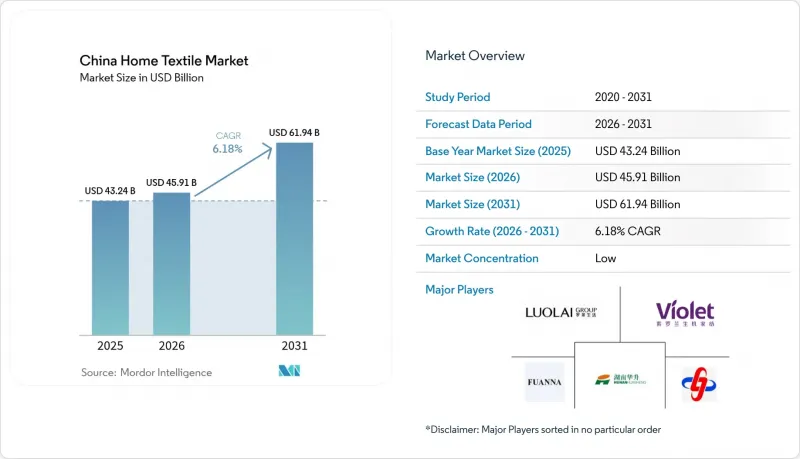
This report is Segmented by Application (Bed Linen, Bath Linen, Kitchen Linen, Upholstery, Others), Material (Cotton, Linen, Synthetic Fibres, Other Materials), End-User (Residential, Commercial), Distribution Channel (Offline, Online), and Geography (East China, South-Central China, North & Northeast China, Southwest China, Northwest China). The Market Forecasts are Provided in Terms of Value (USD).
China Home Textile Market Trends and Insights
Rising Disposable Incomes & Urbanization Drive Premium Segment Expansion
Urban household spending on furnishings has grown faster than national income, especially in tier-2 and tier-3 cities, where new apartments foster first-time purchases of coordinated textile sets. Younger buyers prioritize aesthetics and sleep quality, lifting demand for premium thread counts, organic cotton, and branded matching collections. This consumer shift elongates replacement cycles into seasonal refreshes, generating recurrent revenue streams for suppliers. Retailers respond by curating themed bedroom bundles and limited-edition color palettes. The ongoing influx of rural workers into urban areas sustains baseline volume growth, anchoring the Chinese home textile market at both value and mass-market price points.
E-Commerce Platform Revolution Reshapes Distribution Dynamics
Online channels already contribute more than one-third of sales, and live-streaming, augmented-reality "try-on" apps, and same-day fulfillment now blur the line between discovery and purchase. Marketplaces such as Tmall and JD.com leverage behavioral data to micro-target shoppers with personalized style feeds and dynamic discounting. Direct-to-consumer brands exploit this infrastructure to sidestep legacy wholesalers, allowing them to release micro-collections weekly. For suppliers, these data loops slash forecasting errors and inventory write-downs, improving working-capital efficiency while broadening geographic reach into lower-tier cities. As rural broadband coverage widens, incremental e-commerce penetration still offers at least a decade of upside.
Cotton Price Volatility Creates Input Cost Pressures
ICE cotton futures swung to four-year lows in early 2025 after tariff escalations, yet freight bottlenecks and quality disparities between Xinjiang stocks and imported yarn keep mill procurement unpredictable. Mills hedge with synthetic or blended yarns, but substitution raises re-engineering costs and can dilute brand positioning in premium cotton lines. Financial volatility forces smaller spinners to operate on razor-thin margins, curbing R&D budgets and delaying equipment upgrades. Government stock-release mechanisms provide some stability but cannot fully offset global price swings, making cost pass-through to consumers unavoidable in the near term.
Other drivers and restraints analyzed in the detailed report include:
- Government Sustainability Mandates Accelerate Green Manufacturing Adoption
- Digital Design & AI-Driven Production Enable Mass Customization
- Xinjiang Sourcing Restrictions Force Supply-Chain Restructuring
For complete list of drivers and restraints, kindly check the Table Of Contents.
Segment Analysis
Bed linen accounted for 44.52% of the China home textile market size in 2025, buoyed by multiple-set ownership, seasonal refresh cycles, and increasing preference for organic cotton and higher thread counts. Upmarket brands bundle pillowcases, duvet covers, and fitted sheets to raise average selling prices and encourage coordinated bedroom aesthetics. Wellness marketing links sleep quality to breathable fabrics and accelerates premiumization within this category. Industry players also experiment with antimicrobial finishes and phase-change cooling fibers to differentiate beyond design and color.
Carpets and area rugs, though comprising a smaller revenue base, are projected to register an 8.45% CAGR through 2031-the fastest among all applications-as urban apartment dwellers adopt Western-style decor and demand sound-absorbing floor coverings. Platform-enabled "room-in-a-box" kits often include complementary rugs, driving cross-category pull-through. Innovations in stain-resistant yarns and modular tile configurations elevate ease of cleaning and simplify replacement, making rugs more attractive for families with young children or pets. Commercial builders add further momentum by specifying flame-retardant carpet tiles that qualify for green-building credits.
Cotton maintained 48.93% of China home textile market share in 2025 due to its established supply chain and consumer familiarity. However, sustainability-oriented shoppers now scrutinize water consumption and pesticide use in cotton farming, pushing brands to source organic certificates or blend in recycled cotton. Polyester and other synthetics secure footholds in performance-driven segments through moisture-wicking, wrinkle-free, and quick-dry attributes, particularly for hospitality linens that require frequent laundering. These blends also temper cost spikes during cotton-price surges.
In the China home textile market, bamboo and other niche naturals are expected to expand at an 10.84% CAGR to 2031, capitalizing on antibacterial properties, soft hand feel, and storytelling appeal around renewable agriculture. Government subsidies for bamboo pulp and lower-emission viscose processing reduce raw-material premiums, making eco-certified SKUs more price-competitive. Hemp, jute, and silk likewise benefit from policy incentives and premium positioning, though limited farming acreage keeps their volume share modest. Across materials, brands increasingly adopt digital traceability tags to reassure consumers about provenance and processing practices.
Complete Report Scope:
- By Application
- Bed Linen
- Bath Linen
- Kitchen Linen
- Upholstery
- Others (Carpets and Area Rugs)
- By Material
- Cotton
- Linen
- Synthetic Fibres
- Other Materials (Wool, Hemp, Silk, Jute, Bamboo etc.)
- By End-User
- Residential
- Commercial
- By Distribution Channel
- Offline
- Online
- By Geography
- East China
- South-Central China
- North and Northeast China
- Southwest China
- Northwest China
List of Companies Covered in this Report:
- Luolai Lifestyle Technology Co., Ltd.
- Shenzhen Fuanna Bedding and Furnishing Co., Ltd.
- Hunan Mengjie Home Textile Co., Ltd.
- Violet Home Textile Co., Ltd.
- Ningbo Veken Elite Group Co., Ltd.
- Beyond Home Textile Co., Ltd.
- Yuyue Home Textile Co., Ltd.
- Shuixing Home Textile Co., Ltd.
- Shanghai Shuixing Home Fashion Co., Ltd.
- Jiangsu Royal Home USA Inc. (Nantong)
- Jiangsu Soho International Group
- Sunvim Group Co., Ltd.
- Welspun Group (China operations)
- Trident Group (China distribution)
- Milliken and Company (China floor coverings)
- Pinduoduo / Temu (platform)
- Alibaba/Tmall (platform)
- JD.com (platform)
- IKEA China
- Muji China
- H&M Home China
Additional Benefits:
- The market estimate (ME) sheet in Excel format
- 3 months of analyst support
TABLE OF CONTENTS
1 Introduction
- 1.1 Study Assumptions and Market Definition
- 1.2 Scope of the Study
2 Research Methodology
3 Executive Summary
4 Market Landscape
- 4.1 Market Overview
- 4.2 Market Drivers
- 4.2.1 Rising disposable incomes and urbanisation
- 4.2.2 Expansion of e-commerce and omni-channel retail
- 4.2.3 Government push for sustainable fibres and green manufacturing
- 4.2.4 Digital design and AI-driven on-demand production
- 4.2.5 Domestic tourism-led hotel linen upgrade cycle
- 4.2.6 Break-through functional textiles (e.g., Y-Warm nano-insulation)
- 4.3 Market Restraints
- 4.3.1 Volatile cotton prices and supply-chain shocks
- 4.3.2 Rising labour and compliance costs
- 4.3.3 Forced-labour / Xinjiang-related sourcing restrictions
- 4.3.4 Tier-1 city market saturation and price wars
- 4.4 Value / Supply-Chain Analysis
- 4.5 Regulatory Landscape
- 4.6 Technological Outlook
- 4.7 Porter's Five Forces
- 4.7.1 Threat of New Entrants
- 4.7.2 Bargaining Power of Suppliers
- 4.7.3 Bargaining Power of Buyers
- 4.7.4 Threat of Substitutes
- 4.7.5 Competitive Rivalry
5 Market Size and Growth Forecasts
- 5.1 By Application
- 5.1.1 Bed Linen
- 5.1.2 Bath Linen
- 5.1.3 Kitchen Linen
- 5.1.4 Upholstery
- 5.1.5 Others (Carpets and Area Rugs)
- 5.2 By Material
- 5.2.1 Cotton
- 5.2.2 Linen
- 5.2.3 Synthetic Fibres
- 5.2.4 Other Materials (Wool, Hemp, Silk, Jute, Bamboo etc.)
- 5.3 By End-User
- 5.3.1 Residential
- 5.3.2 Commercial
- 5.4 By Distribution Channel
- 5.4.1 Offline
- 5.4.2 Online
- 5.5 By Geography
- 5.5.1 East China
- 5.5.2 South-Central China
- 5.5.3 North and Northeast China
- 5.5.4 Southwest China
- 5.5.5 Northwest China
6 Competitive Landscape
- 6.1 Market Concentration
- 6.2 Strategic Moves
- 6.3 Market Share Analysis
- 6.4 Company Profiles {(includes Global level Overview, Market level overview, Core Segments, Financials as available, Strategic Information, Market Rank/Share for key companies, Products and Services, and Recent Developments)}
- 6.4.1 Luolai Lifestyle Technology Co., Ltd.
- 6.4.2 Shenzhen Fuanna Bedding and Furnishing Co., Ltd.
- 6.4.3 Hunan Mengjie Home Textile Co., Ltd.
- 6.4.4 Violet Home Textile Co., Ltd.
- 6.4.5 Ningbo Veken Elite Group Co., Ltd.
- 6.4.6 Beyond Home Textile Co., Ltd.
- 6.4.7 Yuyue Home Textile Co., Ltd.
- 6.4.8 Shuixing Home Textile Co., Ltd.
- 6.4.9 Shanghai Shuixing Home Fashion Co., Ltd.
- 6.4.10 Jiangsu Royal Home USA Inc. (Nantong)
- 6.4.11 Jiangsu Soho International Group
- 6.4.12 Sunvim Group Co., Ltd.
- 6.4.13 Welspun Group (China operations)
- 6.4.14 Trident Group (China distribution)
- 6.4.15 Milliken and Company (China floor coverings)
- 6.4.16 Pinduoduo / Temu (platform)
- 6.4.17 Alibaba/Tmall (platform)
- 6.4.18 JD.com (platform)
- 6.4.19 IKEA China
- 6.4.20 Muji China
- 6.4.21 H&M Home China
7 Market Opportunities and Future Outlook
- 7.1 3D-knitted personalised bedding for same-day delivery
- 7.2 Carbon-neutral bamboo-fibre curtain range for green-certified buildings

