PUBLISHER: Mordor Intelligence | PRODUCT CODE: 2115096

PUBLISHER: Mordor Intelligence | PRODUCT CODE: 2115096
United Kingdom Home Textile - Market Share Analysis, Industry Trends & Statistics, Growth Forecasts (2026 - 2031)
According to Mordor Intelligence, the United Kingdom home textile market size is expected to grow from USD 7.62 billion in 2025 to USD 7.75 billion in 2026 and is forecast to reach USD 8.46 billion by 2031 at 1.76% CAGR over 2026-2031.
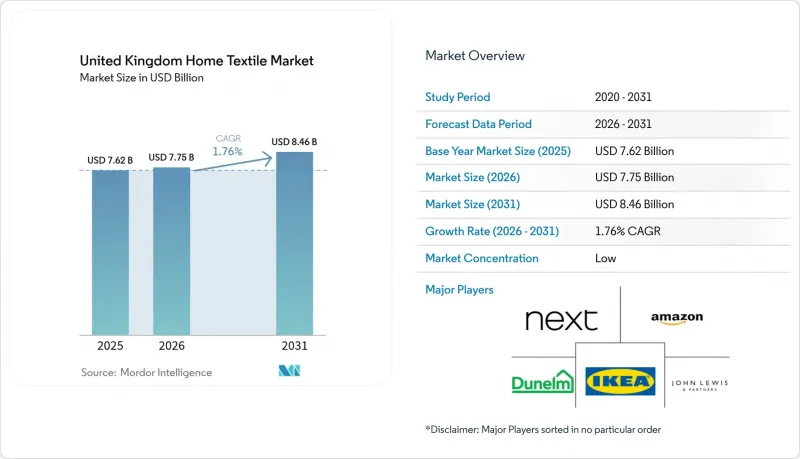
This report is Segmented by Application (Bed Linen, Bath Linen, Kitchen Linen, Upholstery, Others), Material (Cotton, Linen, Synthetic Fibers, Other Materials), End-User (Residential, Commercial), Distribution Channel (Offline, Online), and Geography (England, Scotland, Wales, Northern Ireland). The Market Forecasts are Provided in Terms of Value (USD).
United Kingdom Home Textile Market Trends and Insights
Millennials' Wellness and "Home Sanctuary" Focus Reshapes Purchasing Priorities
Millennials prioritize sleep quality, mental well-being, and cohesive interior aesthetics, elevating demand for temperature-regulating duvet covers, hypoallergenic sheets, and coordinated decor collections. United Kingdom household spending data show higher discretionary outlays on home comfort among under-40 cohorts, confirming a structural shift toward premium-priced textiles perceived as health investments. Persistent hybrid-work patterns sustain time spent at home, reinforcing willingness to upgrade functional bedding. Brands that combine soothing color palettes with functional finishes such as antimicrobial or moisture-wicking treatments are benefiting from repeat purchases. Subscription-based refresh programs for linens are also gaining traction among young professionals who value convenience and hygiene assurances.
E-commerce and Social-Commerce Penetration Accelerates Channel Transformation
Online participation in clothing and home categories at leading retailers reached 33% in 2024 and continues to rise as high-quality product imagery, virtual room visualizers, and frictionless returns overcome tactile barriers . Influencer-led product drops on Instagram and TikTok now account for a growing share of decorative-textile sales, encouraging agile collections and limited-run collaborations. Parcel-shop pickup and same-day click-and-collect options anchor omnichannel convenience, while last-mile carbon reporting appeals to sustainability-minded shoppers. Smaller direct-to-consumer labels leverage targeted ads and drop-shipping to enter the United Kingdom home textile market quickly, squeezing legacy chains that must reconcile store overheads with online price transparency.
Cost-of-Living Squeeze Dampening Discretionary Spend Pressures Volume Growth
Persistent inflation and rising mortgage payments compel households to defer non-essential textile purchases. ONS expenditure tables highlight year-on-year declines in decorative cushion and throw sales, with shoppers concentrating activity around promotional events. Value retailers that offer smaller pack sizes and buy-now-pay-later options are absorbing share from mid-market brands. Consequently, revenue mixes tilt toward staple SKUs, forcing merchants to upgrade pricing analytics and markdown discipline to protect profit.
Other drivers and restraints analyzed in the detailed report include:
- Sustainability-Led Material Substitution Drives Innovation and Premium Positioning
- Hospitality Refurbishment Cycles Ahead of United Kingdom Tourism Push Generate Commercial Demand
- Volatile Cotton and Freight Costs Create Margin Pressure and Planning Challenges
For complete list of drivers and restraints, kindly check the Table Of Contents.
Segment Analysis
Bed linen maintained 45.92% of the United Kingdom home textile market share in 2025, underpinned by non-negotiable hygiene replacement cycles. Yet the smart bedding subsegment is forecast to record an 8.48% CAGR, reflecting rising appetite for phase-change, moisture-wicking, and sensor-enabled sleep solutions. Overall, United Kingdom home textile market size gains in this category stem from professional couples and older adults seeking measurable health benefits, encouraging retailers to bundle pillows, protectors, and connected lighting for subscription deliveries. Bath linen registered steady replenishment demand bolstered by hotel renovations, while kitchen textile volumes benefited from sustained home-cooking habits established during pandemic lockdowns. Carpet and rug sales diverged: premium wool pieces advanced via artisan channels, whereas price-led synthetic rugs faced heavy discounting in warehouse clubs.
Rapid smart-bedding growth foreshadows the gradual erosion of the traditional bed-linen share. Product development pipelines increasingly feature convertible to designs and naturally derived antimicrobial finishes, driving average ticket values up. Suppliers with proprietary technology partnerships or R&D alliances capture first-mover advantage. Meanwhile, compliance with OEKO-TEX and United Kingdom fire-safety norms remains non-negotiable, preserving entry barriers for differentiated innovators.
Cotton contributed 65.79% of the United Kingdom home textile market share in 2025, benefiting from consumer familiarity, skin comfort, and product breadth. Nevertheless, bamboo-hemp blends are projected for a 9.64% CAGR, leveraging low water footprints and fast growth cycles to appeal to eco-conscious shoppers. Linen is also regaining favor among premium consumers seeking relaxed aesthetics and higher durability, while mechanically recycled polyester retains relevance for price-competitiveness and easy-care properties. Rising certification costs and erratic cotton pricing motivate retailers to diversify fiber portfolios; the resulting choice of architecture empowers shoppers to trade up for tangible sustainability credentials. Meryl Fabrics' zero-microfiber-shedding nylon demonstrates how synthetic innovations can coexist with natural-fiber evolution .
Fiber substitution alone is not sufficient. Retailers increasingly pair classic cotton weaves with proprietary antimicrobial or thermo-adaptive coatings, creating premium offers without forcing radical consumer learning curves. Such hybrid propositions preserve cotton's emotional resonance while unlocking incremental margin.
Complete Report Scope:
- By Application
- Bed Linen
- Bath Linen
- Kitchen Linen
- Upholstery
- Others (Carpets and Area Rugs)
- By Material
- Cotton
- Linen
- Synthetic Fibers
- Other Materials (Wool, Hemp, Silk, Jute, Bamboo etc.)
- By End-User
- Residential
- Commercial
- By Distribution Channel
- Offline
- Online
- By Geography
- England
- Scotland
- Wales
- Northern Ireland
List of Companies Covered in this Report:
- Dunelm Group plc
- IKEA (UK)
- NEXT plc
- John Lewis and Partners
- Marks and Spencer
- Amazon (UK Home and Kitchen)
- Wayfair UK
- B&M Home
- The Range
- Home Bargains
- Matalan
- Laura Ashley
- Christy (Welspun UK)
- Silentnight Group
- Slumberdown
- Soak and Sleep
- Piglet in Bed
- Secret Linen Store
- Tekla
- Sheridan (Hanover Direct UK)
Additional Benefits:
- The market estimate (ME) sheet in Excel format
- 3 months of analyst support
TABLE OF CONTENTS
1 Introduction
- 1.1 Study Assumptions and Market Definition
- 1.2 Scope of the Study
2 Research Methodology
3 Executive Summary
4 Market Landscape
- 4.1 Market Overview
- 4.2 Market Drivers
- 4.2.1 Millennials' wellness and "home sanctuary" focus
- 4.2.2 E-commerce and social-commerce penetration
- 4.2.3 Sustainability-led material substitution (organic cotton, bamboo)
- 4.2.4 Hospitality refurb cycles ahead of UK tourism push (2025-26)
- 4.2.5 Duty-free UK access for Pakistani/Indian linens under DCTS
- 4.2.6 Smart and antimicrobial fabrics for health-conscious consumers
- 4.3 Market Restraints
- 4.3.1 Cost-of-living squeeze dampening discretionary spend
- 4.3.2 Volatile cotton and freight costs
- 4.3.3 UK fire-safety compliance costs (BS 5867, BS 7176)
- 4.3.4 Brexit-related customs friction for EU suppliers
- 4.4 Value / Supply-Chain Analysis
- 4.5 Regulatory Landscape
- 4.6 Technological Outlook
- 4.7 Porter's Five Forces
- 4.7.1 Threat of New Entrants
- 4.7.2 Bargaining Power of Suppliers
- 4.7.3 Bargaining Power of Buyers
- 4.7.4 Threat of Substitutes
- 4.7.5 Competitive Rivalry
5 Market Size and Growth Forecasts
- 5.1 By Application
- 5.1.1 Bed Linen
- 5.1.2 Bath Linen
- 5.1.3 Kitchen Linen
- 5.1.4 Upholstery
- 5.1.5 Others (Carpets and Area Rugs)
- 5.2 By Material
- 5.2.1 Cotton
- 5.2.2 Linen
- 5.2.3 Synthetic Fibers
- 5.2.4 Other Materials (Wool, Hemp, Silk, Jute, Bamboo etc.)
- 5.3 By End-User
- 5.3.1 Residential
- 5.3.2 Commercial
- 5.4 By Distribution Channel
- 5.4.1 Offline
- 5.4.2 Online
- 5.5 By Geography
- 5.5.1 England
- 5.5.2 Scotland
- 5.5.3 Wales
- 5.5.4 Northern Ireland
6 Competitive Landscape
- 6.1 Market Concentration
- 6.2 Strategic Moves
- 6.3 Market Share Analysis
- 6.4 Company Profiles (includes Global level Overview, Market level overview, Core Segments, Financials as available, Strategic Information, Market Rank/Share for key companies, Products and Services, and Recent Developments)
- 6.4.1 Dunelm Group plc
- 6.4.2 IKEA (UK)
- 6.4.3 NEXT plc
- 6.4.4 John Lewis and Partners
- 6.4.5 Marks and Spencer
- 6.4.6 Amazon (UK Home and Kitchen)
- 6.4.7 Wayfair UK
- 6.4.8 B&M Home
- 6.4.9 The Range
- 6.4.10 Home Bargains
- 6.4.11 Matalan
- 6.4.12 Laura Ashley
- 6.4.13 Christy (Welspun UK)
- 6.4.14 Silentnight Group
- 6.4.15 Slumberdown
- 6.4.16 Soak and Sleep
- 6.4.17 Piglet in Bed
- 6.4.18 Secret Linen Store
- 6.4.19 Tekla
- 6.4.20 Sheridan (Hanover Direct UK)
7 Market Opportunities and Future Outlook
- 7.1 Circular take-back and repair services for linens
- 7.2 Smart temperature-regulating bedding bundles

