PUBLISHER: Mordor Intelligence | PRODUCT CODE: 2114410

PUBLISHER: Mordor Intelligence | PRODUCT CODE: 2114410
India Waste Management - Market Share Analysis, Industry Trends & Statistics, Growth Forecasts (2026 - 2031)
According to Mordor Intelligence, the India waste management market size was valued at USD 13.58 billion in 2025 and is estimated to grow from USD 14.29 billion in 2026 to reach USD 18.94 billion by 2031, at a CAGR of 5.80% during the forecast period (2026-2031).
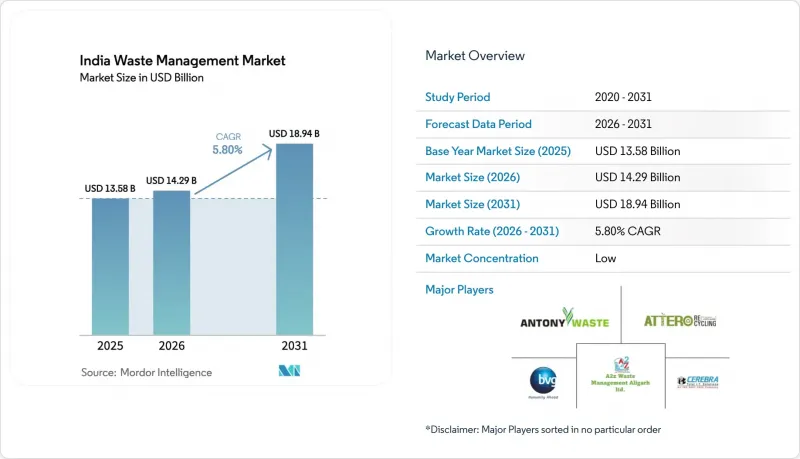
This report is Segmented by Source (Residential, Commercial, Industrial, and More), by Service Type (Collection, Transportation, Sorting & Segregation and More), by Waste Type (Municipal Solid Waste, Industrial Hazardous Waste, E-Waste, Plastic Waste, and More), and by Region (North India, South India, West India, East India and Central India). The Market Forecasts are Provided in Terms of Value (USD).
India Waste Management Market Trends and Insights
15th Finance Commission Grants Unlock USD 18 billion for Municipal SWM
Disbursements covering collection vehicles, mechanized sweepers, and materials-recovery facilities are accelerating PPP bids in cities such as Mumbai, Delhi, and Indore. Performance-linked conditions tied to segregation and landfill diversion are forcing municipalities to adopt digital monitoring. Land-acquisition delays capped first-year utilization at 58%, yet the grant program still contributes +1.3% to overall CAGR in the short term.
National Circular Economy Framework 2025 Mandates Corporate Recycling Targets
Companies with annual turnover above INR 500 crore must recycle at least 30% of packaging waste and 50% of electronic products by 2028, with even stricter 95% battery-mass recovery targets for vehicle manufacturers. Brand owners are increasingly entering multi-year offtake contracts with organized recyclers to hedge against virgin-resin price swings and to secure auditable compliance. Implementation success depends on certified capacity and timely penalties; nevertheless, the framework sets a clear compliance pathway and adds roughly +1.1% to sector CAGR over the forecast horizon.
Source-Segregation Plateau
Mandatory household segregation into wet, dry, and hazardous waste categories remains largely aspirational, with the national rate stuck below 35% in 2025. Poor civic awareness, weak enforcement, and patchy door-to-door coverage degrade feedstock quality, slashing resale value for recyclables and raising contamination costs for composters. Pilot incentives such as property-tax rebates in Karnataka show localized success but have yet to scale nationally. Unless municipalities adopt real-time monitoring and levy penalties, the sub-optimal segregation will shave -0.8% off forecast CAGR.
Other drivers and restraints analyzed in the detailed report include:
- Enforcement of Plastic Waste Management Amendment Rules 2024 & Single-Use-Plastic Ban
- FAME-III Battery EPR Rules Bring 50 GWh End-of-Life Li-ion by 2026
- NIMBY Litigation Against WtE Plants
For complete list of drivers and restraints, kindly check the Table Of Contents.
Segment Analysis
Residential sources accounted for 48.83% of India's waste management market revenue in 2025, although commercial volumes can eclipse residential volumes in many tier-1 business districts. Rising organized retail floor space and office complex densification in tier-2 cities are producing larger, more predictable waste streams. Commercial clients typically lock in multiyear service contracts at gate fees of USD 27 - 46 per tonne, compared with USD 10-15 for household waste, making this customer segment attractive to private operators. Collection routing is further optimized through RFID-tagged bins and GPS-enabled compactor trucks, cutting fuel cost and improving turnaround time. Aided by these dynamics, commercial waste volumes are estimated to grow at an 8.6% CAGR to 2031, outpacing the baseline expansion of residential streams.
Developers of shopping malls and business parks increasingly integrate on-site segregation rooms and balers, enhancing feedstock quality for downstream recyclers. Quick-commerce "dark stores" and last-mile delivery hubs are adopting closed-loop packaging, adding additional recyclable cardboard and plastics to formal networks. Operators such as Antony Waste Handling Cell expanded their commercial footprint by 28% in 2025, acquiring new contracts from large retail chains and corporate campuses, reinforcing revenue visibility. On balance, the commercial segment's higher margin profile and contractual stickiness position it as the prime growth engine within the India waste management market.
Complete Report Scope:
- By Source
- Residential
- Commercial (retail, office, etc.)
- Industrial
- Medical (Health and Pharmaceutical)
- Construction & Demolition
- Others (institutional, agricultural, etc)
- By Service Type
- Collection, Transportation, Sorting & Segregation
- Disposal / Treatment
- Landfill
- Recycling & Resource Recovery
- Incineration & Waste-to-Energy
- Others (Chemical Treatment, Composting, etc.)
- Others (Consulting, Audit & Training, etc.)
- By Waste Type
- Municipal Solid Waste
- Industrial Hazardous Waste
- E-waste
- Plastic Waste
- Biomedical Waste
- Construction & Demolition Waste
- Agricultural Waste
- Other Specialized Waste (radio active, etc)
- By Region
- North India
- South India
- West India
- East India
- Central India
List of Companies Covered in this Report:
- A2Z Green Waste Management Ltd
- Antony Waste Handling Cell Ltd
- Attero Recycling Pvt Ltd
- BVG India Ltd
- Cerebra Integrated Technologies Ltd
- Ecogreen Energy Pvt Ltd
- Ecowise Waste Management Pvt Ltd
- Exigo Recycling Pvt Ltd
- Hanjer Biotech Energies Pvt Ltd
- Hydroair Tectonics (PCD) Ltd
- IL&FS Environmental Infrastructure & Services Ltd
- Jindal ITF Urban Infrastructure Ltd
- NEPRA Resource Management Pvt Ltd
- Ramky Enviro Engineers Ltd
- Recykal (Rapidue Technologies)
- Saahas Zero Waste
- Spak Green Enviro Pvt Ltd
- Tatva Global Environment Ltd
- Waste Ventures India Pvt Ltd
- Zonta Infratech Pvt Ltd
Additional Benefits:
- The market estimate (ME) sheet in Excel format
- 3 months of analyst support
TABLE OF CONTENTS
1 Introduction
- 1.1 Study Assumptions & Market Definition
- 1.2 Scope of the Study
2 Research Methodology
3 Executive Summary
4 Market Landscape
- 4.1 Market Overview
- 4.2 Market Drivers
- 4.2.1 Enforcement of Plastic Waste Management (Amendment) Rules 2024 & single-use plastic ban
- 4.2.2 National Circular Economy Framework 2025 mandates corporate recycling targets
- 4.2.3 FAME-III battery EPR rules bring ~50 GWh end-of-life Li-ion by 2026
- 4.2.4 15th Finance Commission grants unlock ?1.5 trn ULB capex for SWM 2025-26
- 4.2.5 Agri-biomass-to-bioCNG subsidies (SATAT 2.0) spur rural organic-waste valorization
- 4.2.6 Zero-e-waste commitments from hyperscale data-centers drive premium recycling contracts
- 4.3 Market Restraints
- 4.3.1 Source-segregation plateau, national average below 35 % in 2025
- 4.3.2 NIMBY litigation stalls 280 MW planned WtE capacity in 2025
- 4.3.3 Carbon-credit price slump (Less than ₹ 600/tCO2e) erodes RDF co-processing revenues
- 4.3.4 Ammonia-rich mixed food waste corrodes AD plants, raising O&M more than 15 %
- 4.4 Value / Supply-Chain Analysis
- 4.5 Regulatory Outlook
- 4.6 Technological Outlook (AI, IoT, Robotics, WtE)
- 4.7 Logistics Infrastructure & Development Analysis
- 4.8 Industry Attractiveness - Porter's Five Force Analysis
- 4.8.1 Threat of New Entrants
- 4.8.2 Bargaining Power of Suppliers
- 4.8.3 Bargaining Power of Buyers
- 4.8.4 Threat of Substitutes
- 4.8.5 Intensity of Competitive Rivalry
- 4.9 Investment & Funding Analysis
5 Market Size & Growth Forecasts (Values In USD Billion)
- 5.1 By Source
- 5.1.1 Residential
- 5.1.2 Commercial (retail, office, etc.)
- 5.1.3 Industrial
- 5.1.4 Medical (Health and Pharmaceutical)
- 5.1.5 Construction & Demolition
- 5.1.6 Others (institutional, agricultural, etc)
- 5.2 By Service Type
- 5.2.1 Collection, Transportation, Sorting & Segregation
- 5.2.2 Disposal / Treatment
- 5.2.2.1 Landfill
- 5.2.2.2 Recycling & Resource Recovery
- 5.2.2.3 Incineration & Waste-to-Energy
- 5.2.2.4 Others (Chemical Treatment, Composting, etc.)
- 5.2.3 Others (Consulting, Audit & Training, etc.)
- 5.3 By Waste Type
- 5.3.1 Municipal Solid Waste
- 5.3.2 Industrial Hazardous Waste
- 5.3.3 E-waste
- 5.3.4 Plastic Waste
- 5.3.5 Biomedical Waste
- 5.3.6 Construction & Demolition Waste
- 5.3.7 Agricultural Waste
- 5.3.8 Other Specialized Waste (radio active, etc)
- 5.4 By Region
- 5.4.1 North India
- 5.4.2 South India
- 5.4.3 West India
- 5.4.4 East India
- 5.4.5 Central India
6 Competitive Landscape
- 6.1 Market Concentration
- 6.2 Strategic Moves
- 6.3 Market Share Analysis
- 6.4 Company Profiles (includes Global level Overview, Market level overview, Core Segments, Financials as available, Strategic Information, Products & Services, Recent Developments)
- 6.4.1 A2Z Green Waste Management Ltd
- 6.4.2 Antony Waste Handling Cell Ltd
- 6.4.3 Attero Recycling Pvt Ltd
- 6.4.4 BVG India Ltd
- 6.4.5 Cerebra Integrated Technologies Ltd
- 6.4.6 Ecogreen Energy Pvt Ltd
- 6.4.7 Ecowise Waste Management Pvt Ltd
- 6.4.8 Exigo Recycling Pvt Ltd
- 6.4.9 Hanjer Biotech Energies Pvt Ltd
- 6.4.10 Hydroair Tectonics (PCD) Ltd
- 6.4.11 IL&FS Environmental Infrastructure & Services Ltd
- 6.4.12 Jindal ITF Urban Infrastructure Ltd
- 6.4.13 NEPRA Resource Management Pvt Ltd
- 6.4.14 Ramky Enviro Engineers Ltd
- 6.4.15 Recykal (Rapidue Technologies)
- 6.4.16 Saahas Zero Waste
- 6.4.17 Spak Green Enviro Pvt Ltd
- 6.4.18 Tatva Global Environment Ltd
- 6.4.19 Waste Ventures India Pvt Ltd
- 6.4.20 Zonta Infratech Pvt Ltd
7 Market Opportunities & Future Outlook
- 7.1 White-space & Unmet-need Assessment

