PUBLISHER: Mordor Intelligence | PRODUCT CODE: 2114943

PUBLISHER: Mordor Intelligence | PRODUCT CODE: 2114943
Europe Floor Covering - Market Share Analysis, Industry Trends & Statistics, Growth Forecasts (2026 - 2031)
According to Mordor Intelligence, the Europe floor covering market size is estimated at USD 4.29 billion in 2026, and is expected to reach USD 5.12 billion by 2031, at a CAGR of 3.61% during the forecast period (2026-2031).
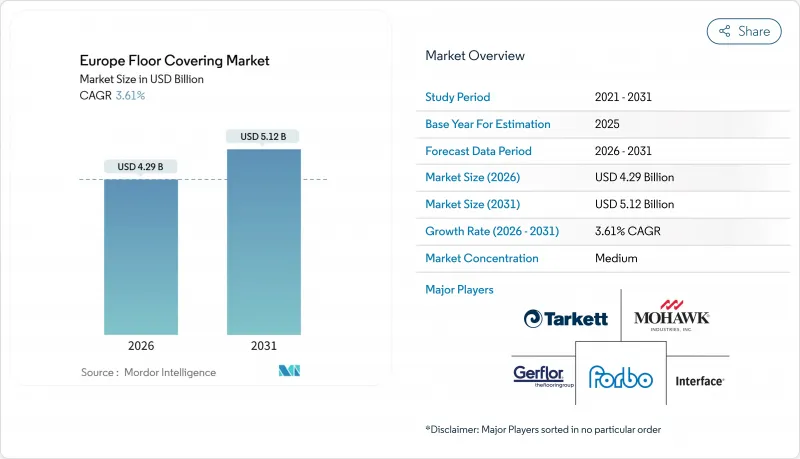
This report Segments by Product Type (Carpet and Rugs, Wood Flooring, and More), by Construction Type (New Construction, Remodeling/Retrofit), by End-Use Sector (Residential, Commercial), Distribution Channel (Specialty Flooring Stores, Home-Improvement Centers, and More), and Geography. Market Forecasts are Provided in Terms of Value (USD).
Europe Floor Covering Market Trends and Insights
EU "Renovation Wave" Stimulating Retro-Fit Demand in Germany, France, and Italy
The Energy Performance of Buildings Directive aligns the region toward deep renovation outcomes and requires minimum performance standards to lift the worst energy classes, which converts flooring components into compliance-critical elements in retrofit scopes. Buildings account for a large share of energy use and emissions in the region; therefore, measures such as floor insulation and acoustic underlayment move from optional to expected where thermal gains are measured at the building level. Germany's multi-year renovation ambition catalyzes demand for moisture-resistant subfloors and rigid, resilient products that can meet acoustic targets without complex assemblies. France's subsidy framework that supports compliant low-emission installations redirects purchases toward engineered formats with verified emission claims. This environment shifts procurement toward multi-attribute specifications, where performance, embodied carbon, and verifiable declarations are evaluated together in public and commercial tenders.
Shift to Circular Materials under EU Green Deal Raising Demand for Recyclable Flooring
Public-sector tenders in the Nordics and Benelux incorporate recycled-content weighting and documented pathways for material recovery, which strengthens demand for flooring that can be disassembled and retrieved at the end of life. The Ecodesign for Sustainable Products Regulation and the revised Construction Products Regulation extend product-level requirements and environmental declarations, making EPDs and material passports central to market access and bid eligibility. Sector initiatives prove the viability of recycling methods for PVC and elevate post-consumer content in backings without performance loss, which supports circular procurement. Manufacturers respond with bio-based and climate-positive ranges, including linoleum lines with agricultural byproducts and high biogenic carbon storage documented across the life cycle. These policies and practices weave circularity into product design and procurement decisions and lift the appeal of closed-loop programs in the European floor covering market.
Other drivers and restraints analyzed in the detailed report include:
- Rapid Penetration of LVT and SPC in Western Europe Driven by DIY Retail Chains
- Growth of Hybrid Work Models Triggering Office Re-Design Cycles in the Nordics and Benelux
- Soaring European Gas and Electricity Prices Inflating Ceramic and Kiln-Fired Tile Costs
- Skilled Installer Shortages in the EU Labor Market Delaying Large-Scale Fit-outs
For complete list of drivers and restraints, kindly check the Table Of Contents.
Segment Analysis
Ceramic tiles held 51.38% of the European floor covering market share in 2025, leading in Southern Europe. Growth has slowed in renovation-driven markets favoring faster installation and lower embodied energy. Vinyl flooring is expected to grow at a 7.65% CAGR through 2031, supported by rigid-core formats meeting acoustic, hygiene, and underfloor heating needs without extensive subfloor work. Resilient flooring with enhanced embossing and antimicrobial layers has expanded into healthcare, education, and food service sectors, where cleaning protocols and indoor air standards are critical. Low-emission adhesives and restricted-VOC lists further drive adoption of loose-lay and click-fit systems in residential remodels, addressing installer shortages and project delays. These trends position resilient flooring as a key growth segment, aligning with renovation budgets and compliance requirements.
Waterproof laminate and engineered wood remain competitive for residential upgrades, valued for acoustic underlayment and indoor air quality claims. Innovations in recycled content, take-back programs, and verified EPDs enhance public-sector eligibility. Rubber and linoleum flooring, backed by life cycle data, attract education and healthcare buyers seeking durable, low-maintenance, and environmentally friendly options. Investments in European resilient flooring capacity and digital printing technology improve availability, lead times, and regional aesthetic alignment, supporting compliance with emission and circularity standards.
Remodeling and retrofit held a 64.44% market share in 2025, driven by policies and financing frameworks targeting upgrades to existing buildings. These efforts emphasize minimum performance standards and energy labeling. New construction is expected to grow at a 9.63% CAGR through 2031, addressing housing shortages in urban areas. Retrofits focus on flooring products with low emissions, acoustic performance, and underfloor heating compatibility to enhance comfort and energy efficiency. Low-profile resilient options are ideal for heritage buildings, minimizing floor elevation changes and avoiding door or threshold modifications. These preferences support faster installation and compliance with European floor covering market requirements.
Underfloor heating and efficient building services in new housing influence demand for dimensionally stable surfaces and thermally rated adhesives. Rigid-core resilient flooring and engineered wood with verified emission performance are preferred for balancing comfort and maintenance. Expanding environmental reporting obligations, such as life cycle declarations, affects product selection to ensure market access and faster permitting. Procurement teams prioritize recovery options to improve circularity ratios, aligning with updated construction product guidelines. These factors shape finishing choices and direct supply toward compliant systems in the European floor covering market.
Complete Report Scope:
- By Product Type
- Carpet and Area Rugs
- Wood Flooring
- Ceramic Tiles Flooring
- Laminate Flooring
- Vinyl Flooring
- Stone Flooring
- Other Products
- By Construction Type
- New Construction
- Remodelling/Retrofit
- By End-User
- Residential
- Commercial
- Hospitality & Leisure
- Retail & Shopping Centers
- Healthcare Facilities
- Education
- Corporate Offices
- Public & Government Buildings
- Other Commercial Users
- By Distribution Channel
- B2C Retail
- Home Centres
- Specialty Flooring Stores
- Online
- Other Distribution Channels
- B2B / Contractors / Builders
- B2C Retail
- By Geography (Europe)
- United Kingdom
- Germany
- France
- Spain
- Italy
- BENELUX (Belgium, Netherlands, Luxembourg)
- NORDICS (Denmark, Finland, Iceland, Norway, Sweden)
- Rest of Europe
List of Companies Covered in this Report:
- Mohawk Industries Inc.
- Tarkett Group
- Forbo Holding AG
- Gerflor Group
- Interface Inc.
- Shaw Industries Group
- Beaulieu International Group
- Armstrong Flooring
- UNILIN (Quick-Step, Pergo)
- BerryAlloc NV
- Egger Group
- Kahrs Group
- Parador GmbH
- Balta Group
- Ege Carpets A/S
- Victoria PLC
- Karndean Designflooring
- LG Hausys Europe
- Responsive Industries Ltd.
- BSW Timber Ltd.
Additional Benefits:
- The market estimate (ME) sheet in Excel format
- 3 months of analyst support
TABLE OF CONTENTS
1 Introduction
- 1.1 Study Assumptions & Market Definition
2 Research Methodology
3 Executive Summary
4 Market Landscape
- 4.1 Market Overview
- 4.2 Market Drivers
- 4.2.1 EU Renovation Wave boosting retrofit in Germany, France, Italy
- 4.2.2 Circular materials under the EU Green Deal favour recyclable flooring
- 4.2.3 DIY-led penetration of LVT and SPC in Western Europe
- 4.2.4 Hybrid work model driving office redesign in Nordics and Benelux
- 4.2.5 Healthcare infrastructure expansion in CEE is lifting resilient flooring
- 4.2.6 Premium upgrades in the United Kingdom homes are raising engineered wood adoption
- 4.3 Market Restraints
- 4.3.1 Elevated European gas and power costs are raising ceramic and kiln costs
- 4.3.2 Tight VOC norms are increasing carpet compliance costs
- 4.3.3 Installer shortages are delaying large fit-outs
- 4.3.4 Volatile timber supply from Russia and Belarus is disrupting wood chains
- 4.4 Industry Valye Chain Analysis
- 4.5 Porter's Five Forces
- 4.5.1 Threat of New Entrants
- 4.5.2 Bargaining Power of Suppliers
- 4.5.3 Bargaining Power of Buyers
- 4.5.4 Threat of Substitutes
- 4.5.5 Intensity of Rivalry
- 4.6 Insights into the Latest Trends and Innovations in the Market
- 4.7 Insights on Recent Developments (New Product Launches, Strategic Initiatives, Investments, Partnerships, JVs, Expansion, M&As, etc.) in the Market
5 Market Size & Growth Forecasts (Value)
- 5.1 By Product Type
- 5.1.1 Carpet and Area Rugs
- 5.1.2 Wood Flooring
- 5.1.3 Ceramic Tiles Flooring
- 5.1.4 Laminate Flooring
- 5.1.5 Vinyl Flooring
- 5.1.6 Stone Flooring
- 5.1.7 Other Products
- 5.2 By Construction Type
- 5.2.1 New Construction
- 5.2.2 Remodelling/Retrofit
- 5.3 By End-User
- 5.3.1 Residential
- 5.3.2 Commercial
- 5.3.2.1 Hospitality & Leisure
- 5.3.2.2 Retail & Shopping Centers
- 5.3.2.3 Healthcare Facilities
- 5.3.2.4 Education
- 5.3.2.5 Corporate Offices
- 5.3.2.6 Public & Government Buildings
- 5.3.2.7 Other Commercial Users
- 5.4 By Distribution Channel
- 5.4.1 B2C Retail
- 5.4.1.1 Home Centres
- 5.4.1.2 Specialty Flooring Stores
- 5.4.1.3 Online
- 5.4.1.4 Other Distribution Channels
- 5.4.2 B2B / Contractors / Builders
- 5.4.1 B2C Retail
- 5.5 By Geography (Europe)
- 5.5.1 United Kingdom
- 5.5.2 Germany
- 5.5.3 France
- 5.5.4 Spain
- 5.5.5 Italy
- 5.5.6 BENELUX (Belgium, Netherlands, Luxembourg)
- 5.5.7 NORDICS (Denmark, Finland, Iceland, Norway, Sweden)
- 5.5.8 Rest of Europe
6 Competitive Landscape
- 6.1 Market Concentration
- 6.2 Strategic Moves
- 6.3 Market Share Analysis
- 6.4 Company Profiles {(includes Global level Overview, Market level overview, Core Segments, Financials as available, Strategic Information, Market Rank/Share for key companies, Products & Services, and Recent Developments)}
- 6.4.1 Mohawk Industries Inc.
- 6.4.2 Tarkett Group
- 6.4.3 Forbo Holding AG
- 6.4.4 Gerflor Group
- 6.4.5 Interface Inc.
- 6.4.6 Shaw Industries Group
- 6.4.7 Beaulieu International Group
- 6.4.8 Armstrong Flooring
- 6.4.9 UNILIN (Quick-Step, Pergo)
- 6.4.10 BerryAlloc NV
- 6.4.11 Egger Group
- 6.4.12 Kahrs Group
- 6.4.13 Parador GmbH
- 6.4.14 Balta Group
- 6.4.15 Ege Carpets A/S
- 6.4.16 Victoria PLC
- 6.4.17 Karndean Designflooring
- 6.4.18 LG Hausys Europe
- 6.4.19 Responsive Industries Ltd.
- 6.4.20 BSW Timber Ltd.
- 6.5 Market Opportunities & Future Outlook
- 6.5.1 Renovation-Led Demand for Sustainable and Low-Carbon Flooring

