PUBLISHER: Mordor Intelligence | PRODUCT CODE: 2124212

PUBLISHER: Mordor Intelligence | PRODUCT CODE: 2124212
Japan Floor Covering - Market Share Analysis, Industry Trends & Statistics, Growth Forecasts (2026 - 2031)
According to Mordor Intelligence, the Japan floor covering market size is expected to grow from USD 2.77 billion in 2025 to USD 2.93 billion in 2026 and is forecast to reach USD 3.92 billion by 2031 at 5.97% CAGR over 2026-2031.
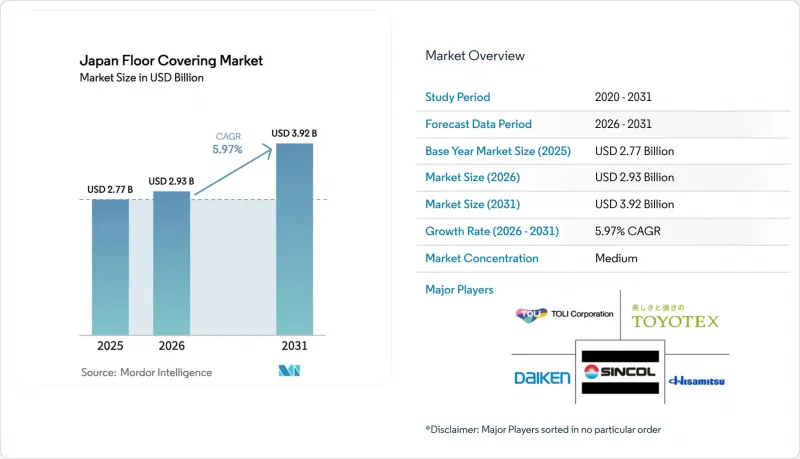
This report is Segmented by Product Type (Carpet & Area Rugs, Wood Flooring, Ceramic Tile, Laminate Flooring, Vinyl Flooring [LVT, Sheet, VCT], Stone Flooring, Other Products), End User (Residential, Commercial), Distribution Channel (B2C/Retail, B2B/Contractors), and Geography (Kanto, Kansai, Chubu, Rest of Japan). Market Forecasts are in Value (USD).
Japan Floor Covering Market Trends and Insights
Aging Housing-Stock Renovation Demand
Renovation-led demand has strengthened as policy and demographic realities channel investment from new builds into upgrades across major metros. MLIT data and government statistics confirm sustained periods of weakness in new housing starts through 2024 and into 2025, reinforcing the shift to stock enhancement programs that improve habitability and energy efficiency in existing homes and condos. Corporate filings reinforce this pivot, with large suppliers reporting rising renovation sales contribution as owners prioritize floor replacement during multi-room updates to consolidate contractor mobilization and limit disruptions. Long-term industry commentary cites a sizable cohort of homes constructed during the 1990s now entering replacement windows for floors and other interior systems, which aligns with standard lifecycle practices in Japan's housing stock. Public and private programs encourage barrier-free design and step-difference reduction as single-occupant and elderly households pursue safety-oriented upgrades that favor resilient surfaces and low-threshold transitions in living spaces. The Japan Floor Covering market benefits from this pattern because flooring replacement can be completed quickly with modular formats, enabling staged renovations while residents remain in place.
Large-Scale Infrastructure Refurbishments Tied to Osaka-Kansai Expo 2025
Government-led programs in Kansai achieved notable transit and access upgrades, with bridge works and a metro extension to the Yumeshima site completed on schedule, which helped trigger a wave of ancillary refurbishments in hospitality and commercial properties. Official statistics show pronounced volatility in Osaka housing activity in late 2025, including strong spikes that reflect pre-Expo and tourism-related investment, which lifts near-term demand for fast-turn flooring solutions in hotel corridors and public pavilions. Design choices at the Expo featured durable and modular surface systems to handle heavy foot traffic and condensed construction windows, providing a reference for product durability and installation speed in high-traffic settings. Post-Expo plans designate parts of Yumeshima for continued commercial use, extending the replacement cycle as permanent facilities complete fit-outs in 2026 and 2027. Regional spillovers into Kyoto, Kobe, and Nara sustain demand for compliant, resilient floors that meet local fire and VOC standards, supporting a multi-year uplift in the Japan Floor Covering market across western Japan.
Declining New Housing Starts in a Mature Construction Market
Government data confirm intermittent declines in national housing starts through late 2024 and into 2025, which constrains new-build demand for floor coverings in detached homes and condominiums. This macro headwind intensifies in rural prefectures that face sharper depopulation and lower replacement rates, creating divergent regional baselines for suppliers. Renovation activity in major metros offsets some of the decline, but the new-build pipeline remains thinner than earlier cycles. Public investment in refurbishments and infrastructure helps stabilize related commercial demand in select regions. The Japan Floor Covering market adapts by aligning sales emphasis with renovation-focused channels and by packaging fast-install systems that reduce time on site.
Other drivers and restraints analyzed in the detailed report include:
- Growing Uptake of Resilient Flooring in Healthcare and Senior-Care Facilities
- Consumer Shift Toward Eco-Friendly and Low-VOC Materials
- Volatility in PVC and Petrochemical Input Prices
For complete list of drivers and restraints, kindly check the Table Of Contents.
Segment Analysis
Vinyl flooring held 39.35% of 2025 product revenue, and Luxury Vinyl Tile is forecast to rise at an 8.39% CAGR through 2031, with wholesale figures showing robust value momentum in plastic flooring categories due to price revisions that offset softer shipment volumes. Strategic products within corporate portfolios, including modular carpet tiles and vinyl tiles, posted growth as contractors prioritized flexible and rapid installations during phased refurbishments that minimized downtime. Product catalogs emphasize low-VOC claims and recycling systems, with expansion of collection capacity for used carpet tiles and the horizontal recycling of special PVC backing, which supports ESG reporting for corporate buyers. Temporary supply suspensions following a supplier factory fire highlighted concentrated sourcing risk, but phased restoration timelines stabilized shipments over 2025, supporting recovery in vinyl sheet categories. The Japan Floor Covering market continues to rely on click-lock and other labor-saving innovations that reduce installation hours and support renovation rhythms across healthcare, hospitality, and residential replacement.
Carpet and area rugs remain significant in commercial settings, with wholesale values reflecting strong performance for domestic tufted tiles and ongoing preference for modular formats in offices and institutional corridors. Ceramic and porcelain tiles face more cautious use in high-seismic zones and multi-story retrofits that would require additional structural measures, which channels heavier usage to ground floors and areas where loads can be accommodated under code. Wood flooring maintains a design premium and thermal comfort appeal, and manufacturers highlight recycled and plantation substrates to satisfy procurement and sustainability thresholds, which guide choices in public and large private projects. Laminate serves cost-sensitive segments that demand improved moisture resistance, while stone remains a niche in luxury residential entryways and high-end hospitality. Overall, the Japan Floor Covering market shows a durable preference for resilient and modular categories that balance compliance, lifecycle, and installation efficiency.
Complete Report Scope:
- By Product Type
- Carpet & Area Rugs
- Wood Flooring
- Ceramic & Porcelain Tiles
- Laminate Flooring
- Vinyl Flooring ( LVT, Sheet, VCT)
- Stone Flooring
- Other Products
- By End User
- Residential
- Commercial
- Hospitality & Leisure
- Retail & Shopping Centers
- Healthcare Facilities
- Education
- Corporate Offices
- Public & Government Buildings
- Other Commercial Users
- By Distribution Channel
- B2C / Retail
- Home Centers
- Specialty Flooring Stores
- Online
- Other Distribution Channels
- B2B / Contractors
- B2C / Retail
- By Region
- Kanto
- Kansai
- Chubu
- Rest of Japan
List of Companies Covered in this Report:
- TOLI Corporation
- Sangetsu Corporation
- Suminoe Textile Co., Ltd.
- Daiken Corporation
- LIXIL Corporation
- Nitto Boseki Co., Ltd.
- Panasonic Housing Solutions Co., Ltd.
- Aica Kogyo Co., Ltd.
- Gerflor Group
- Tarkett S.A.
- Interface Inc.
- Armstrong Flooring Inc.
- Forbo Flooring Systems
- Tai Ping Carpets Japan
- Oriental Carpet Mills
- Yamada Carpets Co., Ltd.
- Shin-Nippon Chemical Co., Ltd. (vinyl flooring)
- Toyo Vinyl Corp.
- Maruhachi Mawata Co., Ltd.
- Nikken Lease Kogyo (modular carpet)
Additional Benefits:
- The market estimate (ME) sheet in Excel format
- 3 months of analyst support
TABLE OF CONTENTS
1 Introduction
- 1.1 Study Assumptions & Market Definition
- 1.2 Scope of the Study
2 Research Methodology
3 Executive Summary
4 Market Landscape
- 4.1 Market Overview
- 4.2 Market Drivers
- 4.2.1 Aging housing-stock renovation demand
- 4.2.2 Large-scale infrastructure refurbishments tied to Osaka-Kansai Expo 2025
- 4.2.3 Growing uptake of resilient flooring in healthcare & senior-care facilities
- 4.2.4 Consumer shift toward eco-friendly and low-VOC materials
- 4.2.5 Revival of tatami-look vinyl & hybrid floors
- 4.2.6 Emergence of smart, IoT-enabled flooring solutions
- 4.3 Market Restraints
- 4.3.1 Declining new housing starts in a mature construction market
- 4.3.2 Volatility in PVC & petrochemical input prices
- 4.3.3 Shortage of certified floor-installation labor
- 4.3.4 Seismic building codes limiting use of heavy tile & stone
- 4.4 Industry Value Chain Analysis
- 4.5 Regulatory Landscape
- 4.6 Porter's Five Forces
- 4.6.1 Threat of New Entrants
- 4.6.2 Bargaining Power of Suppliers
- 4.6.3 Bargaining Power of Buyers
- 4.6.4 Threat of Substitutes
- 4.6.5 Competitive Rivalry
- 4.7 Insights into the Latest Trends and Innovations in the Market
- 4.8 Insights into Recent Developments (New Product Launches, Strategic Initiatives, Investments, Partnerships, JVs, Expansion, M&As, etc.) in the Market
5 Market Size & Growth Forecasts
- 5.1 By Product Type
- 5.1.1 Carpet & Area Rugs
- 5.1.2 Wood Flooring
- 5.1.3 Ceramic & Porcelain Tiles
- 5.1.4 Laminate Flooring
- 5.1.5 Vinyl Flooring ( LVT, Sheet, VCT)
- 5.1.6 Stone Flooring
- 5.1.7 Other Products
- 5.2 By End User
- 5.2.1 Residential
- 5.2.2 Commercial
- 5.2.2.1 Hospitality & Leisure
- 5.2.2.2 Retail & Shopping Centers
- 5.2.2.3 Healthcare Facilities
- 5.2.2.4 Education
- 5.2.2.5 Corporate Offices
- 5.2.2.6 Public & Government Buildings
- 5.2.2.7 Other Commercial Users
- 5.3 By Distribution Channel
- 5.3.1 B2C / Retail
- 5.3.1.1 Home Centers
- 5.3.1.2 Specialty Flooring Stores
- 5.3.1.3 Online
- 5.3.1.4 Other Distribution Channels
- 5.3.2 B2B / Contractors
- 5.3.1 B2C / Retail
- 5.4 By Region
- 5.4.1 Kanto
- 5.4.2 Kansai
- 5.4.3 Chubu
- 5.4.4 Rest of Japan
6 Competitive Landscape
- 6.1 Market Concentration
- 6.2 Strategic Moves
- 6.3 Market Share Analysis
- 6.4 Company Profiles (includes Global level Overview, Market level overview, Core Segments, Financials as available, Strategic Information, Market Rank/Share for key companies, Products & Services, and Recent Developments)
- 6.4.1 TOLI Corporation
- 6.4.2 Sangetsu Corporation
- 6.4.3 Suminoe Textile Co., Ltd.
- 6.4.4 Daiken Corporation
- 6.4.5 LIXIL Corporation
- 6.4.6 Nitto Boseki Co., Ltd.
- 6.4.7 Panasonic Housing Solutions Co., Ltd.
- 6.4.8 Aica Kogyo Co., Ltd.
- 6.4.9 Gerflor Group
- 6.4.10 Tarkett S.A.
- 6.4.11 Interface Inc.
- 6.4.12 Armstrong Flooring Inc.
- 6.4.13 Forbo Flooring Systems
- 6.4.14 Tai Ping Carpets Japan
- 6.4.15 Oriental Carpet Mills
- 6.4.16 Yamada Carpets Co., Ltd.
- 6.4.17 Shin-Nippon Chemical Co., Ltd. (vinyl flooring)
- 6.4.18 Toyo Vinyl Corp.
- 6.4.19 Maruhachi Mawata Co., Ltd.
- 6.4.20 Nikken Lease Kogyo (modular carpet)
7 Market Opportunities & Future Outlook
- 7.1 Carbon-neutral, recycled-content flooring solutions
- 7.2 Modular carpet tiles for agile office re-layouts

