PUBLISHER: Mordor Intelligence | PRODUCT CODE: 2124245

PUBLISHER: Mordor Intelligence | PRODUCT CODE: 2124245
Germany Floor Covering - Market Share Analysis, Industry Trends & Statistics, Growth Forecasts (2026 - 2031)
According to Mordor Intelligence, the Germany floor covering market size was valued at USD 11.87 billion in 2025 and estimated to grow from USD 12.46 billion in 2026 to reach USD 15.88 billion by 2031, at a CAGR of 4.97% during the forecast period (2026-2031).
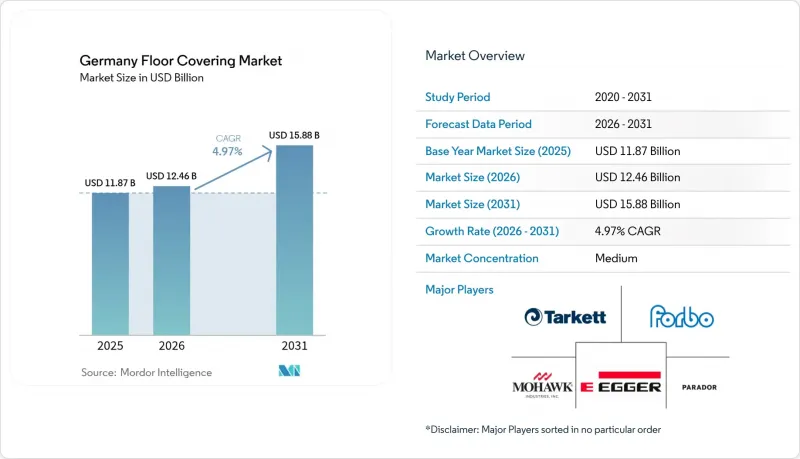
This report is Segmented by Product (Carpet and Area Rugs, Wood Flooring, Ceramic Tiles Flooring, Laminate Flooring, Vinyl Flooring, Stone Flooring, Other Products), End User (Commercial, Residential), Distribution Channel (Home Centers, and Other), and Geography (North Germany, and Other). The Market Forecasts are Provided in Terms of Value (USD).
Germany Floor Covering Market Trends and Insights
Re-urbanisation-led renovation wave in Tier-2 cities
Smaller German cities are experiencing a pronounced refurbishment upswing as young households migrate from rural districts, stimulating elevated replacement cycles in the Germany floor covering market . Property investors in Leipzig and Dresden prioritize fast-install LVT and laminate to shorten vacancy periods and meet the design expectations of digitally native tenants. The East German economy, although contracting 0.1% in 2024, shows flooring resilience because renovation outlays are less cyclical than new construction starts. Lower labor rates in these regions further improve project ROI, nudging landlords to upgrade surfaces sooner than depreciation schedules dictate. Manufacturers attuned to mid-market pricing and click-lock formats, therefore, gain a volume tailwind. The trend also diversifies geographic revenue streams, reducing suppliers' dependence on the mature South-West cluster.
Subsidized energy-efficient refurbishments under BEG program
The BEG framework grants 15-20% rebates on envelope upgrades, injecting fresh capital into flooring budgets and uplifting premium segments of the Germany floor covering market. Homeowners aiming for maximum subsidy increasingly specify materials compatible with underfloor heating, pushing engineered wood and high-density vinyl with certified thermal conductivity. Complementary tax deductions-20% of renovation spend spread across three years-further amplify payback for efficiency-oriented materials. Certification requirements elevate the role of branded suppliers, able to document emission levels and lifecycle performance. The program's short-term horizon concentrates demand into a two-year burst, allowing capable producers to lock in share gains ahead of eventual subsidy tapering. Installers, meanwhile, favor floating floors that speed project completion within tight grant deadlines.
Severe installer labor shortage
The Germany floor covering market contends with more than 15,000 vacancies across floor-related trades, lengthening project lead times and inflating labor costs by 7.9% in 2024 . Developers routinely wait six to eight weeks for certified crews, encouraging end users to gravitate toward DIY-friendly click-lock planks. Manufacturers exploit the gap through pre-finished surfaces and integrated underlays that compress installation windows. Training initiatives from trade associations are ramping up, but will take time to ease shortages. Consequently, volume upside in premium segments that demand expert fitting remains capped in the near term. Retailers mitigate disruption by curating vendor-certified installers and digital scheduling platforms to streamline workforce allocation.
Other drivers and restraints analyzed in the detailed report include:
- Growing demand for low-VOC and recyclable flooring
- Soaring hardwood input prices
For complete list of drivers and restraints, kindly check the Table Of Contents.
Segment Analysis
Wood flooring held 33.92% of the Germany floor covering market share in 2025, reflecting the material's perceived authenticity and lasting value in renovation projects. Vinyl/SPC-LVT, however, exhibits the strongest momentum with a 7.75% CAGR, underpinned by waterproof cores and rapid-click formats that appeal to both professionals and DIY consumers. The Germany floor covering market size allocated to ceramic tiles remains sizable in commercial realms, where durability and maintenance override softness. Laminate segments stabilize as digital print advancements close the realism gap with hardwood, while carpet retracts amid allergy concerns and cleaning effort. Manufacturers such as Windmoller push PVC-free bio-vinyl to reconcile performance with recycling mandates, and Tarkett's linoleum revival adds a natural, carbon-neutral alternative. Cross-category innovation centers on acoustic upgrades and integrated vapor barriers that broaden application scope.
Demand elasticity skews toward mid-priced engineered wood lines that minimize waste of premium timber and meet underfloor heating criteria. Vinyl developers focus on rigid, dent-resistant cores suited to high-traffic commercial environments yet visually aligned with residential aesthetics. Laminate producers invest in high-pressure overlay technologies that lift impact resistance and water tolerance, positioning the category against entry-level LVT. Stone and porcelain tile maintain niche appeal in luxury builds and public facilities, demanding high thermal mass for energy regulation. The product landscape, therefore, continues to fragment, giving multi-category vendors cross-selling advantages while allowing specialists to differentiate via sustainability credentials and advanced installation systems.
Complete Report Scope:
- By Product
- Carpet and Area Rugs
- Wood Flooring
- Ceramic Tiles Flooring
- Laminate Flooring
- Vinyl Flooring
- Stone Flooring
- Other Products
- By End User
- Commercial
- Residential
- By Distribution Channel
- Home Centers
- Flagship Stores
- Specialty Stores
- Online Stores
- Other Distribution Channels
- By Region Germany
- North Germany
- West Germany
- South Germany
- East Germany
List of Companies Covered in this Report:
- Tarkett S.A.
- Forbo Holding AG
- Interface Inc.
- Mohawk Industries Inc. (Unilin/Quick-Step)
- Armstrong Flooring Inc.
- Parador GmbH
- Egger Group
- MeisterWerke Schulte GmbH
- Classen Group
- Haro (Hamberger Flooring GmbH)
- Bauwerk Group
- Project Floors GmbH
- Gerflor SAS
- Swiss Krono Group
- Windmoller GmbH (Wineo)
- Vorwerk Teppichwerke
- Desso B.V. (Tarkett)
- Balta Group
- Sahco Hesslein GmbH
- Associated Weavers Europe NV
Additional Benefits:
- The market estimate (ME) sheet in Excel format
- 3 months of analyst support
TABLE OF CONTENTS
1 Introduction
- 1.1 Study Assumptions & Market Definition
- 1.2 Scope of the Study
2 Research Methodology
3 Executive Summary
4 Market Landscape
- 4.1 Market Overview
- 4.2 Market Drivers
- 4.2.1 Re-urbanisation-led renovation wave in Tier-2 German cities
- 4.2.2 Subsidised energy-efficient refurbishments under BEG programme
- 4.2.3 Growing demand for low-VOC and recyclable flooring
- 4.2.4 Spread of hybrid work is shrinking new-office demand (mainstream)
- 4.2.5 Post-COVID DIY boom boosting home-centre traffic (mainstream)
- 4.3 Market Restraints
- 4.3.1 Severe installer labour shortage
- 4.3.2 Soaring hardwood input prices
- 4.3.3 Sluggish residential permits after 2023 interest-rate hikes (mainstream)
- 4.3.4 Stringent EHS compliance costs for PVC flooring makers (mainstream)
- 4.4 Value / Supply-Chain Analysis
- 4.5 Regulatory Landscape
- 4.6 Technological Outlook
- 4.7 Porter's Five Forces
- 4.7.1 Threat of New Entrants
- 4.7.2 Bargaining Power of Suppliers
- 4.7.3 Bargaining Power of Buyers
- 4.7.4 Threat of Substitutes
- 4.7.5 Intensity of Rivalry
- 4.8 Pricing Analysis
5 Market Size & Growth Forecasts
- 5.1 By Product
- 5.1.1 Carpet and Area Rugs
- 5.1.2 Wood Flooring
- 5.1.3 Ceramic Tiles Flooring
- 5.1.4 Laminate Flooring
- 5.1.5 Vinyl Flooring
- 5.1.6 Stone Flooring
- 5.1.7 Other Products
- 5.2 By End User
- 5.2.1 Commercial
- 5.2.2 Residential
- 5.3 By Distribution Channel
- 5.3.1 Home Centers
- 5.3.2 Flagship Stores
- 5.3.3 Specialty Stores
- 5.3.4 Online Stores
- 5.3.5 Other Distribution Channels
- 5.4 By Region Germany
- 5.4.1 North Germany
- 5.4.2 West Germany
- 5.4.3 South Germany
- 5.4.4 East Germany
6 Competitive Landscape
- 6.1 Market Concentration
- 6.2 Strategic Moves
- 6.3 Market Share Analysis
- 6.4 Company Profiles (includes Global level Overview, Market level overview, Core Segments, Financials as available, Strategic Information, Market Rank/Share for key companies, Products & Services, and Recent Developments)
- 6.4.1 Tarkett S.A.
- 6.4.2 Forbo Holding AG
- 6.4.3 Interface Inc.
- 6.4.4 Mohawk Industries Inc. (Unilin/Quick-Step)
- 6.4.5 Armstrong Flooring Inc.
- 6.4.6 Parador GmbH
- 6.4.7 Egger Group
- 6.4.8 MeisterWerke Schulte GmbH
- 6.4.9 Classen Group
- 6.4.10 Haro (Hamberger Flooring GmbH)
- 6.4.11 Bauwerk Group
- 6.4.12 Project Floors GmbH
- 6.4.13 Gerflor SAS
- 6.4.14 Swiss Krono Group
- 6.4.15 Windmoller GmbH (Wineo)
- 6.4.16 Vorwerk Teppichwerke
- 6.4.17 Desso B.V. (Tarkett)
- 6.4.18 Balta Group
- 6.4.19 Sahco Hesslein GmbH
- 6.4.20 Associated Weavers Europe NV
7 Market Opportunities & Future Outlook
- 7.1 Circular-economy take-back schemes for vinyl flooring
- 7.2 Smart-flooring with embedded IoT occupancy sensors in premium offices

