PUBLISHER: Mordor Intelligence | PRODUCT CODE: 2115035

PUBLISHER: Mordor Intelligence | PRODUCT CODE: 2115035
China Floor Covering - Market Share Analysis, Industry Trends & Statistics, Growth Forecasts (2026 - 2031)
According to Mordor Intelligence, the China floor covering market size is expected to grow from USD 1.29 billion in 2025 to USD 1.36 billion in 2026 and is forecast to reach USD 1.79 billion by 2031 at 5.58% CAGR over 2026-2031.
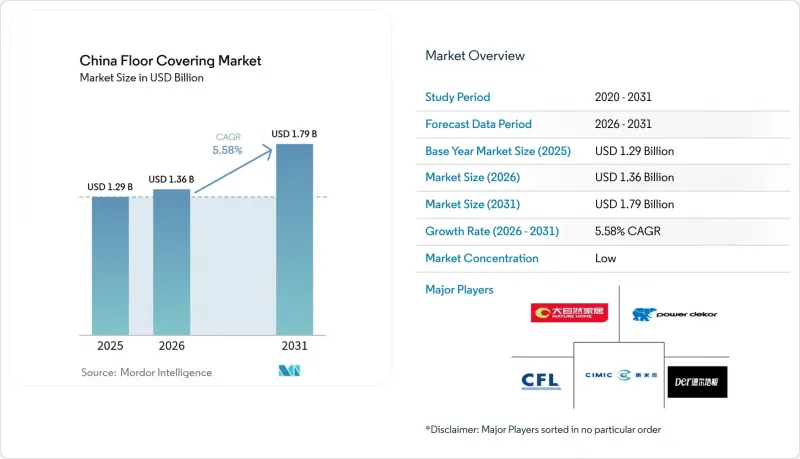
This report Segments by Material (Carpet Flooring, Non-Resilient Flooring, and More), by End Use (Residential and Commercial), by Construction (New Construction, Renovation / Replacement, and More), by Distribution Channel (Manufacturer-Owned Stores, Specialty Stores, and More). The Market Forecasts are Provided in Terms of Value (USD).
China Floor Covering Market Trends and Insights
Rapid Urban Renewal and Affordable Housing Push
Continuous city-level renewal across 300 municipalities, backed by policy funding and the first-time "quality homes" pledge in the 2025 government work report, underpins demand for acoustically engineered and moisture-resistant surfaces . National per-capita housing floor area surpasses 40 m2, underscoring a substantial retrofit pool now shifting from basic price points to specification-driven orders.
Rising Demand for Green-Certified Buildings
Guangzhou's Green Building Regulations mandate certified materials for all public projects, while GB 55037-2022 enhances fire-safety thresholds for commercial and residential structures . These frameworks link certification status to preferential land-use ratios and loan terms, positioning low-VOC flooring as a compliance prerequisite for developers.
Volatile PVC, Wood and Petro-Chemical Feedstock Prices
The March 2025 ban on U.S. log imports and resin price swings force multi-sourcing strategies and trigger producer price adjustments passed downstream within one quarter. Petrochemical feedstock fluctuations directly impact vinyl and synthetic flooring production costs, particularly affecting luxury vinyl tile manufacturing that relies on stable resin pricing for competitive positioning.
Other drivers and restraints analyzed in the detailed report include:
- Growth of PVC-Free Resilient Flooring Technologies
- E-commerce-Enabled Customized Design Services
- Stricter National VOC and Carbon Limits on Flooring
For complete list of drivers and restraints, kindly check the Table Of Contents.
Segment Analysis
Non-resilient lines contributed 63.85% of China flooring market share in 2025. Ceramic, stone, and solid wood remain staples, yet resilient formats are accelerating at a 9.85% CAGR through 2031, closing the gap via rigid-core and SPC upgrades. The China flooring market continues to see rigid core adoption in high-rise residential projects because floating installation shortens project schedules. Pioneer magnesium-oxide cores address stricter fire codes, while PVC-free planks help builders achieve green certification benchmarks.
Manufacturers leverage digital inkjet printing for hyper-realistic textures that erode the aesthetic premium long enjoyed by parquet and marble. In parallel, ceramic producers win orders for heavy-traffic metro station concourses, capitalizing on large-format slabs that lower grout maintenance. The cross-learning across segments fosters hybrid innovations-stone-plastic composite tile that offers the look of porcelain and the thermal comfort of vinyl. Over the forecast span, resilience, recyclability, and quick-lay formats underpin the substitution trend.
Healthcare flooring logged an 8.31% CAGR, the fastest among end uses, as provincial health-commission budgets fund tier-2 and tier-3 hospital upgrades. The segment absorbs weld-seamless homogenous sheet and conductive vinyl designed to withstand daily disinfection cycles. In contrast, residential holds 55.95% share of China flooring market size, reflecting the magnitude of urban renewal. Developers of large-scale housing now differentiate via acoustic underlayment packages bundled at the presale stage. Commercial offices recover steadily; tenants prioritize low-VOC warranties and rapid replacement options compatible with raised-floor cabling.
Schools and universities align with smart-campus programs and prefer loose-lay formats that permit future tech retrofits without demolition debris. Logistics warehouses and e-commerce fulfillment centers demand high-compressive-strength rigid vinyl capable of tolerating autonomous mobile robot traffic.
Complete Report Scope:
- By Material
- Carpet Flooring
- Non-resilient Flooring
- Wood
- Laminate
- Stone
- Ceramic Floor and Wall Tile
- Resilient Flooring
- Vinyl Sheet
- Luxury Vinyl Tile (LVT)
- Stone-Plastic Composite (SPC)
- By End Use
- Residential
- Commercial
- Office
- Retail
- Hospitality
- Healthcare
- Institutional/Education
- Industrial and Logistics
- By Construction
- New Construction
- Renovation / Replacement
- By Distribution Channel
- Manufacturer-Owned Stores
- Speciality Stores
- Online Direct-to-Consumer
- Wholesale / Distributors
- By Region (China)
- East China
- South-Central China
- North China
- Northeast China
- Southwest China
- Northwest China
List of Companies Covered in this Report:
- Nature Home
- Der International
- Power Dekor
- Shanghai Cimic Tiles
- Milliken Flooring
- Forbo Flooring Systems
- Hanflor
- BeFlooring
- Hanse Tile
- Kronospan China
- CFL Flooring
- Bighorn Deer Ceramics
- Elegant Living (Yihua)
- Berry Alloc
- Nature Flooring Holdings
- AHF Products China
- Mohawk Industries China
- Tarkett Asia-Pacific
- Armstrong Flooring China
- LG Hausys Flooring China*
Additional Benefits:
- The market estimate (ME) sheet in Excel format
- 3 months of analyst support
TABLE OF CONTENTS
1 Introduction
- 1.1 Study Assumptions & Market Definition
- 1.2 Scope of the Study
2 Research Methodology
3 Executive Summary
4 Market Landscape
- 4.1 Market Overview
- 4.2 Market Drivers
- 4.2.1 Rapid Urban Renewal And Affordable Housing Push
- 4.2.2 Rising Demand For Green-Certified Buildings
- 4.2.3 Growth Of Pvc-Free Resilient Flooring Technologies
- 4.2.4 E-Commerce-Enabled Customised Design Services
- 4.2.5 Modular And Prefabricated Construction Uptake
- 4.2.6 Export Pull From Belt-And-Road Infrastructure
- 4.3 Market Restraints
- 4.3.1 Volatile Pvc, Wood And Petro-Chemical Feedstock Prices
- 4.3.2 Stricter National Voc And Carbon Limits On Flooring
- 4.3.3 Eu-Dr Deforestation Rules Threatening Wood Exports
- 4.3.4 Anti-Dumping Tariffs On Chinese Vinyl And Tile Abroad
- 4.4 Value / Supply-Chain Analysis
- 4.5 Regulatory Landscape
- 4.6 Technological Outlook
- 4.7 Porter's Five Forces
- 4.7.1 Bargaining Power of Buyers
- 4.7.2 Bargaining Power of Suppliers
- 4.7.3 Threat of New Entrants
- 4.7.4 Threat of Substitutes
- 4.7.5 Intensity of Competitive Rivalry
- 4.8 Capacity and Investment Trends
- 4.9 Sustainability and Circularity Trends
5 Market Size & Growth Forecasts
- 5.1 By Material
- 5.1.1 Carpet Flooring
- 5.1.2 Non-resilient Flooring
- 5.1.2.1 Wood
- 5.1.2.2 Laminate
- 5.1.2.3 Stone
- 5.1.2.4 Ceramic Floor and Wall Tile
- 5.1.3 Resilient Flooring
- 5.1.3.1 Vinyl Sheet
- 5.1.3.2 Luxury Vinyl Tile (LVT)
- 5.1.3.3 Stone-Plastic Composite (SPC)
- 5.2 By End Use
- 5.2.1 Residential
- 5.2.2 Commercial
- 5.2.2.1 Office
- 5.2.2.2 Retail
- 5.2.2.3 Hospitality
- 5.2.2.4 Healthcare
- 5.2.2.5 Institutional/Education
- 5.2.2.6 Industrial and Logistics
- 5.3 By Construction
- 5.3.1 New Construction
- 5.3.2 Renovation / Replacement
- 5.4 By Distribution Channel
- 5.4.1 Manufacturer-Owned Stores
- 5.4.2 Speciality Stores
- 5.4.3 Online Direct-to-Consumer
- 5.4.4 Wholesale / Distributors
- 5.5 By Region (China)
- 5.5.1 East China
- 5.5.2 South-Central China
- 5.5.3 North China
- 5.5.4 Northeast China
- 5.5.5 Southwest China
- 5.5.6 Northwest China
6 Competitive Landscape
- 6.1 Market Concentration
- 6.2 Strategic Moves
- 6.3 Market Share Analysis
- 6.4 Company Profiles (includes Global level Overview, Market level overview, Core Segments, Financials as available, Strategic Information, Market Rank/Share for key companies, Products & Services, and Recent Developments)
- 6.4.1 Nature Home
- 6.4.2 Der International
- 6.4.3 Power Dekor
- 6.4.4 Shanghai Cimic Tiles
- 6.4.5 Milliken Flooring
- 6.4.6 Forbo Flooring Systems
- 6.4.7 Hanflor
- 6.4.8 BeFlooring
- 6.4.9 Hanse Tile
- 6.4.10 Kronospan China
- 6.4.11 CFL Flooring
- 6.4.12 Bighorn Deer Ceramics
- 6.4.13 Elegant Living (Yihua)
- 6.4.14 Berry Alloc
- 6.4.15 Nature Flooring Holdings
- 6.4.16 AHF Products China
- 6.4.17 Mohawk Industries China
- 6.4.18 Tarkett Asia-Pacific
- 6.4.19 Armstrong Flooring China
- 6.4.20 LG Hausys Flooring China*
7 Market Opportunities & Future Outlook
- 7.1 White-space & Unmet-Need Assessment

