PUBLISHER: Mordor Intelligence | PRODUCT CODE: 2115187

PUBLISHER: Mordor Intelligence | PRODUCT CODE: 2115187
Middle-East And Africa Vegetable Oil - Market Share Analysis, Industry Trends & Statistics, Growth Forecasts (2026 - 2031)
According to Mordor Intelligence, Middle East and Africa vegetable oil market size in 2026 is estimated at USD 6.65 billion, growing from 2025 value of USD 6.37 billion with 2031 projections showing USD 8.21 billion, growing at 4.32% CAGR over 2026-2031.
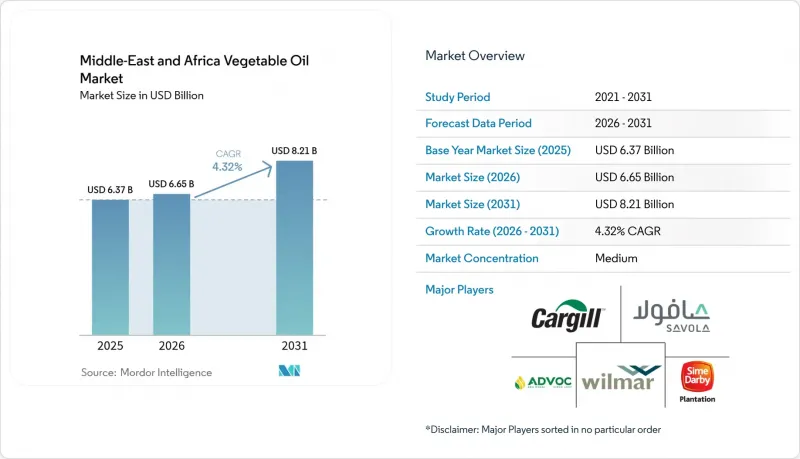
This report is Segmented by Type (Palm Oil, Soybean Oil, Rapeseed Oil, Sunflower Oil, Other Oil Types), Application (Food and Beverages, Personal Care and Cosmetics, Animal Feed, Industrial, Other Applications), and Geography (Saudi Arabia, South Africa, Turkey, Nigeria, Egypt, Rest of Middle East and Africa). The Market Forecasts are Provided in Terms of Value (USD) and Volume (Tons).
Middle-East And Africa Vegetable Oil Market Trends and Insights
Increasing Demand for Cooking Oils and Processed Foods
Urban populations in key markets across the Middle East and Africa have exceeded 60%, driving significant changes in consumption patterns. This shift has led to increased demand for convenience foods and premium cooking oils. Nigeria's population is expected to reach 440 million by 2050, resulting in a growing need for affordable vegetable oils. Concurrently, rising disposable incomes are creating opportunities for value-added products. In the Gulf Cooperation Council countries, the processed food sector is expanding rapidly, fueled by changing lifestyles and a large expatriate population, which is boosting demand for international cuisine ingredients and specialty oils. In Kenya, government efforts to cut cooking oil imports by 50% through enhanced local production highlight how demographic changes are shaping policy decisions and transforming supply chains, as noted by the USDA Foreign Agricultural Service. These demographic trends present a dual opportunity: increased demand for basic cooking oils and a shift toward premiumization in processed food applications. This development has significant implications for refining capacities and distribution networks across the region.
Government Initiatives Supporting Local Production
Governments worldwide are addressing strategic food security concerns by significantly increasing investments in domestic vegetable oil production. This shift comes as nations confront the risks of import-dependent supply chains, highlighted by recent global disruptions. For instance, the UAE's Comprehensive Economic Partnership Agreement with Indonesia not only facilitates palm oil trade but also strengthens the UAE's domestic refining capacity, led by entities like ADVOC and supported by the UAE Ministry of Economy. Similarly, Egypt is offering incentives for biodiesel production facilities to reduce import dependency while enhancing renewable energy feedstock production. In Uganda, government-backed processing infrastructure, as revealed by an edible oil industry mapping, aims to transition the country from a raw material exporter to a value-added producer, potentially altering regional trade patterns. These initiatives signify a critical shift from trade-reliant strategies to production-oriented food security approaches, creating opportunities for technology transfer partnerships and joint ventures between international stakeholders and local manufacturers. Additionally, Iran's success in reducing trans fats through domestic fractionation technology highlights how government-driven programs can achieve both health improvements and industrial advancements.
Heavy Dependence on Imports Exposes the Market to Price and Supply Fluctuations
Egypt's recent supply crisis, caused by global export bans, highlights the region's susceptibility to external shocks due to its significant dependence on imported vegetable oils. Red Sea shipping disruptions have altered trade patterns, forcing importers to bear an additional USD 1 million per round trip for Cape of Good Hope routing and extending delivery times by 10-14 days, according to the Centre for Economic Policy Research. The concentration of global vegetable oil production in a few countries creates systemic risks. Disruptions such as Ukraine's sunflower oil supply issues and Indonesia's intermittent palm oil export restrictions demonstrate how geopolitical events can impact regional supply chains. Import-dependent markets face challenges from currency volatility and commodity price fluctuations. Local currency depreciation exacerbates the effect of global price increases on domestic consumers. To address this vulnerability, there is a growing shift toward regional sourcing and increasing domestic production. However, the substantial capital and time required for these transitions leave markets temporarily exposed to ongoing supply chain disruptions.
Other drivers and restraints analyzed in the detailed report include:
- Expansion of Food Service and Hospitality Industries
- Rising Applications in Biofuels and Other Applications
- Volatility of Raw Material Prices
For complete list of drivers and restraints, kindly check the Table Of Contents.
Segment Analysis
In 2025, palm oil holds a significant 33.94% market share, driven by its cost-efficiency and adaptability across various applications, including food processing and industrial uses. However, its leading position faces growing challenges from health-conscious consumers and advocates for sustainability. Sunflower oil, although more expensive than palm oil, is projected to grow at an impressive 5.27% CAGR through 2031, reflecting a shift in consumer preferences toward oils with healthier fatty acid profiles and cleaner production processes. Soybean oil continues to see stable demand in food manufacturing, while rapeseed oil caters to niche markets, particularly in premium cooking and specialty food products.
Regulatory frameworks are playing an increasingly pivotal role in shaping competition among oil types. For example, the World Health Organization's initiative to eliminate trans fats is driving the industry away from partially hydrogenated oils and toward naturally stable alternatives. Additionally, oils such as coconut, cottonseed, and olive target specialized segments where premium positioning and distinct nutritional profiles command higher margins. However, their growth is limited by supply constraints and price sensitivity. The growing preference for sunflower oil reflects broader health-conscious trends and the influence of European dietary preferences in urban markets. This shift creates opportunities for suppliers capable of ensuring consistent quality and reliable supply chains, even amid geopolitical disruptions affecting traditional sunflower oil exporters.
Complete Report Scope:
- Type
- Palm Oil
- Soybean Oil
- Rapeseed Oil
- Sunflower Oil
- Other Oil Types (Cottonseed Oil, Olive Oil, Coconut Oil)
- Application
- Food and Beverages
- Dairy products
- Bakery and Confectionery
- Snacks and Savory Products
- Meat Products
- Other Types
- Personal Care and Cosmetics
- Animal Feed
- Industrial
- Other Applications
- Food and Beverages
- Geography
- Saudi Arabia
- South Africa
- Turkey
- Nigeria
- Egypt
- Rest of Middle East and Africa
List of Companies Covered in this Report:
- Cargill Incorporated
- Wilmar International
- ADVOC (Abu Dhabi Vegetable Oil Company)
- Sime Darby Plantation Berhad
- Amira Nature Foods Ltd
- Omani Vegetable Oils & Derivatives Co. LLC
- AJWA Group
- Archer Daniels Midland Co. (ADM)
- Savola Group
- IFFCO Group
- Bunge Limited
- Louis Dreyfus Company (LDC)
- Olam International Limited
- Golden Agri-Resources Ltd
- Rafael Salgado S.A.
- Near East Olive Product
- Al Reef for Vegetable Oils
- United Foods Company
- Al Ghurair
- Fuji Oil Co. Holdings
Additional Benefits:
- The market estimate (ME) sheet in Excel format
- 3 months of analyst support
TABLE OF CONTENTS
1 INTRODUCTION
- 1.1 Study Assumptions & Market Definition
- 1.2 Scope of the Study
2 RESEARCH METHODOLOGY
3 EXECUTIVE SUMMARY
4 MARKET LANDSCAPE
- 4.1 Market Overview
- 4.2 Market Drivers
- 4.2.1 Increasing demand for cooking oils and processed foods
- 4.2.2 Government initiatives supporting local production
- 4.2.3 Expansion of food service and hospitality industries
- 4.2.4 Technological advancements in refining, processing, and packaging.
- 4.2.5 Rising Applications in Biofuels and other Applications
- 4.2.6 Expanding strategic trade and logistics hubs
- 4.3 Market Restraints
- 4.3.1 Heavy dependence on imports exposes the market to price and supply fluctuations.
- 4.3.2 Volatility of raw material prices
- 4.3.3 Health concerns over certain oils high in saturated fats
- 4.3.4 Technological disruption, with alternative edible oils or substitutes capturing market share.
- 4.4 Supply Chain Analysis
- 4.5 Regulatory Outlook
- 4.6 Porter's Five Forces
- 4.6.1 Threat of New Entrants
- 4.6.2 Bargaining Power of Buyers/Consumers
- 4.6.3 Bargaining Power of Suppliers
- 4.6.4 Threat of Substitute Products
- 4.6.5 Intensity of Competitive Rivalry
5 MARKET SIZE AND GROWTH FORECAST (in Value and Volume)
- 5.1 Type
- 5.1.1 Palm Oil
- 5.1.2 Soybean Oil
- 5.1.3 Rapeseed Oil
- 5.1.4 Sunflower Oil
- 5.1.5 Other Oil Types (Cottonseed Oil, Olive Oil, Coconut Oil)
- 5.2 Application
- 5.2.1 Food and Beverages
- 5.2.1.1 Dairy products
- 5.2.1.2 Bakery and Confectionery
- 5.2.1.3 Snacks and Savory Products
- 5.2.1.4 Meat Products
- 5.2.1.5 Other Types
- 5.2.2 Personal Care and Cosmetics
- 5.2.3 Animal Feed
- 5.2.4 Industrial
- 5.2.5 Other Applications
- 5.2.1 Food and Beverages
- 5.3 Geography
- 5.3.1 Saudi Arabia
- 5.3.2 South Africa
- 5.3.3 Turkey
- 5.3.4 Nigeria
- 5.3.5 Egypt
- 5.3.6 Rest of Middle East and Africa
6 COMPETITIVE LANDSCAPE
- 6.1 Market Concentration
- 6.2 Strategic Moves
- 6.3 Market Ranking Analysis
- 6.4 Company Profiles (includes Global-level Overview, Market-level Overview, Core Segments, Financials (if available), Strategic Information, Market Rank/Share, Products & Services, Recent Developments)
- 6.4.1 Cargill Incorporated
- 6.4.2 Wilmar International
- 6.4.3 ADVOC (Abu Dhabi Vegetable Oil Company)
- 6.4.4 Sime Darby Plantation Berhad
- 6.4.5 Amira Nature Foods Ltd
- 6.4.6 Omani Vegetable Oils & Derivatives Co. LLC
- 6.4.7 AJWA Group
- 6.4.8 Archer Daniels Midland Co. (ADM)
- 6.4.9 Savola Group
- 6.4.10 IFFCO Group
- 6.4.11 Bunge Limited
- 6.4.12 Louis Dreyfus Company (LDC)
- 6.4.13 Olam International Limited
- 6.4.14 Golden Agri-Resources Ltd
- 6.4.15 Rafael Salgado S.A.
- 6.4.16 Near East Olive Product
- 6.4.17 Al Reef for Vegetable Oils
- 6.4.18 United Foods Company
- 6.4.19 Al Ghurair
- 6.4.20 Fuji Oil Co. Holdings
7 MARKET OPPORTUNITIES AND FUTURE OUTLOOK

