PUBLISHER: Mordor Intelligence | PRODUCT CODE: 2115192

PUBLISHER: Mordor Intelligence | PRODUCT CODE: 2115192
South America Vegetable Oil - Market Share Analysis, Industry Trends & Statistics, Growth Forecasts (2026 - 2031)
According to Mordor Intelligence, the South America vegetable oil market size is estimated at USD 22.04 billion in 2026, and is expected to reach USD 31.04 billion by 2031, at a CAGR of 7.09% during the forecast period (2026-2031).
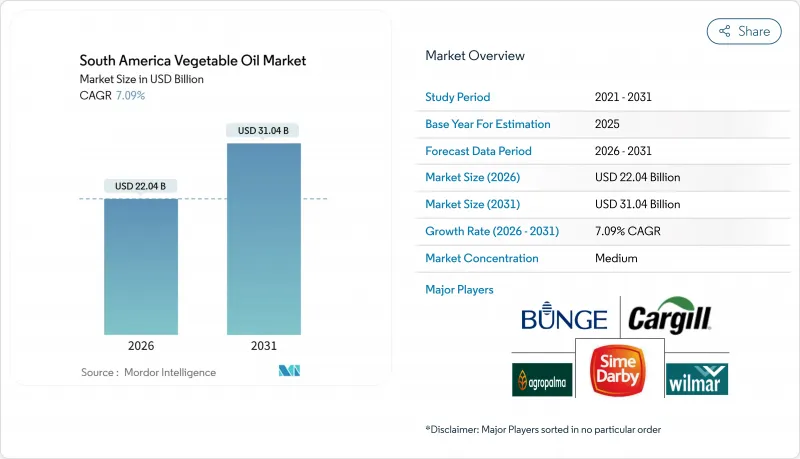
This report is Segmented by Type (Palm Oil, Soybean Oil, Rapeseed Oil, Sunflower Oil, Olive Oil, and More), Nature (Conventional and Organic), and End-Use Segment (Foodservice, Industrial and Biofuel, Personal Care and Cosmetics, Animal Nutrition, Food Processing Industry, and More). The Market Forecasts are Provided in Terms of Value (USD) and Volume (Tons).
South America Vegetable Oil Market Trends and Insights
Rising Demand for Healthier Cooking Alternatives
Urban households in Sao Paulo, Buenos Aires, and Santiago are substituting saturated-fat sources with soybean, sunflower, and canola oils that deliver higher unsaturated-fat profiles. Brazil's Ministry of Health reported a 12% decline in trans-fat intake between 2020 and 2024, correlating with a significant volume increase in refined soybean oil sales through modern retail channels. This shift is amplified by private-label offerings in hypermarkets that price heart-healthy blends competitively against traditional lard and palm-based shortenings. Retailers are also introducing fortified oils with added omega-3 and vitamin D, targeting middle-income consumers who previously lacked access to functional foods. The trend extends beyond retail; foodservice operators in Brazil and Argentina are reformulating menus to comply with front-of-pack warning labels that flag high saturated-fat content, indirectly boosting demand for liquid vegetable oils in commercial kitchens.
Growing Consumer Awareness of Nutritional Benefits
Pan American Health Organization campaigns across South America have spotlighted omega-3 fatty acids and vitamin E as preventive nutrients for cardiovascular disease, prompting a year-on-year increase in canola and sunflower oil imports into Chile and Peru during 2024, according to the Pan American Health Organization. Social-media influencers and government-backed nutrition programs are disseminating messages that link polyunsaturated fats to reduced inflammation and improved cognitive function, creating a halo effect for premium-priced oils. Argentina's National Institute of Food Technology published guidelines in 2024 recommending daily intake thresholds for omega-6 and omega-3 ratios, which food processors are now printing on labels to differentiate products according to the National Institute of Food Technology. This awareness is not confined to affluent segments; even rural cooperatives in Brazil are marketing cold-pressed oils with nutritional claims, leveraging local trust networks to penetrate underserved markets.
Fluctuations in Raw Material Crop Yields Due to Weather and Climate Variability
La Nina episodes in 2024 and early 2025 reduced soil moisture across Argentina and southern Brazil, cutting Argentine soybean output to 48.5 million metric tons versus a potential 52 million metric tons under neutral conditions, according to the USDA Foreign Agricultural Service. Conversely, northern Brazil experienced above-average rainfall that delayed planting and increased fungal pressure, compressing harvest windows and elevating drying costs. El Nino transitions create opposite risks: excessive heat in Argentina can abort pod formation, while flooding in Rio Grande do Sul disrupts logistics and spoils stored beans. These swings translate directly into crush margins; when bean prices spike, processors either curtail runs or pass costs to buyers, dampening demand from price-sensitive foodservice operators. Climate modeling suggests La Nina frequency may increase through 2030, necessitating investments in drought-tolerant soybean varieties and precision irrigation, capital outlays that smaller farms struggle to finance.
Other drivers and restraints analyzed in the detailed report include:
- Expansion of Food Processing and Packaged Food Industries
- Technological Improvements in Extraction and Refining Processes
- Competition from Alternative Lipid Sources
For complete list of drivers and restraints, kindly check the Table Of Contents.
Segment Analysis
Soybean oil held 42.31% of market share in 2025, underpinned by Brazil's and Argentina's combined 227 million metric tons of bean production and entrenched crushing infrastructure that processes meal for export alongside oil for domestic biodiesel. Palm oil, despite a smaller base, is forecast to grow at a 7.65% CAGR through 2031, driven by Colombia's 1.88 million metric tons of sustainable-certified output and Agropalma's expansion across 45,000 hectares in Brazil's Para state. Rapeseed oil remains a niche play, concentrated in Chile and southern Argentina, where cooler climates favor canola cultivation; volumes are modest but command premiums in health-food channels due to favorable omega-3 profiles. Sunflower oil production in Argentina reached approximately 4 million metric tons in 2024, serving both domestic frying applications and European export markets that prize its light flavor and high smoke point.
Peanut oil occupies a specialty segment in confectionery and gourmet cooking, with limited acreage in Argentina and Brazil constraining supply growth. Coconut oil is almost entirely imported from Asia, used primarily in personal-care formulations and premium bakery fats. Olive oil production is emerging in Argentina's Mendoza and La Rioja provinces, targeting export markets in North America and Europe, where South American origin commands curiosity value; however, volumes remain below 30,000 metric tons annually and face quality-consistency challenges. The "Other Types" category captures minor oils, cottonseed, sesame, flaxseed that serve artisanal and organic niches. Enzyme-assisted extraction technologies introduced in 2025 are improving recovery rates for soybean and sunflower oils by 3 percentage points, directly enhancing crush margins and incentivizing capacity expansions.
Complete Report Scope:
- By Type
- Palm Oil
- Soybean Oil
- Rapeseed Oil
- Sunflower Oil
- Peanut Oil
- Coconut Oil
- Olive Oil
- Other Types
- By Nature
- Conventional
- Organic
- By End-Use Segment
- Foodservice
- Industrial and Biofuel
- Personal Care and Cosmetics
- Animal Nutrition
- Food Processing Industry
- Bakery and Confectionery
- Snacks and Savory Products
- Ready-to-Eat and Prepared Foods
- Dairy and Non-Dairy Products
- Others
- Retail
- Supermarkets/Hypermarkets
- Convinience/Grocery Stores
- Online Retail Stores
- Other Distribution Channels
- Geography
- Brazil
- Argentina
- Colombia
- Chile
- Peru
- Rest of South America
List of Companies Covered in this Report:
- Bunge Limited
- Cargill, Incorporated
- Wilmar International Limited
- Archer Daniels Midland Company (ADM)
- Louis Dreyfus Company B.V.
- Aceitera General Deheza S.A. (AGD)
- Agropalma S/A
- Olam International
- COFCO Corporation
- CHS Inc.
- Musim Mas Group
- Sime Darby Plantation Berhad
- Alianza Team S.A.
- Manuelita
- Diana Corporacion
- ASR
- Palmas del Cesar
- Vicentin
- AMAGGI Group
- SLC Agricola
Additional Benefits:
- The market estimate (ME) sheet in Excel format
- 3 months of analyst support
TABLE OF CONTENTS
1 INTRODUCTION
- 1.1 Study Assumptions and Market Definition
- 1.2 Scope of the Study
2 RESEARCH METHODOLOGY
3 EXECUTIVE SUMMARY
4 MARKET LANDSCAPE
- 4.1 Market Overview
- 4.2 Market Drivers
- 4.2.1 Rising demand for healthier cooking alternatives
- 4.2.2 Growing consumer awareness of nutritional benefits
- 4.2.3 Expansion of food processing and packaged food industries
- 4.2.4 Technological improvements in extraction and refining processes
- 4.2.5 Regulatory support for trans-fat reductions boosting demand for alternatives
- 4.2.6 Rising demand for organic and non-GMO oils enhances the vegetable oil market
- 4.3 Market Restraints
- 4.3.1 Fluctuations in raw material crop yields due to weather/climate variability
- 4.3.2 Competition from alternative lipid sources
- 4.3.3 Stringent food safety and labeling regulations
- 4.3.4 Adverse impacts of pests and diseases on oilseed crops
- 4.4 Supply Chain Analysis
- 4.5 Regulatory Landscape
- 4.6 Porter's Five Forces
- 4.6.1 Threat of New Entrants
- 4.6.2 Bargaining Power of Buyers
- 4.6.3 Bargaining Power of Suppliers
- 4.6.4 Threat of Substitutes
- 4.6.5 Competitive Rivalry
5 MARKET SIZE AND GROWTH FORECASTS (VALUE and VOLUME)
- 5.1 By Type
- 5.1.1 Palm Oil
- 5.1.2 Soybean Oil
- 5.1.3 Rapeseed Oil
- 5.1.4 Sunflower Oil
- 5.1.5 Peanut Oil
- 5.1.6 Coconut Oil
- 5.1.7 Olive Oil
- 5.1.8 Other Types
- 5.2 By Nature
- 5.2.1 Conventional
- 5.2.2 Organic
- 5.3 By End-Use Segment
- 5.3.1 Foodservice
- 5.3.2 Industrial and Biofuel
- 5.3.3 Personal Care and Cosmetics
- 5.3.4 Animal Nutrition
- 5.3.5 Food Processing Industry
- 5.3.5.1 Bakery and Confectionery
- 5.3.5.2 Snacks and Savory Products
- 5.3.5.3 Ready-to-Eat and Prepared Foods
- 5.3.5.4 Dairy and Non-Dairy Products
- 5.3.5.5 Others
- 5.3.6 Retail
- 5.3.6.1 Supermarkets/Hypermarkets
- 5.3.6.2 Convinience/Grocery Stores
- 5.3.6.3 Online Retail Stores
- 5.3.6.4 Other Distribution Channels
- 5.4 Geography
- 5.4.1 Brazil
- 5.4.2 Argentina
- 5.4.3 Colombia
- 5.4.4 Chile
- 5.4.5 Peru
- 5.4.6 Rest of South America
6 COMPETITIVE LANDSCAPE
- 6.1 Market Concentration
- 6.2 Strategic Moves
- 6.3 Market Positioning Analysis
- 6.4 Company Profiles (includes Global level Overview, Market level overview, Core Segments, Financials as available, Strategic Information, Market Rank/Share for key companies, Products and Services, and Recent Developments)
- 6.4.1 Bunge Limited
- 6.4.2 Cargill, Incorporated
- 6.4.3 Wilmar International Limited
- 6.4.4 Archer Daniels Midland Company (ADM)
- 6.4.5 Louis Dreyfus Company B.V.
- 6.4.6 Aceitera General Deheza S.A. (AGD)
- 6.4.7 Agropalma S/A
- 6.4.8 Olam International
- 6.4.9 COFCO Corporation
- 6.4.10 CHS Inc.
- 6.4.11 Musim Mas Group
- 6.4.12 Sime Darby Plantation Berhad
- 6.4.13 Alianza Team S.A.
- 6.4.14 Manuelita
- 6.4.15 Diana Corporacion
- 6.4.16 ASR
- 6.4.17 Palmas del Cesar
- 6.4.18 Vicentin
- 6.4.19 AMAGGI Group
- 6.4.20 SLC Agricola
7 MARKET OPPORTUNITIES AND FUTURE OUTLOOK

