PUBLISHER: Mordor Intelligence | PRODUCT CODE: 2115185

PUBLISHER: Mordor Intelligence | PRODUCT CODE: 2115185
Asia-Pacific Vegetable Oil - Market Share Analysis, Industry Trends & Statistics, Growth Forecasts (2026 - 2031)
According to Mordor Intelligence, Asia-Pacific vegetable oil market size in 2026 is estimated at USD 216.41 billion, growing from 2025 value of USD 203.91 billion with 2031 projections showing USD 291.35 billion, growing at 6.13% CAGR over 2026-2031.
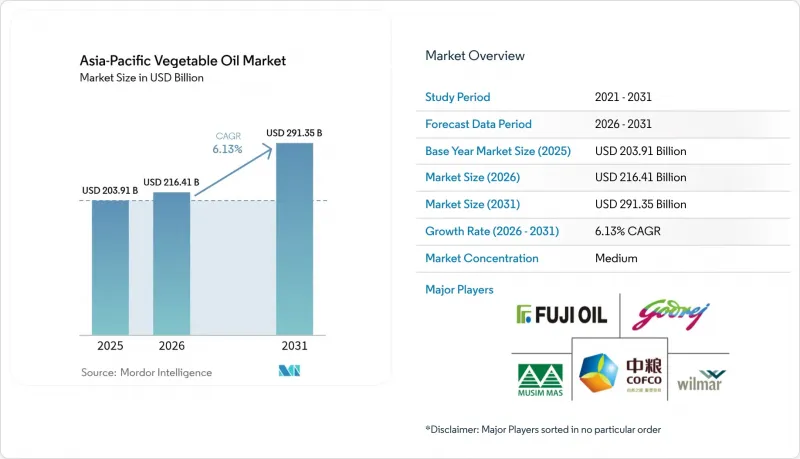
This report is Segmented by Product Type (Palm Oil, Soybean Oil, Rapeseed Oil, and More), Application (Food Applications and Non-Food Applications), and Country (China, India, Japan, South Korea, Australia, Indonesia, Thailand, Vietnam, Philippines, and More). The Market Forecasts are Provided in Terms of Value (USD).
Asia-Pacific Vegetable Oil Market Trends and Insights
Rising popularity of fried, fast, and convenience foods
The Asia-Pacific vegetable oil market is growing steadily as fried, fast, and convenience foods become a regular part of diets in both households and the food service sector. In India, approximately 38% of consumers frequently consume fried snacks and processed foods, as reported by Down To Earth Org in May 2024. Advancements in cold chain infrastructure across the region are enabling businesses to purchase larger quantities of oils while minimizing spoilage risks. Many quick-service restaurant chains are gradually introducing blends of sunflower oil and rice bran oil to offer healthier alternatives with lower saturated fat content. In Japan, the hotel, restaurant, and institutional food service industry experienced growth of approximately 16% in 2023, reaching a market size of around USD 226.2 billion, as per the United States Department of Agriculture. This growth highlights the rising demand for high-performance oils that can endure repeated heating without compromising quality.
Strong growth of biodiesel and renewable fuel programs
Biodiesel and renewable fuel mandates are significantly influencing the Asia-Pacific vegetable oil market. For example, Indonesia's B40 program, as reported by the East Asia Forum Organization, redirected around 13.9 million tonnes of crude palm oil from food-related uses in 2024. The country is also moving forward with trials for its B50 program, which aims to further increase the blending of biodiesel with conventional fuels. Similarly, Malaysia has implemented its B30 initiative, while Thailand has introduced blending programs ranging from B7 to B20. These efforts reflect a regional push to promote the use of palm-based biodiesel as a renewable energy source. The primary goals of these mandates are to reduce greenhouse gas emissions and improve energy security by decreasing reliance on fossil fuels. These programs create a steady demand for vegetable oils, regardless of changes in food consumption patterns.
Negative perception of palm oil due to health and sustainability concerns
In the Asia-Pacific vegetable oil market, palm oil is facing growing criticism due to concerns about health and environmental sustainability. Its high saturated fat content has raised health-related concerns among consumers, particularly those focused on heart health, despite studies suggesting it has neutral effects on cardiovascular health when consumed in moderation. Additionally, stricter deforestation regulations in the European Union have increased global scrutiny of palm oil production practices. As a result, many multinational companies in the region are shifting toward using palm oil certified by organizations such as RSPO (Roundtable on Sustainable Palm Oil) or MSPO (Malaysian Sustainable Palm Oil), or are opting for alternative oils that are perceived as more environmentally friendly. Furthermore, audits have revealed compliance issues among smaller palm oil producers, which has further impacted the competitiveness of palm oil.
Other drivers and restraints analyzed in the detailed report include:
- Rising awareness of fortified and heart-healthy oils
- Shift towards clean-label and minimally processed oils
- Growing interest in functional foods that reduce dependency on added oils
For complete list of drivers and restraints, kindly check the Table Of Contents.
Segment Analysis
Palm oil is expected to continue dominating the Asia-Pacific vegetable oil market in 2025, accounting for approximately 54.74% of the market share. Its strong demand is driven by its extensive use in cooking, packaged foods, and food services. Biodiesel programs, such as Indonesia's B40 initiative, have significantly boosted industrial demand, redirecting approximately 13.9 million tonnes of crude palm oil from edible uses. This dual demand from both the food and fuel sectors ensures steady growth, making the palm oil market less vulnerable to changes in edible oil consumption trends.
Sunflower oil is emerging as the fastest-growing product in the Asia-Pacific vegetable oil market, with a projected CAGR of nearly 7.27% through 2031. Its popularity is increasing due to its health benefits, such as being heart-friendly and having a lighter flavor, which appeals to health-conscious consumers. The rapid growth of modern retail channels in countries like Australia, India, China, and Southeast Asia has made sunflower oil more accessible to a wider audience. As consumers shift toward oils with lower saturated fat content, sunflower oil is gaining traction in both premium and mid-range market segments across the region.
Complete Report Scope:
- By Product Type
- Palm Oil
- Soybean Oil
- Rapeseed Oil
- Sunflower Oil
- Olive Oil
- Others
- By Application
- Food Applications
- Food Processing
- HoReCa
- Retail
- Non-Food Applications
- Biodiesel
- Personal Care and Cosmetics
- Animal Feed
- Others
- Food Applications
- By Country
- China
- India
- Japan
- South Korea
- Australia
- Indonesia
- Thailand
- Vietnam
- Philippines
- Malaysia
- Singapore
- New Zealand
- Rest of Asia-Pacific
List of Companies Covered in this Report:
- Wilmar International Ltd
- COFCO Group
- Musim Mas Holdings
- Golden Agri-Resources Ltd
- Fuji Oil Holdings Inc
- Cargill Incorporated
- Bunge Limited
- Archer Daniels Midland (ADM)
- Olam International Ltd
- Sime Darby Plantation Berhad
- IOI Corporation Berhad
- PT Astra Agro Lestari Tbk
- Nisshin Oillio Group Ltd
- GrainCorp Limited
- Xiwang Foodstuffs Co., Ltd
- Ajinomoto Co., Inc
- K. S. Oils Limited
- Godrej Industries Ltd
- SVMA Agro Products
- AAK AB
Additional Benefits:
- The market estimate (ME) sheet in Excel format
- 3 months of analyst support
TABLE OF CONTENTS
1 INTRODUCTION
- 1.1 Study Assumptions and Market Definition
- 1.2 Scope of the Study
2 RESEARCH METHODOLOGY
3 EXECUTIVE SUMMARY
4 MARKET LANDSCAPE
- 4.1 Market Overview
- 4.2 Market Drivers
- 4.2.1 Changing dietary habits and greater health consciousness
- 4.2.2 Rising popularity of fried, fast, and convenience foods
- 4.2.3 Strong growth of biodiesel and renewable fuel programs
- 4.2.4 Rising awareness of fortified and heart-healthy oils
- 4.2.5 Increasing use of vegetable oils in pharmaceuticals manufacturing
- 4.2.6 Shift towards clean-label and minimally processed oils
- 4.3 Market Restraints
- 4.3.1 Limited availability of certified organic oilseeds in the region
- 4.3.2 Negative perception of palm oil due to health and sustainability concerns
- 4.3.3 Regulatory inconsistencies for sustainability and labeling claims
- 4.3.4 Growing interest in functional foods that reduce dependency on added oils
- 4.4 Regulatory Outlook
- 4.5 Supply Chain Analysis
- 4.6 Porter's Five Forces
- 4.6.1 Threat of New Entrants
- 4.6.2 Bargaining Power of Buyers
- 4.6.3 Bargaining Power of Suppliers
- 4.6.4 Threat of Substitute Products
- 4.6.5 Intensity of Competitive Rivalry
5 MARKET SIZE AND GROWTH FORECASTS (VALUE)
- 5.1 By Product Type
- 5.1.1 Palm Oil
- 5.1.2 Soybean Oil
- 5.1.3 Rapeseed Oil
- 5.1.4 Sunflower Oil
- 5.1.5 Olive Oil
- 5.1.6 Others
- 5.2 By Application
- 5.2.1 Food Applications
- 5.2.1.1 Food Processing
- 5.2.1.2 HoReCa
- 5.2.1.3 Retail
- 5.2.2 Non-Food Applications
- 5.2.2.1 Biodiesel
- 5.2.2.2 Personal Care and Cosmetics
- 5.2.2.3 Animal Feed
- 5.2.2.4 Others
- 5.2.1 Food Applications
- 5.3 By Country
- 5.3.1 China
- 5.3.2 India
- 5.3.3 Japan
- 5.3.4 South Korea
- 5.3.5 Australia
- 5.3.6 Indonesia
- 5.3.7 Thailand
- 5.3.8 Vietnam
- 5.3.9 Philippines
- 5.3.10 Malaysia
- 5.3.11 Singapore
- 5.3.12 New Zealand
- 5.3.13 Rest of Asia-Pacific
6 COMPETITIVE LANDSCAPE
- 6.1 Market Concentration
- 6.2 Strategic Moves
- 6.3 Market Positioning Analysis
- 6.4 Company Profiles (includes Global-level Overview, Market-level Overview, Core Segments, Financials (if available), Strategic Information, Market Rank/Share, Products and Services, Recent Developments)
- 6.4.1 Wilmar International Ltd
- 6.4.2 COFCO Group
- 6.4.3 Musim Mas Holdings
- 6.4.4 Golden Agri-Resources Ltd
- 6.4.5 Fuji Oil Holdings Inc
- 6.4.6 Cargill Incorporated
- 6.4.7 Bunge Limited
- 6.4.8 Archer Daniels Midland (ADM)
- 6.4.9 Olam International Ltd
- 6.4.10 Sime Darby Plantation Berhad
- 6.4.11 IOI Corporation Berhad
- 6.4.12 PT Astra Agro Lestari Tbk
- 6.4.13 Nisshin Oillio Group Ltd
- 6.4.14 GrainCorp Limited
- 6.4.15 Xiwang Foodstuffs Co., Ltd
- 6.4.16 Ajinomoto Co., Inc
- 6.4.17 K. S. Oils Limited
- 6.4.18 Godrej Industries Ltd
- 6.4.19 SVMA Agro Products
- 6.4.20 AAK AB
7 MARKET OPPORTUNITIES AND FUTURE OUTLOOK

