PUBLISHER: Mordor Intelligence | PRODUCT CODE: 2115180

PUBLISHER: Mordor Intelligence | PRODUCT CODE: 2115180
North America Vegetable Oil - Market Share Analysis, Industry Trends & Statistics, Growth Forecasts (2026 - 2031)
According to Mordor Intelligence, the north american vegetable oil market size was valued at USD 50.87 billion in 2025 and estimated to grow from USD 52.58 billion in 2026 to reach USD 62.07 billion by 2031, at a CAGR of 3.37% during the forecast period (2026-2031).
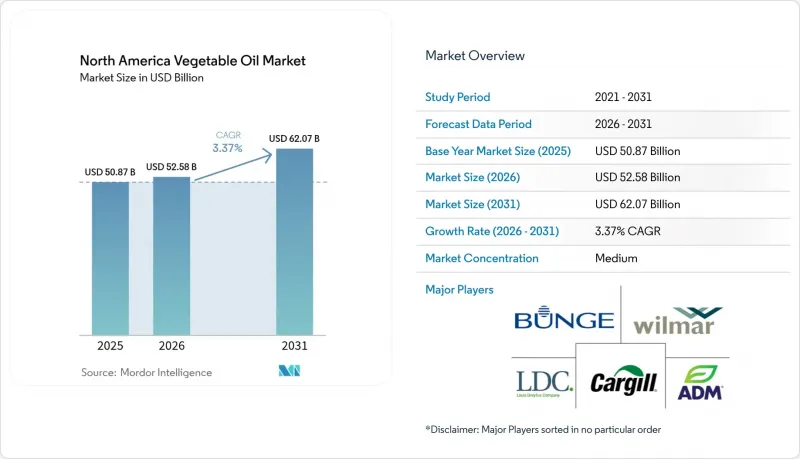
This report is Segmented by Type (Palm Oil, Soybean Oil, Rapeseed Oil, and More), Nature (Conventional and Organic), End User (Food Industry, Animal Feed, Pharmaceutical, and More), and Geography (United States, Canada, Mexico, and Rest of North America). The Market Forecasts are Provided in Terms of Value and Volume (USD and Tons).
North America Vegetable Oil Market Trends and Insights
Expansion of Food Processing and Packaged Food Sectors
The food processing industry's continuous expansion remains a significant driver of vegetable oil demand throughout North America. Processed food manufacturers depend on stable, functional oils to ensure their products maintain quality and appeal to consumers through extended shelf life periods. The United States has demonstrated substantial export performance in processed vegetables, with Canada and Mexico emerging as the primary export destinations . The sector's evolution is particularly evident in the plant-based food segment, where companies are making substantial investments to expand production capabilities, particularly in dairy alternatives such as oatmilk. This industrial transformation reflects broader consumer preferences shifting toward processed convenience foods, where vegetable oils play an essential role in maintaining texture, flavor stability, and preservation qualities. The packaged food sector's increasing emphasis on clean-label ingredients has generated robust demand for non-GMO and organic oil variants, establishing distinct premium market segments within the industry. In response to both regulatory requirements and growing consumer health awareness, processing companies are actively transitioning to high-oleic sunflower and canola oils as alternatives to partially hydrogenated oils.
Growth in Biodiesel and Renewable Energy Mandates Boosting Oil Demand
Renewable energy policies are fundamentally transforming North American vegetable oil markets by establishing consistent demand through regulatory frameworks. The U.S. Renewable Fuel Standard mandates a minimum 50% reduction in lifecycle greenhouse gas emissions for biomass-based diesel, making vegetable oils essential feedstocks for meeting federal and state environmental targets . California's Low Carbon Fuel Standard has significantly influenced the market, implementing a 20% credit cap on soy and canola-based renewable diesel credits to balance food and fuel production needs . These regulations have spurred substantial infrastructure development, with renewable diesel production capacity expected to increase by 100 million gallons between 2024 and 2025, reaching 5.2 billion gallons. The 2025 implementation of the Clean Fuel Production Tax Credit (45Z), which offers incentives up to USD 1 per gallon based on carbon intensity for domestically produced fuels, may reduce imports while increasing local vegetable oil demand. Canadian canola oil has gained strategic importance after EPA approval of renewable fuel pathways, with U.S. imports accounting for 91% of Canada's canola oil exports in 2023.
Environmental Concerns Related to Large-Scale Oil Crop Cultivation and Deforestation
Environmental sustainability concerns are impacting vegetable oil market growth, particularly affecting palm oil imports and increasing demand for domestic alternatives with lower environmental impact. The global vegetable oil market, which grew approximately 5% annually over the past decade, has contributed to tropical deforestation through palm and soybean oil expansion. The EU Deforestation Regulation (EUDR), which prohibits products from land deforested after December 31, 2020, is transforming global supply chains and influencing North American import patterns, despite primarily targeting European markets. While consumer and corporate sustainability commitments increase demand for certified sustainable oils, adoption remains moderate, with only 56% of downstream actors meeting RSPO certification targets in 2022. North American food manufacturers and retailers face challenges in balancing cost, functionality, and sustainability requirements in their supply chains.
Other drivers and restraints analyzed in the detailed report include:
- Increased Use of Vegetable Oils in Cosmetics and Pharmaceuticals
- Rising Demand for Non-GMO and Organic Oil Variants
- Regulatory Challenges and Changing Food Safety and Labeling Requirements
For complete list of drivers and restraints, kindly check the Table Of Contents.
Segment Analysis
The vegetable oil market demonstrates a clear leadership position for rapeseed oil, which currently commands a substantial 34.68% market share in 2025. This dominance is primarily attributed to robust Canadian production capabilities and increasing U.S. biofuel applications. The strength of this market position is further reinforced by the deep trade integration between the United States and Canada, with Canadian exports accounting for 91% of U.S. canola imports in 2024. This trade relationship gained additional momentum following the EPA's strategic decision in December 2022 to approve canola oil for renewable diesel feedstocks. The industry's confidence in this market is exemplified by Louis Dreyfus Company's significant investment in its Yorkton, Saskatchewan facility, where the annual canola crush capacity will increase to exceed 2 million metric tons.
In parallel market developments, palm oil has emerged as the most dynamic segment, achieving a notable growth rate of 4.21% CAGR through 2031. This growth trajectory is primarily driven by palm oil's competitive cost structure and superior functional properties in food manufacturing applications, although sustainability concerns continue to influence some manufacturers to explore alternative options. The soybean oil segment maintains its significant market position through substantial domestic infrastructure development, with crushing capacity expanding by approximately 23% over a three-year period to accommodate renewable diesel demand. However, this rapid expansion has raised concerns about potential industry overcapacity, as highlighted in recent CoBank analysis reports.
Complete Report Scope:
- By Type
- Palm Oil
- Soybean Oil
- Rapeseed Oil
- Sunflower Oil
- Peanut Oil
- Coconut Oil
- Olive Oil
- Other Types
- By Nature
- Conventional
- Organic
- By End User
- Food Industry
- Food Processing Industry
- Margarine and Spreads
- Snacks Foods
- Ready Meals
- Others
- Foodservice/HoReCa
- Retail
- Food Processing Industry
- Animal Feed
- Pharmaceutical
- Biofuels
- Beauty and Personal Care
- Others
- Food Industry
- By Geography
- United States
- Canada
- Mexico
- Rest of North America
List of Companies Covered in this Report:
- Archer Daniels Midland Company
- Cargill Incorporated
- Bunge Limited
- Wilmar International Ltd.
- Louis Dreyfus Company
- Fuji Oil Holdings Inc.
- Olam International
- AGYDSA
- Ragasa Alimentos
- Richardson International
- Viterra Inc.
- Ventura Foods
- Darling Ingredients
- Pacific Coast Canola
- Senvia Canada
- West Coast Grape Seed Co.
- Catania Oils
- La Tourangelle
- Adams Vegetable Oils
- Healthy Harvest Oils
Additional Benefits:
- The market estimate (ME) sheet in Excel format
- 3 months of analyst support
TABLE OF CONTENTS
1 INTRODUCTION
- 1.1 Study Assumptions and Market Definition
- 1.2 Scope of the Study
2 RESEARCH METHODOLOGY
3 EXECUTIVE SUMMARY
4 MARKET LANDSCAPE
- 4.1 Market Overview
- 4.2 Market Drivers
- 4.2.1 Expansion of the food processing and packaged food sectors
- 4.2.2 Growth in biodiesel and renewable energy mandates boosting oil demand
- 4.2.3 Increased use of vegetable oils in cosmetics and pharmaceuticals
- 4.2.4 Rising demand for non-GMO and organic oil variants
- 4.2.5 Fueling consumer awareness of unsaturated fats and omega-3 benefits
- 4.2.6 Product diversification with specialty oils such as high-oleic sunflower oils
- 4.3 Market Restraints
- 4.3.1 Environmental concerns related to large-scale oil crop cultivation and deforestation
- 4.3.2 Regulatory challenges and changing food safety and labeling requirements
- 4.3.3 Risk of adulteration and quality control issues
- 4.3.4 Complexity in traceability and certification for sustainable sourcing
- 4.4 Technology Outlook
- 4.5 Regulatory Outlook
- 4.6 Porter's Five Forces
- 4.6.1 Threat of New Entrants
- 4.6.2 Bargaining Power of Buyers/Consumers
- 4.6.3 Bargaining Power of Suppliers
- 4.6.4 Threat of Substitute Products
- 4.6.5 Intensity of Competitive Rivalry
5 MARKET SIZE AND GROWTH FORECASTS (VALUE AND VOLUME)
- 5.1 By Type
- 5.1.1 Palm Oil
- 5.1.2 Soybean Oil
- 5.1.3 Rapeseed Oil
- 5.1.4 Sunflower Oil
- 5.1.5 Peanut Oil
- 5.1.6 Coconut Oil
- 5.1.7 Olive Oil
- 5.1.8 Other Types
- 5.2 By Nature
- 5.2.1 Conventional
- 5.2.2 Organic
- 5.3 By End User
- 5.3.1 Food Industry
- 5.3.1.1 Food Processing Industry
- 5.3.1.1.1 Margarine and Spreads
- 5.3.1.1.2 Snacks Foods
- 5.3.1.1.3 Ready Meals
- 5.3.1.1.4 Others
- 5.3.1.2 Foodservice/HoReCa
- 5.3.1.3 Retail
- 5.3.1.1 Food Processing Industry
- 5.3.2 Animal Feed
- 5.3.3 Pharmaceutical
- 5.3.4 Biofuels
- 5.3.5 Beauty and Personal Care
- 5.3.6 Others
- 5.3.1 Food Industry
- 5.4 By Geography
- 5.4.1 United States
- 5.4.2 Canada
- 5.4.3 Mexico
- 5.4.4 Rest of North America
6 COMPETITIVE LANDSCAPE
- 6.1 Market Concentration
- 6.2 Strategic Moves
- 6.3 Market Share Analysis
- 6.4 Company Profiles (includes Global-level Overview, Market-level Overview, Core Segments, Financials (if available), Strategic Information, Market Rank/Share, Products and Services, Recent Developments)
- 6.4.1 Archer Daniels Midland Company
- 6.4.2 Cargill Incorporated
- 6.4.3 Bunge Limited
- 6.4.4 Wilmar International Ltd.
- 6.4.5 Louis Dreyfus Company
- 6.4.6 Fuji Oil Holdings Inc.
- 6.4.7 Olam International
- 6.4.8 AGYDSA
- 6.4.9 Ragasa Alimentos
- 6.4.10 Richardson International
- 6.4.11 Viterra Inc.
- 6.4.12 Ventura Foods
- 6.4.13 Darling Ingredients
- 6.4.14 Pacific Coast Canola
- 6.4.15 Senvia Canada
- 6.4.16 West Coast Grape Seed Co.
- 6.4.17 Catania Oils
- 6.4.18 La Tourangelle
- 6.4.19 Adams Vegetable Oils
- 6.4.20 Healthy Harvest Oils
7 MARKET OPPORTUNITIES AND FUTURE OUTLOOK

