PUBLISHER: Mordor Intelligence | PRODUCT CODE: 2124309

PUBLISHER: Mordor Intelligence | PRODUCT CODE: 2124309
Europe Vegetable Oil - Market Share Analysis, Industry Trends & Statistics, Growth Forecasts (2026 - 2031)
According to Mordor Intelligence, the Europe vegetable oil market size is projected to be USD 67.52 billion in 2025, USD 69.98 billion in 2026, and reach USD 83.69 billion by 2031, growing at a CAGR of 3.64% from 2026 to 2031.
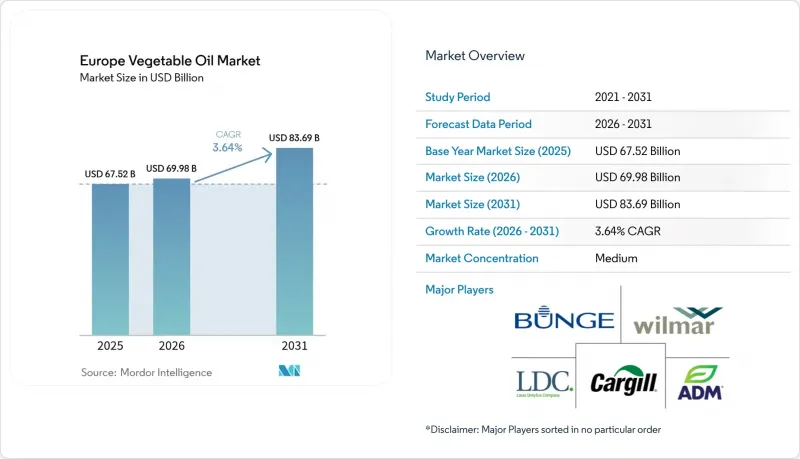
This report is Segmented by Type (Palm Oil, Soybean Oil, Rapeseed Oil, Sunflower Oil, Peanut Oil, Coconut Oil, Olive Oil, Other Types), Nature (Conventional and Organic), End User (Food Industry, Animal Feed, Pharmaceutical, Biofuels, Beauty and Personal Care, Others), and Geography (Germany, UK, Italy, France, Spain, and More). Market Forecasts are Provided in Terms of Value (USD) and Volume (Tons).
Europe Vegetable Oil Market Trends and Insights
Rising health consciousness favoring heart-healthy oils rich in omega-3 and omega-6 fatty acids
Growing health awareness among European consumers is significantly driving demand in the vegetable oil market, particularly for oils recognized for their cardiovascular benefits. Shoppers are increasingly choosing oils high in omega-3 and omega-6 fatty acids, known to support heart health and maintain healthy cholesterol levels. Varieties like rapeseed, sunflower, and flaxseed oils are witnessing higher adoption due to their favorable nutrient composition and lower levels of saturated fats. This shift is reinforced by a rising focus on preventive nutrition, balanced diets, and functional foods that promote overall wellness. Food producers are responding by incorporating these healthier oils into reformulated products to meet clean-label and health-focused expectations. Enhanced nutritional labeling and awareness campaigns across Europe further guide consumers toward better choices. Consequently, heart-healthy vegetable oils are experiencing strong and sustained growth in both retail and foodservice sectors.
Increasing demand for sustainable and biodegradable oils in industrial applications
The European vegetable oil market is witnessing strong growth driven by increasing demand for sustainable and biodegradable oils in industrial applications. Industries are actively shifting toward plant-based oils for lubricants, hydraulic fluids, and other industrial uses to reduce environmental impact and comply with evolving regulations. The updated EU Circular Economy Action Plan (2024) plays a pivotal role in this transition, mandating that 65% of industrial lubricants and hydraulic fluids sold after 2027 must be biodegradable within 28 days under OECD 301B test protocols. This regulatory push is encouraging manufacturers to adopt renewable, eco-friendly oils that are both efficient and sustainable. Additionally, rising corporate commitments to sustainability and carbon reduction are boosting the preference for biodegradable vegetable oil-based alternatives over conventional petroleum-based products. Technological advancements in refining and formulation have also improved the performance and stability of these oils in industrial settings.
Increasing counterfeit or adulterated oil products
The European vegetable oil market is being constrained by the growing prevalence of counterfeit and adulterated products. These fraudulent oils not only diminish nutritional quality but also pose potential health risks to consumers, including exposure to contaminants and inferior ingredients. Practices such as blending premium oils with cheaper substitutes erode consumer confidence and can damage the reputation of established brands. Complex supply chains, particularly for imported oils, make monitoring and enforcement difficult, creating opportunities for unscrupulous actors. While regulators and industry bodies are increasing testing, certification, and traceability efforts, ensuring compliance remains challenging and resource-intensive. Rising consumer demand for authentic, certified, and traceable oils is pushing manufacturers to strengthen quality control measures. Consequently, the issue of adulterated and counterfeit oils continues to act as a notable restraint on market growth and consumer trust.
Other drivers and restraints analyzed in the detailed report include:
- Growth in organic and cold-pressed oils for premium food segments
- Shift toward plant-based diets and healthier cooking alternatives
- Consumer shift toward low-fat diets reducing overall oil consumption
For complete list of drivers and restraints, kindly check the Table Of Contents.
Segment Analysis
Rapeseed oil accounted for the largest revenue share in the European vegetable oil market in 2025, capturing 33.86% of total sales. Its leading position is supported by strong domestic production across key European countries, which ensures stable supply and pricing advantages. The oil's widespread use in both household cooking and food processing applications further reinforces its dominance. Additionally, rapeseed oil is widely perceived as a healthier alternative due to its favorable fatty acid profile, including low saturated fat content. The growing preference for locally sourced and non-GMO edible oils in Europe has also contributed to its sustained demand.
Palm oil is projected to be the fastest-growing product segment in the European vegetable oil market, expanding at a CAGR of 4.35% through 2031. This growth is primarily driven by its cost-effectiveness and high yield efficiency compared to other vegetable oils. Palm oil's functional properties, such as stability at high temperatures and long shelf life, make it highly suitable for processed foods and bakery applications. Increasing demand from the food manufacturing sector, particularly for confectionery and ready-to-eat products, is further accelerating its adoption. Despite regulatory scrutiny and sustainability concerns, certified sustainable palm oil initiatives are helping maintain its acceptance in the European market.
Complete Report Scope:
- By Product Type
- Palm Oil
- Soybean Oil
- Rapeseed Oil
- Sunflower Oil
- Peanut Oil
- Coconut Oil
- Olive Oil
- Other Types
- By Nature
- Conventional
- Organic
- By End User
- Food Industry
- Food Processing Industry
- Margarine and Spreads
- Snacks Foods
- Ready Meals
- Others
- Foodservice/HoReCa
- Retail
- Food Processing Industry
- Animal Feed
- Pharmaceutical
- Biofuels
- Beauty and Personal Care
- Others
- Food Industry
- By Country
- Germany
- United Kingdom
- Italy
- France
- Spain
- Netherlands
- Poland
- Belgium
- Sweden
- Rest of Europe
List of Companies Covered in this Report:
- Cargill, Incorporated
- Archer Daniels Midland Company
- Bunge Ltd.
- Wilmar International
- Louis Dreyfus Company
- Avril Group
- EFKO Group
- Fuji Oil Holdings
- Olam Group
- AAK AB
- Unilever PLC
- Aveno NV
- AAKO Trading
- Nisshin OilliO
- Kernel Holding
- Delta Wilmar
- COFCO International
- Marico Ltd.
- Strauss Group
- Deoleo SA
Additional Benefits:
- The market estimate (ME) sheet in Excel format
- 3 months of analyst support
TABLE OF CONTENTS
1 INTRODUCTION
- 1.1 Study Assumptions and Market Definition
- 1.2 Scope of the Study
2 RESEARCH METHODOLOGY
3 EXECUTIVE SUMMARY
4 MARKET LANDSCAPE
- 4.1 Market Overview
- 4.2 Market Drivers
- 4.2.1 Rising health consciousness favoring heart-healthy oils rich in omega-3 and omega-6 fatty acids
- 4.2.2 Increasing demand for sustainable and biodegradable oils in industrial applications
- 4.2.3 Growth in organic and cold-pressed oils for premium food segments
- 4.2.4 Shift toward plant-based diets and healthier cooking alternatives
- 4.2.5 Stringent EU sustainability directives and circular economy initiatives
- 4.2.6 Technological advancements in extraction and refining processes
- 4.3 Market Restraints
- 4.3.1 Increasing counterfeit or adulterated oil products
- 4.3.2 Consumer shift toward low-fat diets reducing overall oil consumption
- 4.3.3 Fluctuating raw material supply due to weather variability and crop failures.
- 4.3.4 Competition from emerging alternatives like olive oil and seed oils
- 4.4 Supply Chain Analysis
- 4.5 Regulatory Landscape
- 4.6 Technological Outlook
- 4.7 Porter's Five Forces Analysis
- 4.7.1 Threat of New Entrants
- 4.7.2 Bargaining Power of Buyers
- 4.7.3 Bargaining Power of Suppliers
- 4.7.4 Threat of Substitutes
- 4.7.5 Intensity of Competitive Rivalry
5 MARKET SIZE AND GROWTH FORECASTS (VALUE AND VOLUME)
- 5.1 By Product Type
- 5.1.1 Palm Oil
- 5.1.2 Soybean Oil
- 5.1.3 Rapeseed Oil
- 5.1.4 Sunflower Oil
- 5.1.5 Peanut Oil
- 5.1.6 Coconut Oil
- 5.1.7 Olive Oil
- 5.1.8 Other Types
- 5.2 By Nature
- 5.2.1 Conventional
- 5.2.2 Organic
- 5.3 By End User
- 5.3.1 Food Industry
- 5.3.1.1 Food Processing Industry
- 5.3.1.1.1 Margarine and Spreads
- 5.3.1.1.2 Snacks Foods
- 5.3.1.1.3 Ready Meals
- 5.3.1.1.4 Others
- 5.3.1.2 Foodservice/HoReCa
- 5.3.1.3 Retail
- 5.3.1.1 Food Processing Industry
- 5.3.2 Animal Feed
- 5.3.3 Pharmaceutical
- 5.3.4 Biofuels
- 5.3.5 Beauty and Personal Care
- 5.3.6 Others
- 5.3.1 Food Industry
- 5.4 By Country
- 5.4.1 Germany
- 5.4.2 United Kingdom
- 5.4.3 Italy
- 5.4.4 France
- 5.4.5 Spain
- 5.4.6 Netherlands
- 5.4.7 Poland
- 5.4.8 Belgium
- 5.4.9 Sweden
- 5.4.10 Rest of Europe
6 COMPETITIVE LANDSCAPE
- 6.1 Market Concentration
- 6.2 Strategic Moves
- 6.3 Market Share Analysis
- 6.4 Company Profiles (includes Global level Overview, Market level overview, Core Segments, Financials as available, Strategic Information, Market Rank/Share for key companies, Products and Services, and Recent Developments)
- 6.4.1 Cargill, Incorporated
- 6.4.2 Archer Daniels Midland Company
- 6.4.3 Bunge Ltd.
- 6.4.4 Wilmar International
- 6.4.5 Louis Dreyfus Company
- 6.4.6 Avril Group
- 6.4.7 EFKO Group
- 6.4.8 Fuji Oil Holdings
- 6.4.9 Olam Group
- 6.4.10 AAK AB
- 6.4.11 Unilever PLC
- 6.4.12 Aveno NV
- 6.4.13 AAKO Trading
- 6.4.14 Nisshin OilliO
- 6.4.15 Kernel Holding
- 6.4.16 Delta Wilmar
- 6.4.17 COFCO International
- 6.4.18 Marico Ltd.
- 6.4.19 Strauss Group
- 6.4.20 Deoleo SA
7 MARKET OPPORTUNITIES AND FUTURE OUTLOOK

