PUBLISHER: Mordor Intelligence | PRODUCT CODE: 2115847

PUBLISHER: Mordor Intelligence | PRODUCT CODE: 2115847
Africa Wellness Tourism - Market Share Analysis, Industry Trends & Statistics, Growth Forecasts (2026 - 2031)
According to Mordor Intelligence, the Africa wellness tourism market size in 2026 is estimated at USD 14.28 billion, growing from 2025 value of USD 13.47 billion with 2031 projections showing USD 19.16 billion, growing at 6.05% CAGR over 2026-2031.
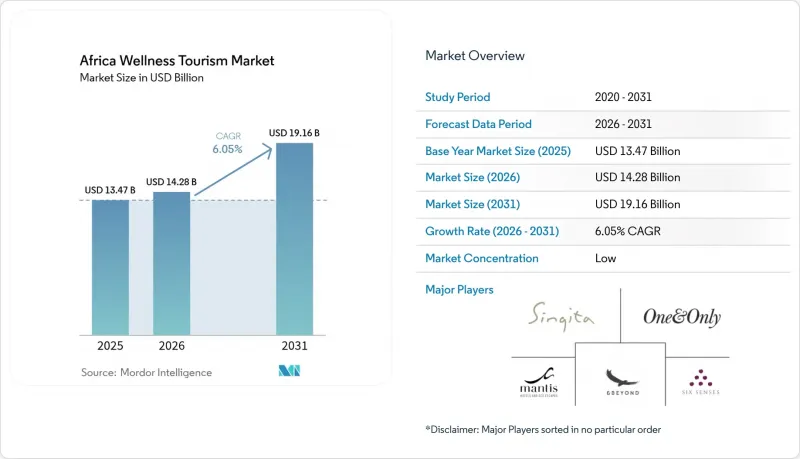
This report is Segmented by Service Type (Yoga & Meditation Retreats, Spa & Beauty Therapies, Naturopathy & Detox Packages, and Other), Traveler Type (Primary Wellness Travel, Secondary Wellness Travel), Accommodation Type (Yoga Retreats, and Other), and Geography (North Africa, and Other). The Market Forecasts are Provided in Terms of Value (USD).
Africa Wellness Tourism Market Trends and Insights
Rising Domestic Middle-Class Demand for Wellness Experiences
Domestic wellness travel now supplies a reliable utilization base for operators who historically depended on seasonal, long-haul clientele. The Global Wellness Institute's 2024 policy toolkit notes that a stable local customer base shields businesses from external demand shocks. African cities such as Lagos, Nairobi, and Johannesburg have seen sustained salary growth since 2024, enabling residents to spend on spa weekends, mindfulness retreats, and nutritional detox programs. Local operators enjoy cultural fluency and cost advantages that resonate with home-market sensibilities. International chains, in turn, recalibrate program design to reflect African wellness philosophies, from botanical rituals to communal healing circles. This alignment stimulates year-round room occupancy, supports continuous staff training, and motivates investors to widen retreat footprints across secondary cities.
Government Tourism Diversification Strategies Toward Wellness
Rwanda, Mauritius, and South Africa now embed wellness pillars within national tourism plans, channeling grants into certification programs that sharpen service quality. Rwanda pioneered spa practitioner accreditation classes in 2024, while Mauritius pairs medical tourism platforms with preventive wellness sessions. South Africa's provincial tourism boards market indigenous healing within regulated frameworks to reassure international visitors. These interventions attract foreign direct investment by clarifying licensing timelines and raising baseline standards. Harmonized African Union visa policies further streamline multi-country itineraries, encouraging travelers to string together wellness stops across several nations. Over the long term, coordinated policy pushes should cut red tape, lower insurance premiums, and lift occupancy rates across remote lodges.
Limited Rural Infrastructure & Connectivity
Poor road quality, intermittent electricity, and constrained water access jointly inflate construction and operating costs in pristine parklands. The TRILAND project's phased road upgrades will ease truck logistics, yet most works remain on drawing boards. Consequently, developers must budget for solar arrays, boreholes, and satellite backhaul, driving up capital intensity. Entry barriers deter small entrepreneurs, consolidating first-mover advantages for groups that master off-grid engineering. Controlled bed capacity also boosts exclusivity, allowing nightly rates above USD 2,000 in Botswana's delta. While infrastructure gaps slow overall volume, they paradoxically support sustainable carrying capacities that align with wellness ideals of tranquility and minimal crowding.
Other drivers and restraints analyzed in the detailed report include:
- Expansion of International Luxury Hotel Brands Into Africa
- Digital-Detox Itineraries Leveraging Low-Connectivity Safari Areas
- Tourist Safety & Security Perceptions
For complete list of drivers and restraints, kindly check the Table Of Contents.
Segment Analysis
Spa and beauty therapies accounted for 44.23% of Africa wellness tourism market share in 2025, validating their universal appeal and replicable operating model. Operators capitalize on North African hammam heritage and Southern African mineral-rich mud treatments to differentiate menus. The Africa wellness tourism market size for digital-detox escapes is projected to climb from USD 2.37 billion in 2026 to USD 4.19 billion by 2031, reflecting a 12.14% CAGR. New retreat platforms now bundle measured dopamine-fast protocols, starlit sound baths, and analog journaling workshops. Investors also back mental-wellness retreats that blend cognitive behavioral therapy with ancestral drumming circles, satisfying demand from corporate burnout sufferers. Spiritual healing journeys tap diaspora interest by integrating naming ceremonies, ancestral veneration, and river purification rites, thereby nurturing repeat visitation from North American and Caribbean markets.
Digital-detox pioneers convert prior connectivity liabilities into unique selling points. Lodge architects design Faraday-cage meditation pods that block electromagnetic fields, while neuroscientists track heart-rate variability to evidence stress reduction outcomes. Such data-backed efficacy increases the chances of reimbursement by wellness insurers in Europe. Meanwhile, naturopathy and detox programs leverage Africa's botanical abundance, substituting imported supplements with indigenous moringa, baobab, and rooibos formulations. Yoga and meditation retreats adopt Swahili mantras and Xhosa breathwork, preserving authenticity while meeting global practice standards. Collectively, these innovations widen the Africa wellness tourism market by appealing to both tradition seekers and biohacking enthusiasts.
Complete Report Scope:
- By Service Type
- Yoga & Meditation Retreats
- Spa & Beauty Therapies
- Naturopathy & Detox Packages
- Mental-Wellness Retreats
- Digital-Detox Escapes
- Spiritual Healing Journeys
- By Traveler Type
- Primary Wellness Travel
- Secondary Wellness Travel
- By Accommodation Type
- Yoga Retreats
- Wellness Hotels (Chain)
- Boutique Retreats
- Eco-Wellness Lodges
- Wellness Clinics with Stay
- By Geography
- North Africa
- West Africa
- East Africa
- Central Africa
- Southern Africa
List of Companies Covered in this Report:
- Mantis Collection
- One&Only Resorts
- Six Senses Hotels Resorts Spas
- &Beyond
- Singita
- Wilderness Safaris
- Healing Earth
- Amani Spa Group
- Bushmans Kloof Wilderness Reserve & Wellness Retreat
- Karkloof Safari Spa
- Gibb's Farm
- Azura Retreats
- North Island Seychelles
- Fairmont Hotels & Resorts (Africa properties)
- Four Seasons Hotels & Resorts (Africa properties)
- Satori Africa
- Africa Wellness Safaris
- Royal Mansour Marrakech
- The Oyster Box Hotel Spa
- The Source of Hope Wellness Centre
Additional Benefits:
- The market estimate (ME) sheet in Excel format
- 3 months of analyst support
TABLE OF CONTENTS
1 Introduction
- 1.1 Study Assumptions & Market Definition
- 1.2 Scope of the Study
2 Research Methodology
3 Executive Summary
4 Market Landscape
- 4.1 Market Overview
- 4.2 Market Drivers
- 4.2.1 Rising domestic middle-class demand for wellness experiences
- 4.2.2 Government tourism diversification strategies toward wellness
- 4.2.3 Expansion of international luxury hotel brands into Africa
- 4.2.4 Growing awareness of integrative health & preventive care
- 4.2.5 Surge in Afro-centric spiritual-healing retreats (diaspora pull)
- 4.2.6 Digital-detox itineraries leveraging low-connectivity safari areas
- 4.3 Market Restraints
- 4.3.1 Limited rural infrastructure & connectivity
- 4.3.2 Tourist safety & security perceptions
- 4.3.3 Shortage of accredited practitioners in traditional therapies
- 4.3.4 Lengthy visa processes hindering spontaneous travel
- 4.4 Value / Supply-Chain Analysis
- 4.5 Regulatory Landscape
- 4.6 Technological Outlook
- 4.7 Porter's Five Forces
- 4.7.1 Competitive Rivalry
- 4.7.2 Bargaining Power of Suppliers
- 4.7.3 Bargaining Power of Buyers
- 4.7.4 Threat of Substitutes
- 4.7.5 Threat of New Entrants
5 Market Size & Growth Forecasts
- 5.1 By Service Type
- 5.1.1 Yoga & Meditation Retreats
- 5.1.2 Spa & Beauty Therapies
- 5.1.3 Naturopathy & Detox Packages
- 5.1.4 Mental-Wellness Retreats
- 5.1.5 Digital-Detox Escapes
- 5.1.6 Spiritual Healing Journeys
- 5.2 By Traveler Type
- 5.2.1 Primary Wellness Travel
- 5.2.2 Secondary Wellness Travel
- 5.3 By Accommodation Type
- 5.3.1 Yoga Retreats
- 5.3.2 Wellness Hotels (Chain)
- 5.3.3 Boutique Retreats
- 5.3.4 Eco-Wellness Lodges
- 5.3.5 Wellness Clinics with Stay
- 5.4 By Geography
- 5.4.1 North Africa
- 5.4.2 West Africa
- 5.4.3 East Africa
- 5.4.4 Central Africa
- 5.4.5 Southern Africa
6 Competitive Landscape
- 6.1 Market Concentration
- 6.2 Strategic Moves
- 6.3 Market Share Analysis
- 6.4 Company Profiles (includes Global level Overview, Market level overview, Core Segments, Financials as available, Strategic Information, Market Rank/Share for key companies, Products & Services, and Recent Developments)
- 6.4.1 Mantis Collection
- 6.4.2 One&Only Resorts
- 6.4.3 Six Senses Hotels Resorts Spas
- 6.4.4 &Beyond
- 6.4.5 Singita
- 6.4.6 Wilderness Safaris
- 6.4.7 Healing Earth
- 6.4.8 Amani Spa Group
- 6.4.9 Bushmans Kloof Wilderness Reserve & Wellness Retreat
- 6.4.10 Karkloof Safari Spa
- 6.4.11 Gibb's Farm
- 6.4.12 Azura Retreats
- 6.4.13 North Island Seychelles
- 6.4.14 Fairmont Hotels & Resorts (Africa properties)
- 6.4.15 Four Seasons Hotels & Resorts (Africa properties)
- 6.4.16 Satori Africa
- 6.4.17 Africa Wellness Safaris
- 6.4.18 Royal Mansour Marrakech
- 6.4.19 The Oyster Box Hotel Spa
- 6.4.20 The Source of Hope Wellness Centre
7 Market Opportunities & Future Outlook
- 7.1 Growing medical-wellness crossover packages targeting diaspora
- 7.2 Community-owned eco-wellness lodges in conservation corridors

