PUBLISHER: Mordor Intelligence | PRODUCT CODE: 2125327

PUBLISHER: Mordor Intelligence | PRODUCT CODE: 2125327
Asia-Pacific Wellness Tourism - Market Share Analysis, Industry Trends & Statistics, Growth Forecasts (2026 - 2031)
According to Mordor Intelligence, the Asia-Pacific wellness tourism market size was valued at USD 187.78 billion in 2025 and estimated to grow from USD 204.18 billion in 2026 to reach USD 310.56 billion by 2031, at a CAGR of 8.74% during the forecast period (2026-2031).
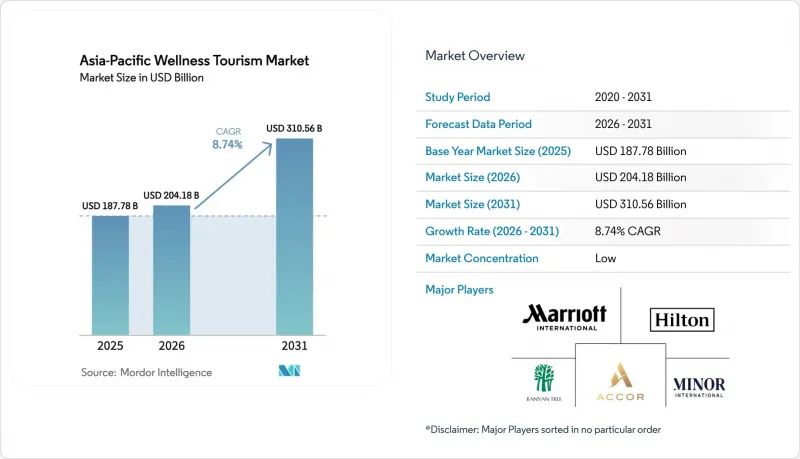
This report is Segmented by Service Type (Yoga & Meditation Retreats, and Other), Traveler Type (Primary Wellness Travel, Secondary Wellness Travel), Accommodation Type (Yoga Retreats, Wellness Hotels (Chain), Boutique Retreats, Eco-Wellness Lodges, Wellness Clinics With Stay), and Geography (India, and Other). The Market Forecasts are Provided in Terms of Value (USD).
Asia-Pacific Wellness Tourism Market Trends and Insights
Rising Middle-Class Disposable Income & Improved Air Links
Surging real wages and favorable demographic profiles have expanded the pool of travelers able to afford dedicated wellness breaks, especially throughout China, India, Indonesia, and Vietnam, where domestic air connectivity has multiplied over the past five years. Low-cost carriers have launched new point-to-point routes that reduce door-to-door travel time and lower fares, enabling weekend wellness escapes that were formerly limited to higher-income groups. Accelerated infrastructure development at secondary airports in Malaysia, Thailand, and the Philippines also lifts access for rural wellness assets, amplifying regional dispersion of visitor flows. Short-haul affordability widens the funnel for first-time wellness travelers, seeding long-term market expansion as repeat visitation boosts average spending on advanced treatments. Destinations able to combine quick flight access with authentic healing modalities consequently achieve stickier demand and favorable RevPAR trends across wellness-centric accommodation. Government incentives that subsidize regional route launches further reinforce the virtuous cycle, suggesting the growth dividend will extend through the medium term.
Post-Pandemic Health Consciousness
The COVID-19 crisis recast health preservation as a lifestyle imperative, vaulting immunity-building, stress reduction, and disease prevention to the heart of travel decision-making. Corporate wellness budgets have swelled as employers seek stress-relief programming to mitigate burnout among remote and hybrid workforces, catalyzing demand for evidence-based retreats that combine diagnostics with coaching. Parallel consumer surveys indicate that affluent Asian millennials value wellness as an "essential" rather than a discretionary purchase, shifting spend from retail to experiential services. Hotels and resorts that swiftly integrated on-site testing, pharmacist consultations, and immunity-focused menus during the reopening phase remain top-of-mind for repeat guests who now expect clinical rigor baked into every itinerary. Marketing narratives grounded in health outcomes rather than pampering experiences resonate widely, creating premium pricing headroom that sustains revenue growth even as traveler cost sensitivity rises elsewhere. The shift appears durable given persistent anxiety over future health shocks, entrenching wellness as a structural, not cyclical, travel driver.
High Price Sensitivity Among Gen-Z & Budget Travelers
Younger travelers across emerging Southeast Asian economies crave authentic wellness immersion yet remain constrained by modest discretionary income levels and rising inflation. Social media amplifies aspirational demand, but the luxury positioning of many destination spas places packages out of reach, prompting a proliferation of budget operators that often compromise on therapist quality, safety protocols, and hygiene. Price-focused competition can erode brand equity for incumbents if discounting leads to service dilution, while aggressive cost control measures may limit artisan sourcing, thereby diminishing authenticity. Operators that calibrate tiered product lines offering accessibly priced day passes alongside premium multi-day transformations better capture Gen-Z volumes without cannibalizing upscale segments. Innovative financing models such as buy-now-pay-later partnerships can further democratize access, though margin impacts must be weighed against acquisition gains. Over the short term, price friction is likely to restrain growth in lower-income source markets until rising wages or more efficient operating models narrow the affordability gap.
Other drivers and restraints analyzed in the detailed report include:
- Government Promotion of AYUSH, TCM & J-Wellness
- Digital-Nomad and Work-From-Anywhere Visas
- Shortage of Licensed Therapists & Wellness Practitioners
For complete list of drivers and restraints, kindly check the Table Of Contents.
Segment Analysis
Digital-detox escapes post a 11.64% CAGR through 2031, eclipsing growth across traditional spa categories even as spa and beauty therapies account for the largest 19.21% revenue slice of the Asia-Pacific wellness tourism market size in 2025. Retreat designers capitalize on employer anxiety over smartphone addiction by mandating tech-free zones, curating nature immersion itineraries, and offering cognitive coaching that restores focus and sleep patterns. Bundling mindfulness workshops with structured silence periods elevates perceived transformation value, helping properties command rates 20%-30% above conventional spa packages while reducing variable cost exposure to imported beauty products. For established resorts, layering digital-detox programs onto existing infrastructure generates incremental yield without extensive capex, encouraging chain-wide rollout despite heterogenous property footprints. Meanwhile, outcome-based modalities such as naturopathy cleanses and longevity monitoring attract health-optimized millennials who value measurable biomarkers over indulgent pampering. Authentic traditional medicine centers in Kerala, Bali, and Chiang Mai integrate centuries-old herbal therapies with clinical diagnostics, drawing repeat guests who track health progression across sequential visits and advocate through social networks, reinforcing organic demand flywheels.
Complete Report Scope:
- By Service Type
- Yoga & Meditation Retreats
- Spa & Beauty Therapies
- Naturopathy & Detox Packages
- Mental-Wellness Retreats
- Digital-Detox Escapes
- Spiritual Healing Journeys
- By Traveler Type
- Primary Wellness Travel
- Secondary Wellness Travel
- By Accommodation Type
- Yoga Retreats
- Wellness Hotels (Chain)
- Boutique Retreats
- Eco-Wellness Lodges
- Wellness Clinics with Stay
- By Geography
- India
- China
- Japan
- Australia
- South Korea
- South East Asia (Singapore, Malaysia, Thailand, Indonesia, Vietnam, and Philippines)
- Rest of Asia-Pacific
List of Companies Covered in this Report:
- Accor
- Marriott International
- Hilton Worldwide
- Hyatt Hotels Corporation
- InterContinental Hotels Group (IHG)
- Banyan Tree Holdings
- Minor International (Anantara / Avani)
- Six Senses Hotels Resorts Spas
- Aman Group
- Mandarin Oriental Hotel Group
- Shangri-La Group
- The Indian Hotels Company (IHCL - Taj / Vivanta)
- Chiva-Som International Health Resort
- COMO Hotels and Resorts
- Rosewood Hotel Group
- Centara Hotels & Resorts
- Dusit International
- Gwinganna Lifestyle Retreat
- Ananda in the Himalayas
- Kamalaya Koh Samui
Additional Benefits:
- The market estimate (ME) sheet in Excel format
- 3 months of analyst support
TABLE OF CONTENTS
1 Introduction
- 1.1 Study Assumptions and Market Definition
- 1.2 Scope of the Study
2 Research Methodology
3 Executive Summary
4 Market Landscape
- 4.1 Market Overview
- 4.2 Market Drivers
- 4.2.1 Rising middle-class disposable income & intra-regional air-connectivity boom
- 4.2.2 Post-pandemic health consciousness accelerating preventive-care travel
- 4.2.3 Government promotion of AYUSH, TCM & J-Wellness creating demand pull
- 4.2.4 Digital nomad & "work-from-any-where" visas extending length-of-stay for wellness seekers
- 4.2.5 Corporate off-site mental-wellness retreats tackling employee burnout (under-radar)
- 4.2.6 Buy-Now-Pay-Later travel financing unlocking premium retreat affordability (under-radar)
- 4.3 Market Restraints
- 4.3.1 High price sensitivity among Gen-Z & budget travellers
- 4.3.2 Shortage of licensed therapists & wellness practitioners across APAC
- 4.3.3 Fragmented accreditation & quality-control frameworks
- 4.3.4 Rising insurance exclusions for non-prescribed wellness services (under-radar)
- 4.4 Value / Supply-Chain Analysis
- 4.5 Regulatory Landscape
- 4.6 Technological Outlook
- 4.7 Porter's Five Forces
- 4.7.1 Threat of New Entrants
- 4.7.2 Bargaining Power of Suppliers
- 4.7.3 Bargaining Power of Buyers
- 4.7.4 Threat of Substitutes
- 4.7.5 Industry Rivalry
5 Market Size & Growth Forecasts
- 5.1 By Service Type
- 5.1.1 Yoga & Meditation Retreats
- 5.1.2 Spa & Beauty Therapies
- 5.1.3 Naturopathy & Detox Packages
- 5.1.4 Mental-Wellness Retreats
- 5.1.5 Digital-Detox Escapes
- 5.1.6 Spiritual Healing Journeys
- 5.2 By Traveler Type
- 5.2.1 Primary Wellness Travel
- 5.2.2 Secondary Wellness Travel
- 5.3 By Accommodation Type
- 5.3.1 Yoga Retreats
- 5.3.2 Wellness Hotels (Chain)
- 5.3.3 Boutique Retreats
- 5.3.4 Eco-Wellness Lodges
- 5.3.5 Wellness Clinics with Stay
- 5.4 By Geography
- 5.4.1 India
- 5.4.2 China
- 5.4.3 Japan
- 5.4.4 Australia
- 5.4.5 South Korea
- 5.4.6 South East Asia (Singapore, Malaysia, Thailand, Indonesia, Vietnam, and Philippines)
- 5.4.7 Rest of Asia-Pacific
6 Competitive Landscape
- 6.1 Market Concentration
- 6.2 Strategic Moves
- 6.3 Market Share Analysis
- 6.4 Company Profiles (includes Global level Overview, Market level overview, Core Segments, Financials as available, Strategic Information, Market Rank/Share for key companies, Products & Services, and Recent Developments)
- 6.4.1 Accor
- 6.4.2 Marriott International
- 6.4.3 Hilton Worldwide
- 6.4.4 Hyatt Hotels Corporation
- 6.4.5 InterContinental Hotels Group (IHG)
- 6.4.6 Banyan Tree Holdings
- 6.4.7 Minor International (Anantara / Avani)
- 6.4.8 Six Senses Hotels Resorts Spas
- 6.4.9 Aman Group
- 6.4.10 Mandarin Oriental Hotel Group
- 6.4.11 Shangri-La Group
- 6.4.12 The Indian Hotels Company (IHCL - Taj / Vivanta)
- 6.4.13 Chiva-Som International Health Resort
- 6.4.14 COMO Hotels and Resorts
- 6.4.15 Rosewood Hotel Group
- 6.4.16 Centara Hotels & Resorts
- 6.4.17 Dusit International
- 6.4.18 Gwinganna Lifestyle Retreat
- 6.4.19 Ananda in the Himalayas
- 6.4.20 Kamalaya Koh Samui
7 Market Opportunities & Future Outlook
- 7.1 Cross-border AYUSH & Traditional-Medicine retreat packages targeting Chinese & Western millennials
- 7.2 Immersive mixed-reality wellness experiences integrated with metaverse-enabled booking platforms

