PUBLISHER: Mordor Intelligence | PRODUCT CODE: 2125524

PUBLISHER: Mordor Intelligence | PRODUCT CODE: 2125524
Europe Wellness Tourism - Market Share Analysis, Industry Trends & Statistics, Growth Forecasts (2026 - 2031)
According to Mordor Intelligence, the Europe wellness tourism market size was valued at USD 3.49 billion in 2025 and estimated to grow from USD 3.65 billion in 2026 to reach USD 4.56 billion by 2031, at a CAGR of 4.55% during the forecast period (2026-2031).
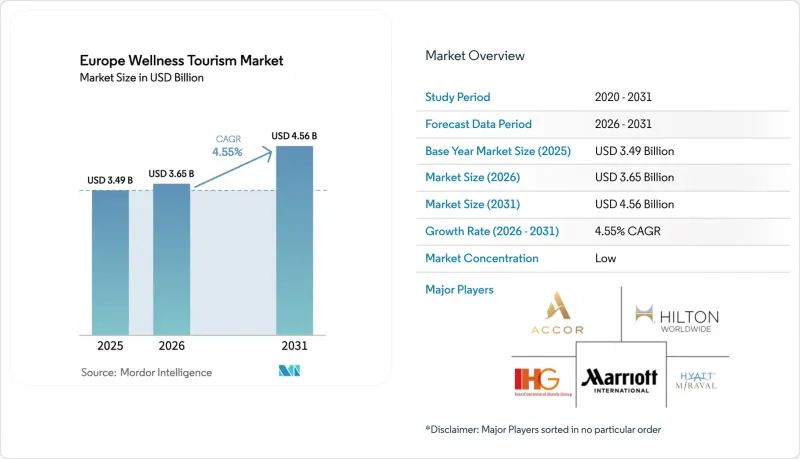
This report is Segmented by Service Type (Inbound Services and Outbound Travel Packages), Traveler (Solo Travelers, Couples, and More), Age Group (Gen Z (18-24), Millennials (25-40) and More), Channel of Booking (Direct (Resort/Center Website), Online Travel Agencies (OTAs), Wellness Tour Operators), Geography (United Kingdom, Germany, France and More).
Europe Wellness Tourism Market Trends and Insights
Rising Health Consciousness & Preventive Healthcare
Policy makers echo this trend, the European Commission's Health at a Glance 2024 stresses preventive healthcare as a priority, reinforcing demand for wellness stays that integrate diagnostics, nutrition, and movement. Operators leverage this momentum by bundling medical checkups, mindfulness sessions, and outdoor activities, enabling the Europe wellness tourism market to capture discretionary spend otherwise allocated to conventional holidays. Wellness villages in Germany and forest-based retreats in Finland illustrate how preventive care packages are becoming mainstream. As consumer education deepens, suppliers that showcase measurable health outcomes continue to secure premium pricing.
Strong Infrastructure & Spa Tradition
Centuries-old bath cultures in Germany, Austria, and Italy anchor a dependable pipeline of domestic and regional visitors. Restored Roman baths, Alpine thermal springs, and Thalassotherapy centers in France offer purpose-built facilities well suited to contemporary wellness programs. The Europe wellness tourism market benefits from these sunk investments: operators add modern diagnostics, sleep labs, and functional training zones without large-scale construction. Municipal governments frequently co-finance upgrades, viewing spa clusters as regional economic stabilizers. This long-standing infrastructure lowers entry barriers for new themed experiences, from biohacking workshops to longevity clinics.
High Cost of Premium Wellness Packages
Wellness retreats in Europe's top spa towns often command daily rates exceeding USD 600, narrowing the addressable base to affluent consumers. The European Parliament cautions that elevated price points exclude mid-income travelers and strain growth potential. Inflation in utilities and skilled labor widens cost gaps versus comparable Thai or Turkish resorts. To defend volume, operators introduce shorter three-night programs, off-season discounts, and tiered service models. Dynamic pricing engines also help right-size tariffs to demand patterns. While price sensitivity weighs on upscale properties, mid-market players that optimize cost structures can still secure share within the Europe wellness tourism market.
Other drivers and restraints analyzed in the detailed report include:
- Ageing Population Seeking Wellness Retreats
- Government & EU Support for Wellness Tourism
- Seasonal Demand Fluctuations
For complete list of drivers and restraints, kindly check the Table Of Contents.
Segment Analysis
Inbound services generated 65.90% of 2025 revenue within the Europe wellness tourism market. Thermal baths in Baden-Baden, mud therapies in Abano Terme, and Nordic saunas in Lapland continue to lure regional visitors. The Europe wellness tourism market size for inbound programs is expected to expand at a steady pace as supply upgrades align with new preventive-health expectations. Cross-selling accommodation, gastronomy, and diagnostics elevates average spending and prolongs stays.
Outbound wellness packages show a 6.24% CAGR for 2026-2031. Europeans are pursuing yoga in Portugal, Ayurveda in India, and marine-therapy cruises in the Mediterranean. Flexible work schedules enable shoulder-season travel, supporting load factors for tour operators. The Europe wellness tourism market benefits as outbound specialists leverage dynamic packaging technology, curated practitioner networks, and transparent sustainability labels that appeal to Gen Z explorers.
Couples represented 39.75% of 2025 transactions in the Europe wellness tourism market. Romantic spa suites, double-occupancy thermal pools, and tailor-made nutrition counseling encourage joint participation. Packages that integrate wine-tasting with mindfulness walks strengthen emotional bonding while enhancing resort margins. The Europe wellness tourism market size derived from couples is poised for incremental gains as the wedding-anniversary and babymoon segments mature.
Solo travelers register a 7.05% CAGR and are reshaping product design. Women account for a sizable share, often booking fitness-centric retreats that blend personal growth with social interaction. Resorts respond by scheduling communal dining tables, group hikes, and life-coaching sessions, balancing autonomy with companionship. Loyalty apps that track health metrics foster repeat stays and advocacy, deepening penetration of solos in the Europe wellness tourism market.
Complete Report Scope:
- By Service Type
- Inbound Services (Spa, Therapy, Yoga, etc.)
- Outbound Travel Packages
- By Traveler Demographic
- Solo Travelers
- Couples
- Groups / Corporate Retreats
- Seniors
- By Age Group
- Gen Z (18-24)
- Millennials (25-40)
- Gen X (41-56)
- Seniors (57+)
- By Channel of Booking
- Direct (Resort/Center Website)
- Online Travel Agencies (OTAs)
- Wellness Tour Operators
- By Geography
- Europe
- United Kingdom
- Germany
- France
- Spain
- Italy
- BENELUX (Belgium, Netherlands, Luxembourg)
- NORDICS (Denmark, Finland, Iceland, Norway, Sweden)
- Rest of Europe
- Europe
List of Companies Covered in this Report:
- Accor S.A.
- Hilton Worldwide Holdings Inc.
- Marriott International Inc.
- InterContinental Hotels Group PLC
- Hyatt Hotels Corporation
- Six Senses Hotels Resorts Spas
- Aman Group
- Belmond Ltd.
- TUI Group
- Center Parcs (UK) Ltd.
- Relais & Chateaux
- SHA Wellness Clinic
- Clinique La Prairie
- Lanserhof Group
- Therme Group
- Blue Lagoon Ltd.
- Lefay Resorts & Residences
- Rocco Forte Hotels
- Banyan Tree Holdings Ltd.
- Minor Hotels (Anantara)
- Goco Hospitality
- Raison d'Etre Spa
- Miraval Resorts*
Additional Benefits:
- The market estimate (ME) sheet in Excel format
- 3 months of analyst support
TABLE OF CONTENTS
1 Introduction
- 1.1 Study Assumptions & Market Definition Scope of the Study
2 Research Methodology
3 Executive Summary
4 Market Landscape
- 4.1 Market Overview
- 4.2 Market Drivers
- 4.2.1 Rising Health Consciousness & Preventive Healthcare
- 4.2.2 Strong Infrastructure & Spa Tradition
- 4.2.3 Ageing Population Seeking Wellness Retreats
- 4.2.4 Government & EU Support for Wellness Tourism
- 4.2.5 Growth of Digital Detox and Sustainable Travel
- 4.3 Market Restraints
- 4.3.1 High Cost of Premium Wellness Packages
- 4.3.2 Seasonal Demand Fluctuations
- 4.3.3 Stringent Health Regulations & Licensing
- 4.3.4 Competition from Low-Cost International Destinations
- 4.4 Value / Supply-Chain Analysis
- 4.5 Regulatory Outlook
- 4.6 Technological Outlook
- 4.7 Porter's Five Forces
- 4.7.1 Threat of New Entrants
- 4.7.2 Threat of Substitutes
- 4.7.3 Bargaining Power of Suppliers
- 4.7.4 Bargaining Power of Buyers
5 Market Size & Growth Forecasts (Value, US$ Bn)
- 5.1 By Service Type
- 5.1.1 Inbound Services (Spa, Therapy, Yoga, etc.)
- 5.1.2 Outbound Travel Packages
- 5.2 By Traveler Demographic
- 5.2.1 Solo Travelers
- 5.2.2 Couples
- 5.2.3 Groups / Corporate Retreats
- 5.2.4 Seniors
- 5.3 By Age Group
- 5.3.1 Gen Z (18-24)
- 5.3.2 Millennials (25-40)
- 5.3.3 Gen X (41-56)
- 5.3.4 Seniors (57+)
- 5.4 By Channel of Booking
- 5.4.1 Direct (Resort/Center Website)
- 5.4.2 Online Travel Agencies (OTAs)
- 5.4.3 Wellness Tour Operators
- 5.5 By Geography
- 5.5.1 Europe
- 5.5.1.1 United Kingdom
- 5.5.1.2 Germany
- 5.5.1.3 France
- 5.5.1.4 Spain
- 5.5.1.5 Italy
- 5.5.1.6 BENELUX (Belgium, Netherlands, Luxembourg)
- 5.5.1.7 NORDICS (Denmark, Finland, Iceland, Norway, Sweden)
- 5.5.1.8 Rest of Europe
- 5.5.1 Europe
6 Competitive Landscape
- 6.1 Market Concentration
- 6.2 Strategic Moves
- 6.3 Market Share Analysis
- 6.4 Company Profiles (includes Global level Overview, Market level overview, Core Segments, Financials as available, Strategic Information, Market Rank/Share for key companies, Products & Services, and Recent Developments)
- 6.4.1 Accor S.A.
- 6.4.2 Hilton Worldwide Holdings Inc.
- 6.4.3 Marriott International Inc.
- 6.4.4 InterContinental Hotels Group PLC
- 6.4.5 Hyatt Hotels Corporation
- 6.4.6 Six Senses Hotels Resorts Spas
- 6.4.7 Aman Group
- 6.4.8 Belmond Ltd.
- 6.4.9 TUI Group
- 6.4.10 Center Parcs (UK) Ltd.
- 6.4.11 Relais & Chateaux
- 6.4.12 SHA Wellness Clinic
- 6.4.13 Clinique La Prairie
- 6.4.14 Lanserhof Group
- 6.4.15 Therme Group
- 6.4.16 Blue Lagoon Ltd.
- 6.4.17 Lefay Resorts & Residences
- 6.4.18 Rocco Forte Hotels
- 6.4.19 Banyan Tree Holdings Ltd.
- 6.4.20 Minor Hotels (Anantara)
- 6.4.21 Goco Hospitality
- 6.4.22 Raison d'Etre Spa
- 6.4.23 Miraval Resorts*
7 Market Opportunities & Future Outlook
- 7.1 White-space & Unmet-Need Assessment

