PUBLISHER: Mordor Intelligence | PRODUCT CODE: 2116431

PUBLISHER: Mordor Intelligence | PRODUCT CODE: 2116431
India Wellness Tourism - Market Share Analysis, Industry Trends & Statistics, Growth Forecasts (2026 - 2031)
According to Mordor Intelligence, the India wellness tourism market size is expected to grow from USD 28.87 billion in 2025 to USD 30.95 billion in 2026 and is forecast to reach USD 43.76 billion by 2031 at a 7.18% CAGR over 2026-2031.
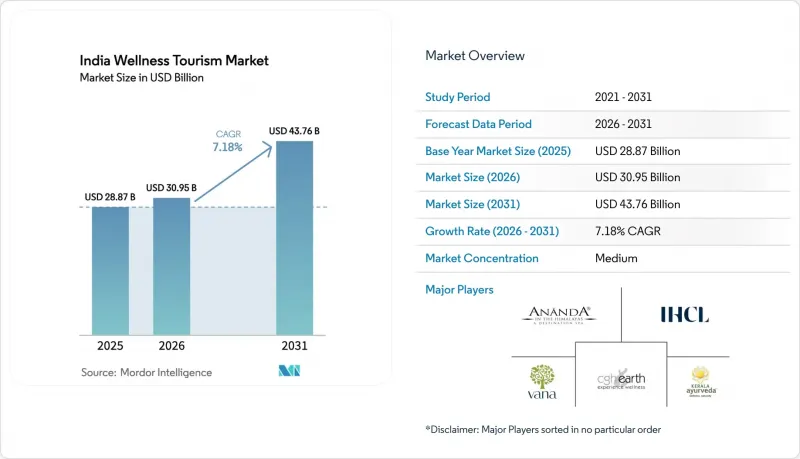
This report is Segmented by Service Type (Yoga & Meditation Retreats, Spa & Beauty Therapies, and More), Traveler Type (Primary Wellness Travel, and Secondary Wellness Travel), Accommodation Type (Yoga Retreats, Wellness Hotels (chain), Boutique Retreats, and More), and Geography (North India, West India, South India, East India). The Market Forecasts are Provided in Terms of Value (USD Billion).
India Wellness Tourism Market Trends and Insights
Rapid Expansion of AYUSH-Certified Resorts
FY26 budgetary support for AYUSH rises 14.2% to USD 444 million (INR 3,992.9 crore) and funds infrastructure grants and quality certification that expand credible supply across hospitals, dispensaries, and resort-affiliated clinics. The formal network now includes 3,844 AYUSH hospitals and 36,848 dispensaries, which anchor clinical standards and complement branded hospitality investments that scale the certified resort footprint in core states. Private operators add momentum through health-forward acquisitions and greenfield sites that blend physician-led diagnostics with resort-grade amenities to draw high-value guests for 3- to 14-night protocols, which strengthens the demand foundation of the India wellness tourism market. Standards development by the Bureau of Indian Standards, totalling 180 Indian Standards for AYUSH therapies and products, improves insurer acceptance and raises the bar for safety and efficacy disclosures across the value chain. Kerala Ayurveda's strong Q1 FY26 growth and its plan for a higher full-year topline signal that clinically rigorous models convert into premium pricing, higher occupancy, and repeat bookings that stabilize cash flows during shoulder seasons. As certified capacity expands, traveller confidence increases, and the India wellness tourism market gains durable traction across both domestic and inbound segments that value credentialed practitioners and quality assurance.
Inclusion of Wellness Packages in the e-Tourist Visa Scheme
India's e-Ayush visa, launched in July 2023, created a dedicated path for non-surgical Ayurveda, yoga, and naturopathy stays and simplified entry for wellness travellers who previously navigated medical visa processes unsuited to preventive care. In H1 2025, authorities issued 2.3 lakh AYUSH-linked entries, which represent a 15% year-over-year increase and indicate rising awareness across key source markets for the India wellness tourism market. The 60-day validity and triple-entry feature suit Panchakarma and other serial therapies that require staged programs and intermittent breaks, and this flexibility aligns well with contemporary long-stay patterns for detox and recovery journeys. A process update effective April 1, 2025, requires an invitation letter from a registered AYUSH facility, which filters out informal operators and shortens processing for certified resorts that maintain consistent compliance. Government-to-government initiatives, such as India's MoU with Malaysia on medical and wellness tourism, position wellness as a service export with diplomatic support that can expand source markets through streamlined promotion and reciprocal facilitation. Additional e-visa eligibility extensions, including to Kuwait in 2025, provide a template for tapping West Asian demand for alcohol-free, spiritually aligned programs that resonate with culture-linked wellness preferences.
Fragmented Quality Standards Across States
Quality enforcement varies across states, and a notable percentage of herbal products do not pass tests, which affects traveller confidence and constrains international distribution through medical-travel agents who require recognized certifications. A large cohort of micro and small AYUSH manufacturers did not meet the March 2025 WHO-GMP deadline, and slow approval cycles discourage product innovation that would otherwise be integrated into clinical packages. Inconsistent state-level oversight complicates buyer decisions, because standards in Kerala can differ from Karnataka or Uttarakhand, which causes aggregators to rely on brand reputation rather than harmonized seals. The absence of a unified certification framework raises curation costs for international operators and suppresses conversion in the India wellness tourism market for insured travellers who need consistent documentation. Initiatives to digitize practitioner registries and harmonize standards can lower transaction costs, lift trust, and expand the distribution reach of verified resorts and clinics in 2026. As states improve compliance systems and transparency, the India wellness tourism market gains access to new source markets that depend on third-party quality validation.
Other drivers and restraints analyzed in the detailed report include:
- Corporate Adoption of Wellness Off-Sites for Employee Retention
- Digitally Enabled Discovery (Meta-Search & Influencer Marketing)
- High GST on Wellness Services vs. Medical Services
For complete list of drivers and restraints, kindly check the Table Of Contents.
Segment Analysis
Yoga and Meditation Retreats account for the largest share, with 41.24% in 2025, which reflects India's lineage in these disciplines and the enduring appeal of structured programs in destinations like Rishikesh for the India wellness tourism market. Digital-Detox Escapes is the fastest-growing category, with a 17.33% projected CAGR from 2026 to 2031, driven by device-free policies, curated nature immersion, and measurable stress and sleep improvements that HR teams value in employee wellness calendars. Resorts have formalized surrender-on-check-in practices for smartphones and crafted itineraries around meditation, breath work, forest bathing, sound healing, and guided silence that align with mental health outcomes. Naturopathy and detox packages gain traction with insured households who now receive reimbursement for AYUSH therapies, which changes pricing dynamics and broadens reach beyond affluent self-pay guests. Spa and beauty therapies face commoditization in urban markets, but at destination resorts, they remain embedded in integrated programs, which balance therapeutic value with guest expectations for pampering in the India wellness tourism market.
Comparing historical and forecast phases, modalities tied to physical infrastructure rebounded post-2024 and stabilized in 2026 through integrated digital touchpoints that add value across the guest lifecycle. Continuous journeys that start with tele-consults, move into on-site programs, and extend into structured aftercare raise lifetime value and asset utilization, which strengthens unit economics at resorts. The India wellness tourism market size for Yoga and Meditation Retreats reflects this continuity, because clinical consults and outcomes tracking now accompany movement and meditation practices in premium programs. Operators use standards issued by the Bureau of Indian Standards to document therapies for insurer acceptance and cross-border referrals, which enhances trust in detox and naturopathy programs for inbound guests. As operators expand disciplined program design and credential disclosures, the category mix diversifies and cements the India wellness tourism market's appeal to both clinical and lifestyle travellers.
Complete Report Scope:
- By Service Type
- Yoga & Meditation Retreats
- Spa & Beauty Therapies
- Naturopathy & Detox Packages
- Mental-Wellness Retreats
- Digital-Detox Escapes
- Spiritual Healing Journeys
- By Traveler Type
- Primary Wellness Travel
- Secondary Wellness Travel
- By Accommodation Type
- Yoga Retreats
- Wellness Hotels (Chain)
- Boutique Retreats
- Eco-Wellness Lodges
- Wellness Clinics with Stay
- By Geographic Region
- North India
- West India
- South India
- East India
List of Companies Covered in this Report:
- Ananda in the Himalayas
- Vana Retreat
- Kerala Ayurveda Ltd
- Kairali Ayurvedic Group
- IHCL (Taj Wellness Retreats)
- CGH Earth Wellness (Swaswara)
- The Leela Palaces Hotels & Resorts
- Oberoi Hotels & Resorts ('Spa by Oberoi')
- Accor India (Rixos, Pullman Wellness)
- Hyatt India ('Well being at Hyatt')
- ITC Hotels ('Kaya Kalp Spa')
- Jindal Naturecure Institute
- Apollo Life Wellness
- Atmantan Wellness Resort
- Soukya Holistic Health Centre
- Niraamaya Retreats
- DLF The Lodhi ('Aasana Spa')
- Marriott India ('Quan Spa', Westin 'Heavenly Spa')
- SaffronStays Wellness Villas
- Ayurooms
Additional Benefits:
- The market estimate (ME) sheet in Excel format
- 3 months of analyst support
TABLE OF CONTENTS
1 Introduction
- 1.1 Study Assumptions & Market Definition
- 1.2 Scope of the Study
2 Research Methodology
3 Executive Summary
4 Market Landscape
- 4.1 Market Overview
- 4.2 Market Drivers
- 4.2.1 Rapid expansion of AYUSH-certified resorts
- 4.2.2 Inclusion of wellness packages in e-Tourist Visa scheme
- 4.2.3 Corporate adoption of wellness off-sites for employee retention
- 4.2.4 Digitally enabled discovery (meta-search & influencer marketing)
- 4.2.5 Rising domestic disposable income in Tier-2 cities
- 4.2.6 Uptake of preventive health spending post-COVID-19
- 4.3 Market Restraints
- 4.3.1 Fragmented quality standards across states
- 4.3.2 High GST on wellness services vs. medical services
- 4.3.3 Limited international air-seat capacity to secondary airports
- 4.3.4 Shortage of certified naturopathy & Ayurveda practitioners
- 4.4 Value / Supply-Chain Analysis
- 4.5 Regulatory Landscape
- 4.6 Technological Outlook
- 4.7 Porter's Five Forces Analysis
- 4.7.1 Threat of New Entrants
- 4.7.2 Bargaining Power of Suppliers
- 4.7.3 Bargaining Power of Buyers
- 4.7.4 Threat of Substitutes
- 4.7.5 Competitive Rivalry
5 Market Size & Growth Forecasts
- 5.1 By Service Type
- 5.1.1 Yoga & Meditation Retreats
- 5.1.2 Spa & Beauty Therapies
- 5.1.3 Naturopathy & Detox Packages
- 5.1.4 Mental-Wellness Retreats
- 5.1.5 Digital-Detox Escapes
- 5.1.6 Spiritual Healing Journeys
- 5.2 By Traveler Type
- 5.2.1 Primary Wellness Travel
- 5.2.2 Secondary Wellness Travel
- 5.3 By Accommodation Type
- 5.3.1 Yoga Retreats
- 5.3.2 Wellness Hotels (Chain)
- 5.3.3 Boutique Retreats
- 5.3.4 Eco-Wellness Lodges
- 5.3.5 Wellness Clinics with Stay
- 5.4 By Geographic Region
- 5.4.1 North India
- 5.4.2 West India
- 5.4.3 South India
- 5.4.4 East India
6 Competitive Landscape
- 6.1 Market Concentration
- 6.2 Strategic Moves
- 6.3 Market Share Analysis
- 6.4 Company Profiles {(includes Global level Overview, Market level overview, Core Segments, Financials as available, Strategic Information, Market Rank/Share for key companies, Products & Services, and Recent Developments)}
- 6.4.1 Ananda in the Himalayas
- 6.4.2 Vana Retreat
- 6.4.3 Kerala Ayurveda Ltd
- 6.4.4 Kairali Ayurvedic Group
- 6.4.5 IHCL (Taj Wellness Retreats)
- 6.4.6 CGH Earth Wellness (Swaswara)
- 6.4.7 The Leela Palaces Hotels & Resorts
- 6.4.8 Oberoi Hotels & Resorts ('Spa by Oberoi')
- 6.4.9 Accor India (Rixos, Pullman Wellness)
- 6.4.10 Hyatt India ('Well being at Hyatt')
- 6.4.11 ITC Hotels ('Kaya Kalp Spa')
- 6.4.12 Jindal Naturecure Institute
- 6.4.13 Apollo Life Wellness
- 6.4.14 Atmantan Wellness Resort
- 6.4.15 Soukya Holistic Health Centre
- 6.4.16 Niraamaya Retreats
- 6.4.17 DLF The Lodhi ('Aasana Spa')
- 6.4.18 Marriott India ('Quan Spa', Westin 'Heavenly Spa')
- 6.4.19 SaffronStays Wellness Villas
- 6.4.20 Ayurooms
7 Market Opportunities & Future Outlook
- 7.1 Wellness-focused public-private coastal circuit development
- 7.2 Integration of Ayushman Bharat insurance for preventive retreats

