PUBLISHER: Mordor Intelligence | PRODUCT CODE: 2115890

PUBLISHER: Mordor Intelligence | PRODUCT CODE: 2115890
India Commercial Construction - Market Share Analysis, Industry Trends & Statistics, Growth Forecasts (2026 - 2031)
According to Mordor Intelligence, India commercial construction market size in 2026 is estimated at USD 191.12 billion, growing from 2025 value of USD 181.31 billion with 2031 projections showing USD 248.69 billion, growing at 5.41% CAGR over 2026-2031.
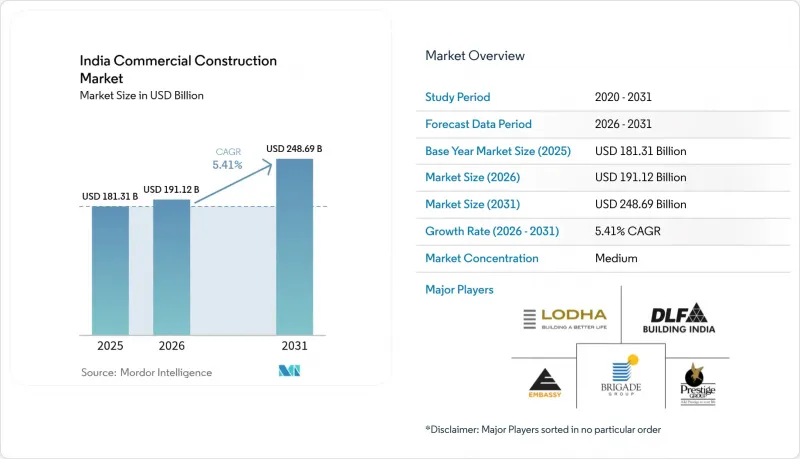
This report is Segmented by Commercial Sector Type (Office, Retail, Industrial and Logistics, and Others), by Construction Type (New Construction and Renovation), by Investment Source (Public and Private), and by Region (North India, South India, West India, East India, and Central India). The Market Forecasts are Provided in Terms of Value (USD).
India Commercial Construction Market Trends and Insights
Smart-Cities & Infrastructure Push
More than 7,500 smart-city projects worth USD 18.1 billion have reached completion, and early successes in Agra and Pune demonstrate replicable models for mixed-use districts. Integrated command centers drive specialty demand for data-rich operations buildings, while transit upgrades spur commercial clusters along new corridors. Land-aggregation hurdles in smaller municipalities still delay timelines, prompting state governments to refine acquisition policies. Public-private partnerships proliferate as municipalities bundle road, utility, and commercial precincts into single concessions. Over the medium term, these initiatives provide a consistent demand floor for the India commercial construction market.
REIT-Led Liquidity Injection
Four active REITs now steward USD 1.72 billion in cumulative distributions and have unlocked a USD 7.47 billion gross asset base for reinvestment. The August 2025 listing of Knowledge Realty Trust raised USD 578 million, signaling maturing investor appetite for yield-oriented commercial portfolios. Roughly 60% of Grade-A office stock meets REIT eligibility, expanding the investable universe for pension and sovereign funds. Fresh equity enables faster ground-breaking for large campuses, especially in corridors with reliable fiber and power links. Wider acceptance of small-and medium-sized REIT structures is poised to funnel retail capital toward mid-tier projects in Tier 2 locations, widening the funding base across the India commercial construction market.
Construction-Cost Inflation
Average build costs touched USD 33.4 per square foot in 2025 after a 39% four-year climb. Labor alone rose 25% in the past 12 months as migration to urban centers slowed. Volatile steel and cement pricing squeeze smaller developers that lack hedging facilities. Contractors respond by substituting locally quarried aggregates, adopting automated rebar-bending stations, and scheduling pours during off-peak power-tariff windows. Nonetheless, if wage pressures persist into 2026, marginal projects could slip beneath hurdle rates, trimming the headline growth of the India commercial construction market.
Other drivers and restraints analyzed in the detailed report include:
- Data-Center Build-Outs
- Flex-Space Culture
- Regulatory Approval Delays
For complete list of drivers and restraints, kindly check the Table Of Contents.
Segment Analysis
The Office segment captured 60.90% of 2025 revenue, illustrating the primacy of global capability centers in metros like Bengaluru and Mumbai. Workspace densification, wellness-oriented designs, and pre-certified green cores now define premium absorption patterns. The India commercial construction market size for Office assets is set to advance at a steady clip as multinationals renew long-term commitments and domestic tech firms upscale headquarters footprints. Rising preference for touch-down areas and meeting-rich layouts underpins fit-out flexibility, while landlords deploy smart sensors to track utilization and cut operating expenses.
Industrial & Logistics, energized by e-commerce and production-linked incentives, exhibits the strongest 6.84% CAGR outlook. Grade-A warehouses integrate solar rooftops, high-bay automation, and cold-chain nodes near consumption centers. Developers parcel last-mile hubs into multi-story structures that optimize expensive urban land. The India commercial construction market harmonizes industrial sheds, cross-dock facilities, and collaborative office pods within single parks to shrink tenant commute times and slash emissions. As supply chains regionalize, land acquisition along the Delhi-Mumbai Freight Corridor and Chennai-Bengaluru belt intensifies, further tilting the growth axis toward integrated industrial townships.
Complete Report Scope:
- By Commercial Sector Type
- Office
- Retail
- Industrial and Logistics
- Others
- By Construction Type
- New Construction
- Renovation
- By Investment Source
- Public
- Private
- By Region
- North India
- South India
- West India
- East India
- Central India
List of Companies Covered in this Report:
- DLF Ltd.
- Prestige Group
- Macrotech Developers (Lodha)
- Embassy Group
- Brigade Enterprises
- Godrej Properties
- K Raheja Corp
- Shapoorji Pallonji Real Estate
- L&T Construction
- Tata Projects
- Sobha Ltd.
- Oberoi Realty
- Mahindra Lifespace
- NBCC (India) Ltd.
- Omaxe Ltd.
- B. L. Kashyap & Sons
- Bharti Realty
- Salarpuria Sattva
- Phoenix Mills
- Unitech Group
Additional Benefits:
- The market estimate (ME) sheet in Excel format
- 3 months of analyst support
TABLE OF CONTENTS
1 Introduction
- 1.1 Study Assumptions & Market Definition
- 1.2 Scope of the Study
2 Research Methodology
3 Executive Summary
4 Market Landscape
- 4.1 Market Overview
- 4.2 Market Drivers
- 4.2.1 Smart-Cities & infra push
- 4.2.2 REIT-led liquidity injection
- 4.2.3 Flex-space culture
- 4.2.4 Data-centre build-outs
- 4.2.5 Net-zero retrofit wave
- 4.3 Market Restraints
- 4.3.1 Construction-cost inflation
- 4.3.2 Regulatory approval delays
- 4.3.3 Grid-capacity bottlenecks (Tier-2)
- 4.3.4 Flight-to-quality vacancy risk
- 4.4 Value / Supply-Chain Analysis
- 4.4.1 Overview
- 4.4.2 Real Estate Developers and Contractors - Key Quantitative and Qualitative Insights
- 4.4.3 Architectural and Engineering Companies - Key Quantitative and Qualitative Insights
- 4.4.4 Building Material and Equipment Companies - Key Quantitative and Qualitative Insights
- 4.5 Government Initiatives & Vision
- 4.6 Regulatory Outlook
- 4.7 Technological Outlook
- 4.8 Industry Attractiveness - Porter's Five Force Analysis
- 4.8.1 Bargaining Power of Suppliers
- 4.8.2 Bargaining Power of Buyers
- 4.8.3 Threat of New Entrants
- 4.8.4 Threat of Substitutes
- 4.8.5 Intensity of Competitive Rivalry
- 4.9 Pricing (Construction Materials) and Construction Cost (Materials, Labour, Equipment) Analysis
- 4.10 Comparison of Key Industry Metrics of India with Other Countries
- 4.11 Key Upcoming/Ongoing Projects (with a focus on Mega Projects)
5 Market Size & Growth Forecasts (Value, In USD Billion)
- 5.1 By Commercial Sector Type
- 5.1.1 Office
- 5.1.2 Retail
- 5.1.3 Industrial and Logistics
- 5.1.4 Others
- 5.2 By Construction Type
- 5.2.1 New Construction
- 5.2.2 Renovation
- 5.3 By Investment Source
- 5.3.1 Public
- 5.3.2 Private
- 5.4 By Region
- 5.4.1 North India
- 5.4.2 South India
- 5.4.3 West India
- 5.4.4 East India
- 5.4.5 Central India
6 Competitive Landscape
- 6.1 Market Concentration
- 6.2 Strategic Moves
- 6.3 Market Share Analysis
- 6.4 Company Profiles (includes Global level Overview, Market level overview, Core Segments, Financials as available, Strategic Information, Products & Services, and Recent Developments)
- 6.4.1 DLF Ltd.
- 6.4.2 Prestige Group
- 6.4.3 Macrotech Developers (Lodha)
- 6.4.4 Embassy Group
- 6.4.5 Brigade Enterprises
- 6.4.6 Godrej Properties
- 6.4.7 K Raheja Corp
- 6.4.8 Shapoorji Pallonji Real Estate
- 6.4.9 L&T Construction
- 6.4.10 Tata Projects
- 6.4.11 Sobha Ltd.
- 6.4.12 Oberoi Realty
- 6.4.13 Mahindra Lifespace
- 6.4.14 NBCC (India) Ltd.
- 6.4.15 Omaxe Ltd.
- 6.4.16 B. L. Kashyap & Sons
- 6.4.17 Bharti Realty
- 6.4.18 Salarpuria Sattva
- 6.4.19 Phoenix Mills
- 6.4.20 Unitech Group
7 Market Opportunities & Future Outlook
- 7.1 White-space & Unmet-Need Assessment

