PUBLISHER: Mordor Intelligence | PRODUCT CODE: 2124436

PUBLISHER: Mordor Intelligence | PRODUCT CODE: 2124436
Germany Commercial Construction - Market Share Analysis, Industry Trends & Statistics, Growth Forecasts (2026 - 2031)
According to Mordor Intelligence, Germany commercial construction market size in 2026 is estimated at USD 72.82 billion, growing from 2025 value of USD 69.62 billion with 2031 projections showing USD 90.94 billion, growing at 4.59% CAGR over 2026-2031.
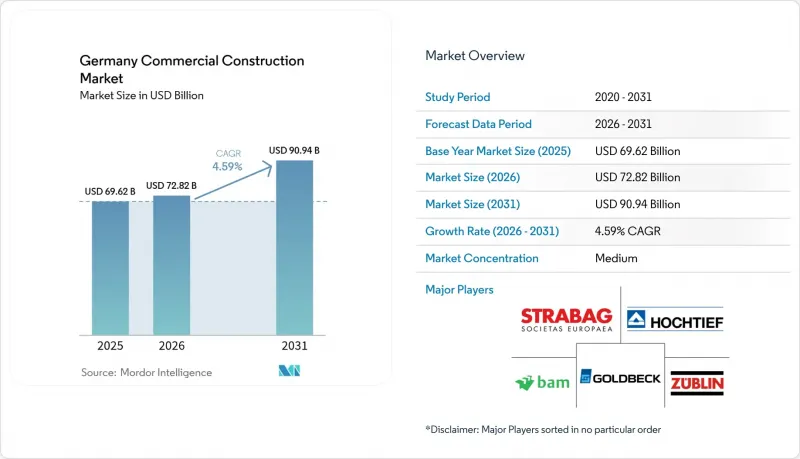
This report is Segmented by Commercial Sector Type (Office, Industrial & Logistics, and More), by Construction Type (New Construction and Renovation), by Investment Source (Private and Public), and by City (Berlin, Frankfurt, Munich, Hamburg, and Rest of Germany). The Report Offers Market Size and Forecasts in Value (USD) for all the Above Segments.
Germany Commercial Construction Market Trends and Insights
Energy-efficiency retrofit incentives drive market transformation
Germany's streamlined BEG grant scheme now covers up to 45% of eligible renovation costs, lowering capital hurdles for mid-sized property owners. Contractors with HVAC, facade, and smart-building expertise see fuller backlogs as compliance becomes a tenant-attraction tool in tight urban sub-markets. Building owners prioritize envelope upgrades and heat-pump integration to lock in lower operating costs. The retrofit wave supports a nationwide shift toward net-zero goals and improves the Germany commercial construction market's earnings visibility. Momentum is expected to persist through 2028, when stricter EU taxonomy rules take effect.
Rapid growth in data-center construction reshapes infrastructure priorities
Microsoft earmarked USD 3.52 billion for German AI infrastructure, while Amazon committed USD 8.58 billion to its sovereign-cloud region near Berlin. Frankfurt's power-dense corridor remains the nucleus, yet secondary sites in Berlin and Munich are scaling. Projects demand redundant grids, liquid-cooling, and renewable energy tie-ins to meet the 2027 100% clean-power mandate. Specialized contractors with mission-critical credentials gain a pricing premium, reinforcing the Germany commercial construction market's pivot toward technology-centric assets.
Construction-material price volatility constrains project economics
Germany's materials index climbed 3.2% year over year in February 2025 as energy costs remained elevated. Developers struggle to lock in lump-sum contracts, adding contingency allowances that push some projects beyond feasibility thresholds. Roofing and electrical packages show the steepest inflation, prompting substitution toward prefabricated elements where possible. Although hedging strategies soften the blow, persistent volatility pressures the Germany commercial construction market's near-term margin outlook.
Other drivers and restraints analyzed in the detailed report include:
- Expansion of last-mile logistics and urban warehousing fuels new builds
- Industrialised building methods gain institutional acceptance
- Labor shortage intensifies despite wage increases
For complete list of drivers and restraints, kindly check the Table Of Contents.
Segment Analysis
Office construction held 22.12% of the Germany commercial construction market share in 2025, yet demand is evolving as hybrid work models reduce average floor-space needs and intensify expectations for energy-efficient buildings. At the same time, industrial and logistics facilities are on track for a 5.02% CAGR to 2031, reflecting the surge in e-commerce fulfilment and the re-design of supply chains that now favor last-mile hubs close to consumers. These projects call for automated racking, low-carbon materials, and on-site renewable power, moving the segment well beyond conventional warehouse design. Smaller segments-healthcare, education, and mixed-use schemes-benefit from demographic shifts and public spending but expand at a slower pace than logistics, underscoring Germany's growing role as a European distribution node.
DACHSER's USD 48.4 million facility in Unna, equipped for 22,000 pallets and slated to create 290 jobs, shows the scale and complexity that new logistics builds now demand. Photovoltaic roofs and recyclable construction materials are standard specifications, making environmental certification a baseline rather than a premium feature. Retail construction faces structural headwinds as shoppers migrate online, prompting developers to rethink malls as experience-led destinations or repurpose them for alternative commercial uses. Contractors that master smart-building integration and energy-retrofit skills are best positioned to capture the shifting mix of work, keeping the Germany commercial construction market resilient even as traditional office and retail pipelines adjust.
Complete Report Scope:
- By Commercial Sector Type
- Office
- Retail
- Industrial and Logistics
- Others
- By Construction Type
- New Construction
- Renovation
- By Investment Source
- Public
- Private
- By City
- Berlin
- Munich
- Frankfurt
- Hamburg
- Rest of Germany
List of Companies Covered in this Report:
- Strabag SE
- HOCHTIEF
- Ed. Zublin AG
- GOLDBECK GmbH
- BAM Deutschland AG
- Leonhard Weiss GmbH & Co. KG
- Max Bogl Bauservice GmbH & Co. KG
- Zech Group SE
- Koster GmbH
- PORR Deutschland GmbH
- Implenia Construction GmbH
- Bilfinger SE
- Johann Bunte Bauunternehmung GmbH & Co. KG
- Aug. Prien Bauunternehmung (GmbH & Co. KG)
- Dechant Hoch- und Ingenieurbau GmbH
- GOLDBECK Ost GmbH Niederlassung Sachsen-Plauen
- WOLFF & MULLER Holding GmbH & Co. KG
- GP Gunter Papenburg AG
- HABAU Deutschland GmbH
Additional Benefits:
- The market estimate (ME) sheet in Excel format
- 3 months of analyst support
TABLE OF CONTENTS
1 Introduction
- 1.1 Study Assumptions & Market Definition
- 1.2 Scope of the Study
2 Research Methodology
3 Executive Summary
4 Market Insights and Dynamics
- 4.1 Market Overview
- 4.2 Market Drivers
- 4.2.1 Energy-efficiency retrofit incentives (BEG & related schemes)
- 4.2.2 Expansion of last-mile logistics & urban warehousing
- 4.2.3 Rapid growth in data-centre construction for cloud & AI workloads
- 4.2.4 Increasing institutional capital allocation to German commercial RE
- 4.2.5 Industrialised building methods (modular / prefab) gaining traction
- 4.2.6 Corporate shift to flexible workspace driving adaptive-reuse projects
- 4.3 Market Restraints
- 4.3.1 Volatile construction-material prices tied to energy markets
- 4.3.2 Acute skilled-labour shortage and wage inflation
- 4.3.3 Lengthy permitting timelines in smaller municipalities
- 4.3.4 EU taxonomy carbon-intensity limits raising financing hurdles
- 4.4 Value / Supply-Chain Analysis
- 4.4.1 Overview
- 4.4.2 Real Estate Developers and Contractors - Key Quantitative and Qualitative Insights
- 4.4.3 Architectural and Engineering Companies - Key Quantitative and Qualitative Insights
- 4.4.4 Building Material and Equipment Companies - Key Quantitative and Qualitative Insights
- 4.5 Government Initiatives & Vision
- 4.6 Regulatory Outlook
- 4.7 Technological Outlook
- 4.8 Porter's Five Forces
- 4.8.1 Bargaining Power of Suppliers
- 4.8.2 Bargaining Power of Buyers
- 4.8.3 Threat of New Entrants
- 4.8.4 Threat of Substitutes
- 4.8.5 Intensity of Competitive Rivalry
- 4.9 Pricing (Construction Materials) and Construction Cost (Materials, Labour, Equipment) Analysis
- 4.10 Comparison of Key Industry Metrics of Germany with Other Countries
- 4.11 Key Upcoming/Ongoing Projects (with a focus on Mega Projects)
5 Market Size & Growth Forecasts (Value in USD)
- 5.1 By Commercial Sector Type
- 5.1.1 Office
- 5.1.2 Retail
- 5.1.3 Industrial and Logistics
- 5.1.4 Others
- 5.2 By Construction Type
- 5.2.1 New Construction
- 5.2.2 Renovation
- 5.3 By Investment Source
- 5.3.1 Public
- 5.3.2 Private
- 5.4 By City
- 5.4.1 Berlin
- 5.4.2 Munich
- 5.4.3 Frankfurt
- 5.4.4 Hamburg
- 5.4.5 Rest of Germany
6 Competitive Landscape
- 6.1 Market Concentration
- 6.2 Strategic Moves
- 6.3 Market Share Analysis
- 6.4 Company Profiles (includes Global level Overview, Market level overview, Core Segments, Financials as available, Strategic Information, Market Rank/Share for key companies, Products & Services, and Recent Developments)
- 6.4.1 Strabag SE
- 6.4.2 HOCHTIEF
- 6.4.3 Ed. Zublin AG
- 6.4.4 GOLDBECK GmbH
- 6.4.5 BAM Deutschland AG
- 6.4.6 Leonhard Weiss GmbH & Co. KG
- 6.4.7 Max Bogl Bauservice GmbH & Co. KG
- 6.4.8 Zech Group SE
- 6.4.9 Koster GmbH
- 6.4.10 PORR Deutschland GmbH
- 6.4.11 Implenia Construction GmbH
- 6.4.12 Bilfinger SE
- 6.4.13 Johann Bunte Bauunternehmung GmbH & Co. KG
- 6.4.14 Aug. Prien Bauunternehmung (GmbH & Co. KG)
- 6.4.15 Dechant Hoch- und Ingenieurbau GmbH
- 6.4.16 GOLDBECK Ost GmbH Niederlassung Sachsen-Plauen
- 6.4.17 WOLFF & MULLER Holding GmbH & Co. KG
- 6.4.18 GP Gunter Papenburg AG
- 6.4.19 HABAU Deutschland GmbH
7 Market Opportunities & Future Outlook

