PUBLISHER: Mordor Intelligence | PRODUCT CODE: 2116139

PUBLISHER: Mordor Intelligence | PRODUCT CODE: 2116139
Africa Prefabricated Housing Construction - Market Share Analysis, Industry Trends & Statistics, Growth Forecasts (2026 - 2031)
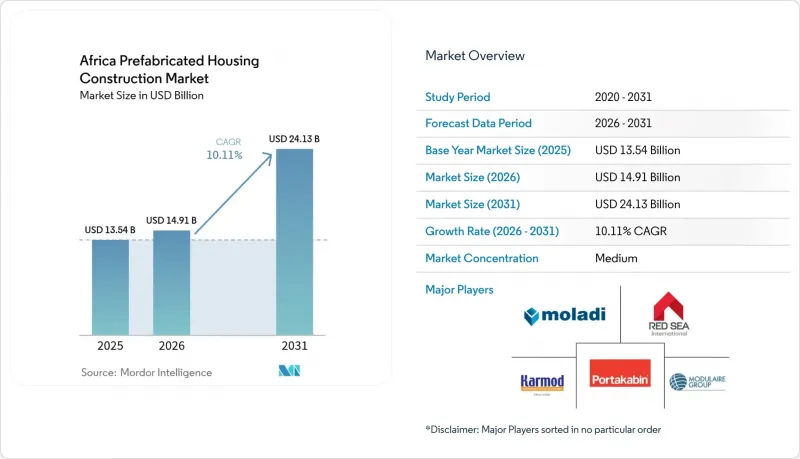
According to Mordor Intelligence, the Africa prefabricated housing construction market size was valued at USD 13.54 billion in 2025 and estimated to grow from USD 14.91 billion in 2026 to reach USD 24.13 billion by 2031, at a CAGR of 10.11% during the forecast period (2026-2031).
This report is Segmented by Material Type (Concrete, Glass, Metal, Timber, Other Materials), by Housing Type (Single-Family, Multi-Family), by Product Type (Modular Homes, Panelized & Componentized Systems, Manufactured Homes, Other Prefab Types), and by Geography (Nigeria, Egypt, South Africa, Rest of Africa). The Market Forecasts are Provided in Terms of Value (USD).
Africa Prefabricated Housing Construction Market Trends and Insights
Rapid Urbanization And Housing Deficits In Major Cities Creating Demand For Fast, Scalable Delivery
Africa's urban population is projected to hit 1.4 billion by 2050, with just four countries-Nigeria, Egypt, Ethiopia, and the Democratic Republic of Congo-contributing one-third of that growth. Nigeria alone faces a 28-million-unit housing shortfall, and the continent collectively needs 53 million additional dwellings, widening a USD 1 trillion financing gap. Densities above 50,000 people per square kilometer in Lagos, Cairo, and Johannesburg have pushed land values to levels where modular systems that require lighter foundations and minimal excavation deliver decisive cost savings. Governments now favor suppliers able to complete projects within 60-90 days and guarantee repeatability at scale, positioning factories with bulk off-take agreements to outcompete project-by-project contractors.
Government Affordable Housing Programs And PPPs Opening Pipelines For Standardized Prefab Units
Kenya's Affordable Housing Act of 2024 imposes a 1.5% payroll levy matched by employers, creating a ring-fenced fund empowered to award transparent turnkey contracts. Nigeria channels capital through Federal Housing Finance Limited, while Egypt's Social Housing and Mortgage Finance Fund has delivered 840,000 units to date. Cote d'Ivoire, backed by IFC transaction advisory, targets 150,000 units by 2025, and Senegal has published a World Bank-reviewed procurement plan inviting prefab bids. These initiatives de-risk factory investment by ensuring multi-year demand, though local-content thresholds and technology-transfer clauses require foreign entrants to adopt joint-venture or licensing models. Collectively, they add 2.8% to the Africa prefabricated housing construction market CAGR forecast by guaranteeing predictable volume for standardized designs.
Limited Local Manufacturing Depth And Imported Component Reliance Raising Delivered Costs And Lead Times
Precision components-insulated panels, welded mesh, and high-spec joinery-remain largely imported, inflating landed costs by 15-25% relative to brick-and-mortar in Nigeria and Kenya. Kenya's National Housing Corporation opened an EPS plant to feed its 110,000-unit pipeline, yet capacity shortfalls still necessitate freighted panels from Asia at more than USD 200 per cubic meter. South Africa's mature precast sector lessens exposure, but even certified suppliers import sealants and fasteners from Europe. AFC's USD 100 million special-economic-zone program finances new panel lines, although commissioning typically takes 18-24 months. These structural gaps shave 1.8% off forecast growth until meaningful localization gains momentum after 2026.
Other drivers and restraints analyzed in the detailed report include:
- Offsite Construction Shortening Build Times And Reducing Costs Amid Skilled-Labor Constraints
- Disaster Relief, Conflict Resettlement, And Climate Adaptation Needs Favoring Modular, Relocatable Homes
- Fragmented Regulations, Permitting Variability, And Building-Code Gaps Slowing Approvals And Uptake
For complete list of drivers and restraints, kindly check the Table Of Contents.
Segment Analysis
Concrete accounted for 44.12% of Africa's prefabricated housing construction market share in 2025, favored for fire resistance, affordability, and code familiarity. Holcim's ECOPact low-carbon mix delivered EDGE-certified units in Kenya's Mvule Gardens, showing concrete can meet green mandates without sacrificing structural integrity. The segment benefits from widespread cement capacity, local aggregates, and established supply chains that dampen currency risk. However, engineered-wood products-cross-laminated timber (CLT) and glue-laminated beams-are set to log an 10.69% CAGR, the fastest in the category, as carbon-pricing pilots and municipal incentives spread to Johannesburg and Nairobi. Mass Timber Technology's precision-cut CLT panels already qualify for South African tax rebates that trim property levies by up to 15%.
Growing environmental scrutiny and rapid installation advantages are driving pilot adoptions in mid-rise residential blocks. Arup's East Africa study confirms CLT offers 40-50% lower embodied carbon than reinforced concrete, and local plantation pine sources in Tanzania could enable price parity by 2027. Concrete is expected to defend its dominance through incremental innovation, such as geopolymer blends, while timber's upside will hinge on scaling kiln capacity, fire-testing regimes, and third-party certifications analogous to Agrement. Combined, these dynamics keep concrete ahead on volume, yet position timber as the sustainability-led growth engine within the Africa prefabricated housing construction market.
Complete Report Scope:
- By Material Type
- Concrete
- Glass
- Metal
- Timber
- Other Materials
- By Housing Type
- Single-Family
- Multi-Family
- By Product Type
- Modular Homes
- Panelized & Componentized Systems
- Manufactured Homes
- Other Prefab Types
- By Country
- Nigeria
- Egypt
- South Africa
- Rest of Africa
List of Companies Covered in this Report:
- Moladi
- Red Sea Housing Services
- Karmod Prefabricated Technologies
- Algeco (Modulaire Group)
- Portakabin
- Concor Buildings
- China State Construction Engineering Corp.
- Afritecture
- Vantem Global
- Kwikspace
- LafargeHolcim - 3DPrint & Modular
- BHC Steel Buildings
- Pretorius Structures
- ABT Innovative Building Solutions
- T3 Building Solutions
- Mac-Build Modular
- Siteform
- Hussain Aluminium (Prefab Division)
- ENCA Construction
- Group Five (Modular)
Additional Benefits:
- The market estimate (ME) sheet in Excel format
- 3 months of analyst support
TABLE OF CONTENTS
1 Introduction
- 1.1 Study Assumptions & Market Definition
- 1.2 Scope of the Study
2 Research Methodology
3 Executive Summary
4 Market Landscape
- 4.1 Market Overview
- 4.2 Market Drivers
- 4.2.1 Rapid urbanization and housing deficits in major cities creating demand for fast, scalable delivery.
- 4.2.2 Government affordable housing programs and PPPs opening pipelines for standardized prefab units.
- 4.2.3 Offsite construction shortening build times and reducing costs amid skilled labor constraints.
- 4.2.4 Disaster relief, conflict resettlement, and climate adaptation needs favoring modular, relocatable homes.
- 4.2.5 Growing investor interest in rental, staff housing, and student accommodation using industrialized methods.
- 4.3 Market Restraints
- 4.3.1 Limited local manufacturing depth and imported component reliance raising delivered costs and lead times.
- 4.3.2 Fragmented regulations, permitting variability, and building-code gaps slowing approvals and uptake.
- 4.3.3 Financing barriers-low mortgage penetration, high rates, and limited developer capital-constraining scale.
- 4.4 Value / Supply-Chain Analysis
- 4.5 Regulatory Landscape
- 4.6 Technological Outlook
- 4.7 Porter's Five Forces
- 4.7.1 Threat of New Entrants
- 4.7.2 Bargaining Power of Suppliers
- 4.7.3 Bargaining Power of Buyers
- 4.7.4 Threat of Substitutes
- 4.7.5 Competitive Rivalry
5 Market Size & Growth Forecasts (Value)
- 5.1 By Material Type
- 5.1.1 Concrete
- 5.1.2 Glass
- 5.1.3 Metal
- 5.1.4 Timber
- 5.1.5 Other Materials
- 5.2 By Housing Type
- 5.2.1 Single-Family
- 5.2.2 Multi-Family
- 5.3 By Product Type
- 5.3.1 Modular Homes
- 5.3.2 Panelized & Componentized Systems
- 5.3.3 Manufactured Homes
- 5.3.4 Other Prefab Types
- 5.4 By Country
- 5.4.1 Nigeria
- 5.4.2 Egypt
- 5.4.3 South Africa
- 5.4.4 Rest of Africa
6 Competitive Landscape
- 6.1 Market Concentration
- 6.2 Strategic Moves
- 6.3 Market Share Analysis
- 6.4 Company Profiles {(includes Global level Overview, Market level overview, Core Segments, Financials as available, Strategic Information, Products & Services, and Recent Developments)}
- 6.4.1 Moladi
- 6.4.2 Red Sea Housing Services
- 6.4.3 Karmod Prefabricated Technologies
- 6.4.4 Algeco (Modulaire Group)
- 6.4.5 Portakabin
- 6.4.6 Concor Buildings
- 6.4.7 China State Construction Engineering Corp.
- 6.4.8 Afritecture
- 6.4.9 Vantem Global
- 6.4.10 Kwikspace
- 6.4.11 LafargeHolcim - 3DPrint & Modular
- 6.4.12 BHC Steel Buildings
- 6.4.13 Pretorius Structures
- 6.4.14 ABT Innovative Building Solutions
- 6.4.15 T3 Building Solutions
- 6.4.16 Mac-Build Modular
- 6.4.17 Siteform
- 6.4.18 Hussain Aluminium (Prefab Division)
- 6.4.19 ENCA Construction
- 6.4.20 Group Five (Modular)
7 Market Opportunities & Future Outlook
- 7.1 White-space & Unmet-Need Assessment

