PUBLISHER: Mordor Intelligence | PRODUCT CODE: 2116272

PUBLISHER: Mordor Intelligence | PRODUCT CODE: 2116272
Singapore Insurtech - Market Share Analysis, Industry Trends & Statistics, Growth Forecasts (2026 - 2031)
According to Mordor Intelligence, the Singapore insurtech market size in terms of investment value was valued at USD 153.99 million in 2025 and is estimated to grow from USD 167.20 million in 2026 to reach USD 252.30 million by 2031, at a CAGR of 8.58% during the forecast period (2026-2031).
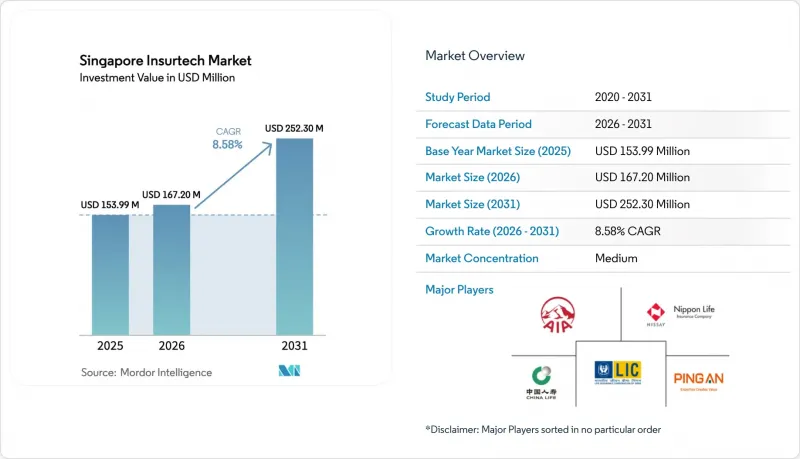
This report is Segmented by Insurance Type (Life Insurance, Non-Life Insurance), Distribution Channel (Direct To Consumer, Intermediate, Embedded), and Geography (Singapore). The Market Forecasts are Provided in Terms of Value (USD).
Singapore Insurtech Market Trends and Insights
Digital Adoption & Smartphone Penetration
Singapore's connectivity provides a strong foundation for digital insurance distribution, with mobile connections reaching 162.6% of the population and wireless broadband subscriptions at 182.2% as of January 2025. The finance and insurance sector contributes to a broader digital economy that reached USD 99.65 billion (SGD 128.1 billion) in 2024, equal to 18.6% of GDP, signaling a steady shift of customer journeys to digital interfaces, equivalent to USD 94.8 billion at recent average exchange rates. Full, standalone 5G coverage, achieved nationwide by 2025, enables telematics, computer vision-based claims assessments, and secure mobile submissions that reduce cycle times. These infrastructure advantages reinforce the Singapore InsurTech market by advancing real-time data capture, decisioning, and service workflows at scale.
Regulatory Support & MAS Initiatives
Targeted public funding and regulatory design have promoted live testing at manageable risk, backed by the MAS FinTech Regulatory Sandbox, Sandbox Express, and Sandbox Plus, which together broadened access to controlled pilots and non-routine models such as embedded or parametric insurance. The Financial Sector Technology and Innovation 3.0 scheme allocates USD 116.8 million (SGD 150 million) to sector-wide capacity building, while the 2024 top-up of USD 77.9 million (SGD 100 million) targets quantum and AI needs, further nudging the stack toward secure, explainable automation. The November 2025 consultation on Guidelines on AI Risk Management signals a shift from principles to lifecycle controls, requiring clear AI inventories, risk assessments, and oversight, with the consultation running to January 31, 2026. This evolving supervision increases clarity for the Singapore insurtech market by setting predictable guardrails for algorithmic use while encouraging safe deployment paths.
Cybersecurity & Data Privacy Risks
Threat activity remains elevated, with ransomware incidents and phishing attempts rising in 2024 and repeated supply chain exposures during 2025 that affected both insurers and banks. Income Insurance disclosed a May 2025 breach involving a third-party vendor, affecting at least 146 policyholders' personal data, reinforcing the need for stronger vendor risk management and incident response playbooks. In April 2025, two banks reported customer data compromises linked to a service provider, highlighting that interdependencies can magnify adverse outcomes when controls fail outside the core insurer perimeter. PDPA rules require breach notification within 72 hours in defined circumstances and impose significant penalties, including up to 10% of annual turnover or USD 0.78 million (SGD 1 million), whichever is higher, intensifying compliance and capital planning needs for data-intensive services. The Singapore insurtech market must prioritize identity-centric security and data minimization to balance scale with resilience in light of these regulatory and operational realities.
Other drivers and restraints analyzed in the detailed report include:
- Demand for Personalized Insurance Solutions
- AI, ML & Advanced Analytics Enablement
- Legacy Insurer Resistance to Digital Models
For complete list of drivers and restraints, kindly check the Table Of Contents.
Segment Analysis
Non-Life Insurance accounts for 63.50% of value in 2025 and is projected to grow at a 10.65% CAGR through 2031, reflecting faster uptake of cyber, travel, and device-protection products that fit mobile commerce and mobility contexts. Global carriers continue to expand embedded offerings through partner ecosystems, and recent platform activity showcases automatic claims triggers and in-app evidence collection that shorten cycle times. Distribution elasticity in retail, travel, and device channels gives non-life product suites more frequent customer touchpoints in Singapore. As multi-product platforms mature, the Singapore insurtech market increases its capacity to bundle and cross-sell coverage based on customer behaviour signals. Near-term momentum should benefit Non-Life as contextual distribution evolves along with improved data access and consent frameworks.
Life Insurance holds the remaining value in 2025 and continues to face longer development cycles, although digitization of underwriting, claims, and policy servicing is advancing across leading incumbents. The use of advanced analytics in medical claims triage shows potential to free capacity and improve speed without compromising oversight. Singapore's aging profile raises the relevance of health and protection coverage, and digital advice alongside human channels can improve financial planning outcomes. The Singapore insurtech market prioritizes transparent, mobile-first experiences to sustain engagement as Life products diversify through riders and wellness-linked benefits. Near-term focus in Life will remain on automating operations, streamlining distribution, and integrating data responsibly within the regulatory guidelines.
Complete Report Scope:
- By Insurance Type
- Life Insurance
- Non-Life Insurance
- By Distribution Channel
- Direct to Consumer
- Intermediate
- Embedded
List of Companies Covered in this Report:
- AIA Group
- Nippon Life Group
- Life Insurance Corporation of India (LIC)
- China Life Insurance Group
- Ping An Insurance Group
- Prudential plc
- Manulife Financial Group
- Dai-ichi Life Group
- Meiji Yasuda Life Group
- Tokio Marine Group
- MS&AD Insurance Group
- Samsung Life Insurance Group
- HDFC Life Group
- Sun Life Financial Group
- HSBC Life Group
- Aviva Group
- TAL Group
- AMP Group
- Muang Thai Life Assurance Group
- Hong Leong Financial Group
Additional Benefits:
- The market estimate (ME) sheet in Excel format
- 3 months of analyst support
TABLE OF CONTENTS
1 Introduction
- 1.1 Study Assumptions & Market Definition
- 1.2 Scope of the Study
2 Research Methodology
3 Executive Summary
4 Market Landscape
- 4.1 Market Overview
- 4.2 Market Drivers
- 4.2.1 Digital Adoption & Smartphone Penetration
- 4.2.2 Regulatory Support & MAS Initiatives
- 4.2.3 Demand for Personalized Insurance Solutions
- 4.2.4 AI, ML & Advanced Analytics Enablement
- 4.2.5 Supportive Fintech Regulatory Ecosystem
- 4.2.6 Rising Insurtech & Venture Investments
- 4.3 Market Restraints
- 4.3.1 Cybersecurity & Data Privacy Risks
- 4.3.2 Regulatory Compliance Complexity
- 4.3.3 Legacy Insurer Resistance to Digital Models
- 4.3.4 Limited Consumer Awareness in Select Segments
- 4.4 Macroeconomic & Industry Indicators Impacting the Market
- 4.5 Technology Analysis
- 4.6 Industry Value Chain Analysis
- 4.7 Porter's Five Forces Analysis
- 4.7.1 Threat of New Entrants
- 4.7.2 Bargaining Power of Suppliers
- 4.7.3 Bargaining Power of Buyers
- 4.7.4 Threat of Substitutes
- 4.7.5 Competitive Rivalry
5 Market Size & Growth Forecasts (Value)
- 5.1 By Insurance Type
- 5.1.1 Life Insurance
- 5.1.2 Non-Life Insurance
- 5.2 By Distribution Channel
- 5.2.1 Direct to Consumer
- 5.2.2 Intermediate
- 5.2.3 Embedded
6 Competitive Landscape
- 6.1 Market Concentration
- 6.2 Strategic Moves
- 6.3 Market Share Analysis
- 6.4 Company Profiles (includes Global level Overview, Market level overview, Core Segments, Financials as available, Strategic Information, Market Rank/Share for key companies, Products & Services, and Recent Developments)
- 6.4.1 AIA Group
- 6.4.2 Nippon Life Group
- 6.4.3 Life Insurance Corporation of India (LIC)
- 6.4.4 China Life Insurance Group
- 6.4.5 Ping An Insurance Group
- 6.4.6 Prudential plc
- 6.4.7 Manulife Financial Group
- 6.4.8 Dai-ichi Life Group
- 6.4.9 Meiji Yasuda Life Group
- 6.4.10 Tokio Marine Group
- 6.4.11 MS&AD Insurance Group
- 6.4.12 Samsung Life Insurance Group
- 6.4.13 HDFC Life Group
- 6.4.14 Sun Life Financial Group
- 6.4.15 HSBC Life Group
- 6.4.16 Aviva Group
- 6.4.17 TAL Group
- 6.4.18 AMP Group
- 6.4.19 Muang Thai Life Assurance Group
- 6.4.20 Hong Leong Financial Group
7 Market Opportunities & Future Outlook

