PUBLISHER: Mordor Intelligence | PRODUCT CODE: 2116616

PUBLISHER: Mordor Intelligence | PRODUCT CODE: 2116616
United States Insurtech - Market Share Analysis, Industry Trends & Statistics, Growth Forecasts (2026 - 2031)
According to Mordor Intelligence, the United States insurtech market size was valued at USD 310.2 billion in 2025 and estimated to grow from USD 327.17 billion in 2026 to reach USD 426.96 billion by 2031, at a CAGR of 5.47% during the forecast period (2026-2031).
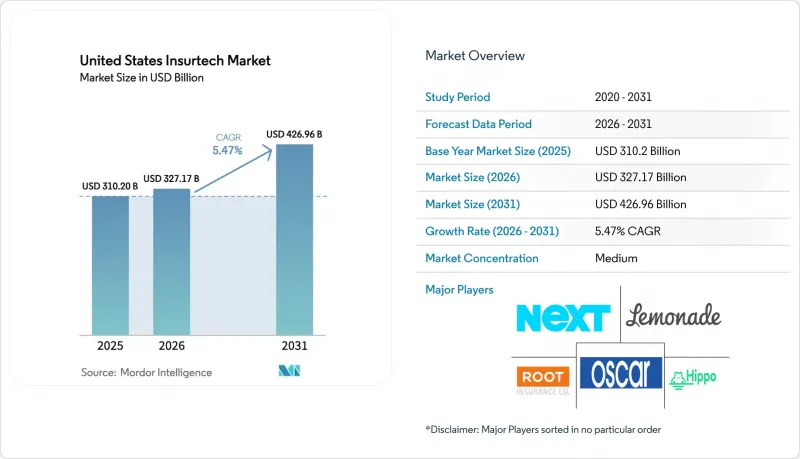
This report is Segmented by Business Model (Carrier, Enabler, and Distributor), Insurance Line (Life Insurance, Non-Life Insurance), Distribution Channel (Direct To Consumer, Intermediate, and Embedded), and Region (South, West, Midwest, and Northeast). The Market Forecasts are Provided in Terms of Value (USD).
United States Insurtech Market Trends and Insights
Demand for Data Analytics & AI
88% of US auto insurers and 70% of home insurers already deploy or pilot AI tools for loss triage and fraud prevention, prompting the NAIC to form a Third-Party Data and Models Task Force in 2024. Real-time risk assessment compresses quote-to-bind cycles from weeks to minutes, sharpening underwriting precision. Commercial carriers seek "agentic" AI to cope with rising claim severity and talent shortages, targeting operational expense ratios below 25%. However, Colorado's algorithmic-bias statute and similar bills increase compliance costs, favoring well-capitalized platforms able to audit model fairness. The United States insurtech market, therefore, rewards firms that can prove explainability while sustaining predictive accuracy.
Digital-First Consumer Purchasing
Mobile-optimised journeys now dictate insurer relevance: policyholders under 40 finalise 72% of new covers on smartphones. Telematics-driven auto policies price risk dynamically, making usage-based insurance attractive as vehicle premiums rise. Fleet operators integrate GPS diagnostics with carrier APIs to negotiate real-time premiums, pushing direct-to-consumer channels toward self-service experiences. Embedded checkout flows let retailers bundle parcel protection or travel cover in a single click, reducing acquisition costs by as much as 60%. These shifts elevate customer-experience metrics above price alone and reinforce direct digital strategies within the United States insurtech market.
Data-Privacy & Cyber-Breach Risk
The Change Healthcare intrusion compromising 100 million individuals underscores the vulnerability of interconnected claims workflows. Similar incidents at Globe Life's customer portal prompted swift regulatory review under California's Consumer Privacy Act, highlighting the possibility of multimillion-dollar fines. Heightened scrutiny obliges insurtechs to implement zero-trust architectures, multi-factor authentication, and annual penetration testing that can absorb up to 10% of operating expenditure. Investor sentiment remains positive toward cyber-resilience leaders, but valuation discounts emerge for platforms perceived as lagging on privacy assurance.
Other drivers and restraints analyzed in the detailed report include:
- Regulatory Sandbox & Open-API Mandates
- Embedded-Insurance via Open Banking
- Legacy-System Integration Costs
For complete list of drivers and restraints, kindly check the Table Of Contents.
Segment Analysis
Carrier platforms accounted for 45.12% of the United States insurtech market share in 2025, reflecting the enduring importance of capital strength and claims infrastructure. Enabler vendors, though smaller in absolute revenue, register the fastest progress with a 5.74% CAGR, suggesting that asset-light SaaS toolkits resonate with incumbents seeking rapid modernisation. The United States insurtech market size attributed to Enablers is projected to advance from roughly USD 14.4 billion today to more than USD 20.1 billion by 2031, as API orchestration, low-code product factories, and fraud analytics engines become plug-and-play essentials.
Strategic deals validate the trend: Munich Re entered full-stack operations by announcing a USD 2.6 billion purchase of Next Insurance in March 2025, while Travelers moved into cyber-specialty with its agreement to acquire Corvus. Such moves blur the carrier-enabler divide, shifting focus toward control of customer data and underwriting algorithms. Enablers leverage multi-tenant architecture to serve numerous carriers simultaneously, yielding superior marginal economics and positioning them as indispensable partners throughout the United States insurtech market.
Complete Report Scope:
- By Business Model
- Carrier
- Enabler
- Distributor
- By Insurance Line
- Life
- Non-Life
- By Distribution Channel
- Direct to Consumer
- Intermediate
- Embedded
- By Geography
- South
- West
- Midwest
- NorthEast
List of Companies Covered in this Report:
- Lemonade
- Root Insurance
- Hippo
- Next Insurance
- Metromile
- Oscar Health
- Bright Health
- Clover Health
- Gusto
- Pie Insurance
- Ethos Life
- Kin Insurance
- Clearcover
- Branch Insurance
- Insurify
- Policygenius
- Bold Penguin
- Trov
- Sidecar Health
- American Well
Additional Benefits:
- The market estimate (ME) sheet in Excel format
- 3 months of analyst support
TABLE OF CONTENTS
1 Introduction
- 1.1 Study Assumptions & Market Definition
- 1.2 Scope of the Study
2 Research Methodology
3 Executive Summary
4 Market Landscape
- 4.1 Market Overview
- 4.2 Market Drivers
- 4.2.1 Demand for data analytics & AI
- 4.2.2 Digital-first consumer purchasing
- 4.2.3 Regulatory sandbox & open-API mandates
- 4.2.4 Embedded-insurance via open banking
- 4.2.5 Climate-risk parametric products
- 4.2.6 Usage-Based & Behavior-Based Pricing (UBI/BBI)
- 4.3 Market Restraints
- 4.3.1 Data-privacy & cyber-breach risk
- 4.3.2 Legacy-system integration costs
- 4.3.3 Actuarial data-science talent gap
- 4.3.4 Scrutiny on algorithmic bias
- 4.4 Value / Supply-Chain Analysis
- 4.5 Technological Outlook
- 4.6 Regulatory Landscape
- 4.7 Funding & Investment Activity
- 4.8 Impact of Insurtech on US Insurance Industry
- 4.9 Porter's Five Forces
- 4.9.1 Bargaining Power of Suppliers
- 4.9.2 Bargaining Power of Buyers
- 4.9.3 Threat of New Entrants
- 4.9.4 Threat of Substitutes
- 4.9.5 Competitive Rivalry
5 Market Size & Growth Forecasts
- 5.1 By Business Model
- 5.1.1 Carrier
- 5.1.2 Enabler
- 5.1.3 Distributor
- 5.2 By Insurance Line
- 5.2.1 Life
- 5.2.2 Non-Life
- 5.3 By Distribution Channel
- 5.3.1 Direct to Consumer
- 5.3.2 Intermediate
- 5.3.3 Embedded
- 5.4 By Geography
- 5.4.1 South
- 5.4.2 West
- 5.4.3 Midwest
- 5.4.4 NorthEast
6 Competitive Landscape
- 6.1 Market Concentration
- 6.2 Strategic Moves
- 6.3 Market Share Analysis
- 6.4 Company Profiles (includes Global level Overview, Market level overview, Core Segments, Financials as available, Strategic Information, Market Rank/Share, Products & Services, Recent Developments)
- 6.4.1 Lemonade
- 6.4.2 Root Insurance
- 6.4.3 Hippo
- 6.4.4 Next Insurance
- 6.4.5 Metromile
- 6.4.6 Oscar Health
- 6.4.7 Bright Health
- 6.4.8 Clover Health
- 6.4.9 Gusto
- 6.4.10 Pie Insurance
- 6.4.11 Ethos Life
- 6.4.12 Kin Insurance
- 6.4.13 Clearcover
- 6.4.14 Branch Insurance
- 6.4.15 Insurify
- 6.4.16 Policygenius
- 6.4.17 Bold Penguin
- 6.4.18 Trov
- 6.4.19 Sidecar Health
- 6.4.20 American Well
7 Market Opportunities & Future Outlook
- 7.1 White-space & Unmet-Need Assessment

