PUBLISHER: Mordor Intelligence | PRODUCT CODE: 2116853

PUBLISHER: Mordor Intelligence | PRODUCT CODE: 2116853
Europe Insurtech - Market Share Analysis, Industry Trends & Statistics, Growth Forecasts (2026 - 2031)
According to Mordor Intelligence, the european insurtech market size was valued at USD 285.60 billion in 2025 and estimated to grow from USD 301.98 billion in 2026 to reach USD 399.13 billion by 2031, at a CAGR of 5.74% during the forecast period (2026-2031).
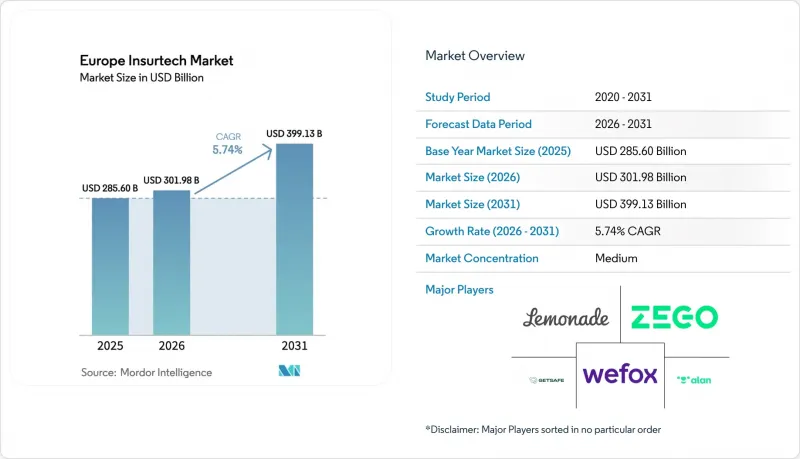
This report is Segmented by Product Line (Life Insurance, Health Insurance, Property & Casualty, Specialty Lines), Distribution Channel (Direct-To-Consumer Digital, Aggregators/Marketplaces, and More), End User (Retail/Individual, SME/Commercial, Large Enterprise/Corporate, and More), and Geography (United Kingdom, Germany, France, and More). The Market Forecasts are Provided in Terms of Value (USD).
Europe Insurtech Market Trends and Insights
Digital-first adoption and open-insurance APIs
European consumers now expect end-to-end digital journeys for quoting, binding, servicing, and claims after pandemic lockdowns accelerated channel migration. The EU Financial Data Access law that comes into force in 2027 mandates standardized APIs, which will slash switching friction and open multi-carrier comparison on any device. Incumbents, therefore, divert larger IT budgets to customer-facing micro-services in order to preserve share. Fintech sandboxes in the United Kingdom and Netherlands shorten product-testing cycles and encourage start-ups to plug directly into core-banking ecosystems. As open insurance matures, pricing transparency will reward firms that can pipe in alternative data sets for more granular risk scoring.
Embedded insurance with e-commerce and mobility
Premium written at checkout on ride-hailing, car-subscription, and online retail platforms more than doubled from 2023 to 2024, outpacing all other distribution formats. Qover and Allianz each extended white-label programs that package motor coverage in under 60 seconds for customers buying electric vehicles. Contextual offers lift conversion and keep acquisition cost below EUR 10 per policy, far lower than comparison-site averages. Regulatory sandboxes allow rapid proof-of-concept deployment while preserving product-suitability checks mandated by the Insurance Distribution Directive. E-commerce partners now request bundled cyber and warranty policies, broadening embedded use cases beyond travel and gadget lines.
Fragmented regulations across EU member states
Insurtechs must juggle 28 licensing regimes across the EU, the United Kingdom, and EFTA, each with unique capital buffers and consumer-protection nuances. Solvency II transposition varies, so a passported license rarely removes local reporting duties. Brexit doubled compliance workload for United Kingdom-based firms that sell into Europe, forcing many to establish dual entities. EIOPA's harmonization roadmap runs to 2030, which delays relief for start-ups seeking continental reach. Larger incumbents can amortize additional governance costs, widening the resource gap and cooling competitive heat.
Other drivers and restraints analyzed in the detailed report include:
- Generative-AI underwriting and claims automation
- Climate-driven parametric coverage expansion
- Venture-capital pullback and valuation compression
For complete list of drivers and restraints, kindly check the Table Of Contents.
Segment Analysis
Property & casualty generated 38.05% of premium in 2025, yet specialty categories enjoy the fastest 7.34% CAGR, adding meaningful dollars to the Europe insurtech market size through 2031. Early movers leverage external telemetry, supply-chain data, and pet-health APIs to shape granular risk pools and deliver combined ratios below 90%. Life and health policy growth holds steady as e-health records speed up underwriting in Germany and France. P&C automation funnels straightforward motor and home quotes into digital funnels, while marine and cyber underwriters handle complex exposures at higher margins. The NIS2 cybersecurity mandate and pet-ownership upticks both fuel premium expansion, enhancing diversification.
Past years show similar trends. From 2020 to 2024, specialty premiums more than doubled in absolute terms, aided by cloud-native pricing engines. Insurtech fleet products, for example, price kilometer usage in real time and rebate safe-driving behaviors monthly. Specialty underwriters also tap reinsurance sidecars to manage tail risk, enabling further appetite without straining capital. Collectively, these factors keep specialty lines the core growth engine of the Europe insurtech market.
Complete Report Scope:
- By Product Line (Insurance Type)
- Life Insurance
- Health Insurance
- Property & Casualty (Motor, Home, Commercial, Liability)
- Specialty Lines (Cyber, Pet, Marine, Travel)
- By Distribution Channel
- Direct-to-Consumer (Digital)
- Aggregators / Marketplaces
- Digital Brokers / MGAs
- Embedded Insurance Platforms
- Traditional Agents / Brokers (digitally enabled)
- Bancassurance (digitally enabled)
- Other Channels
- By End User
- Retail / Individual
- SME / Commercial
- Large Enterprise / Corporate
- Government / Public Sector
- By Region
- United Kingdom
- Germany
- France
- Spain
- Italy
- BENELUX (Belgium, Netherlands, and Luxembourg)
- NORDICS (Denmark, Finland, Iceland, Norway, and Sweden)
- Rest of Europe
List of Companies Covered in this Report:
- Alan
- Zego
- Wefox
- Lemonade
- Getsafe
- Tractable
- Shift Technology
- FRISS
- Qover
- Cuvva
- Laka
- Cytora
- Anorak
- Element
- Wakam
- Inshur
- Bought By Many (ManyPets)
- Ottonova
- Koala
- simplesurance
Additional Benefits:
- The market estimate (ME) sheet in Excel format
- 3 months of analyst support
TABLE OF CONTENTS
1 Introduction
- 1.1 Study Assumptions & Market Definition
- 1.2 Scope of the Study
2 Research Methodology
3 Executive Summary
4 Market Landscape
- 4.1 Market Overview
- 4.2 Market Drivers
- 4.2.1 Rising digital-first insurance adoption post-COVID
- 4.2.2 Regulatory push for open insurance & digital customer rights
- 4.2.3 Embedded insurance partnerships with e-commerce & mobility platforms
- 4.2.4 Generative-AI-driven straight-through underwriting & claims
- 4.2.5 Silver-economy demand for eldercare & longevity products
- 4.2.6 Surging demand for parametric insurance solutions amid escalating climate risks
- 4.3 Market Restraints
- 4.3.1 Fragmented EU regulatory regimes hamper cross-border scaling
- 4.3.2 VC funding slowdown & valuation compression since 2022
- 4.3.3 Scarcity of actuarial-grade synthetic data for AI model training
- 4.3.4 Persistent data quality and bias challenges in AI model development
- 4.4 Value / Supply-Chain Analysis
- 4.5 Regulatory Landscape
- 4.6 Technological Outlook
- 4.7 Porter's Five Forces
- 4.7.1 Bargaining Power of Buyers
- 4.7.2 Bargaining Power of Suppliers
- 4.7.3 Threat of New Entrants
- 4.7.4 Threat of Substitutes
- 4.7.5 Competitive Rivalry
5 Market Size & Growth Forecasts (Value)
- 5.1 By Product Line (Insurance Type)
- 5.1.1 Life Insurance
- 5.1.2 Health Insurance
- 5.1.3 Property & Casualty (Motor, Home, Commercial, Liability)
- 5.1.4 Specialty Lines (Cyber, Pet, Marine, Travel)
- 5.2 By Distribution Channel
- 5.2.1 Direct-to-Consumer (Digital)
- 5.2.2 Aggregators / Marketplaces
- 5.2.3 Digital Brokers / MGAs
- 5.2.4 Embedded Insurance Platforms
- 5.2.5 Traditional Agents / Brokers (digitally enabled)
- 5.2.6 Bancassurance (digitally enabled)
- 5.2.7 Other Channels
- 5.3 By End User
- 5.3.1 Retail / Individual
- 5.3.2 SME / Commercial
- 5.3.3 Large Enterprise / Corporate
- 5.3.4 Government / Public Sector
- 5.4 By Region
- 5.4.1 United Kingdom
- 5.4.2 Germany
- 5.4.3 France
- 5.4.4 Spain
- 5.4.5 Italy
- 5.4.6 BENELUX (Belgium, Netherlands, and Luxembourg)
- 5.4.7 NORDICS (Denmark, Finland, Iceland, Norway, and Sweden)
- 5.4.8 Rest of Europe
6 Competitive Landscape
- 6.1 Market Concentration
- 6.2 Strategic Moves
- 6.3 Market Share Analysis
- 6.4 Company Profiles (includes Global level Overview, Market level overview, Core Segments, Financials as available, Strategic Information, Market Rank/Share for key companies, Products & Services, and Recent Developments)
- 6.4.1 Alan
- 6.4.2 Zego
- 6.4.3 Wefox
- 6.4.4 Lemonade
- 6.4.5 Getsafe
- 6.4.6 Tractable
- 6.4.7 Shift Technology
- 6.4.8 FRISS
- 6.4.9 Qover
- 6.4.10 Cuvva
- 6.4.11 Laka
- 6.4.12 Cytora
- 6.4.13 Anorak
- 6.4.14 Element
- 6.4.15 Wakam
- 6.4.16 Inshur
- 6.4.17 Bought By Many (ManyPets)
- 6.4.18 Ottonova
- 6.4.19 Koala
- 6.4.20 simplesurance
7 Market Opportunities & Future Outlook
- 7.1 Embedded Insurance Solutions and Seamless Customer Integration
- 7.2 AI and IoT Advancements and Enhanced Risk Management Strategies

