PUBLISHER: Mordor Intelligence | PRODUCT CODE: 2116617

PUBLISHER: Mordor Intelligence | PRODUCT CODE: 2116617
Middle East And Africa Insurtech - Market Share Analysis, Industry Trends & Statistics, Growth Forecasts (2026 - 2031)
According to Mordor Intelligence, the Middle East and Africa Insurtech market size was valued at USD 12.09 billion in 2025 and estimated to grow from USD 13.06 billion in 2026 to reach USD 19.23 billion by 2031, at a CAGR of 8.03% during the forecast period (2026-2031).
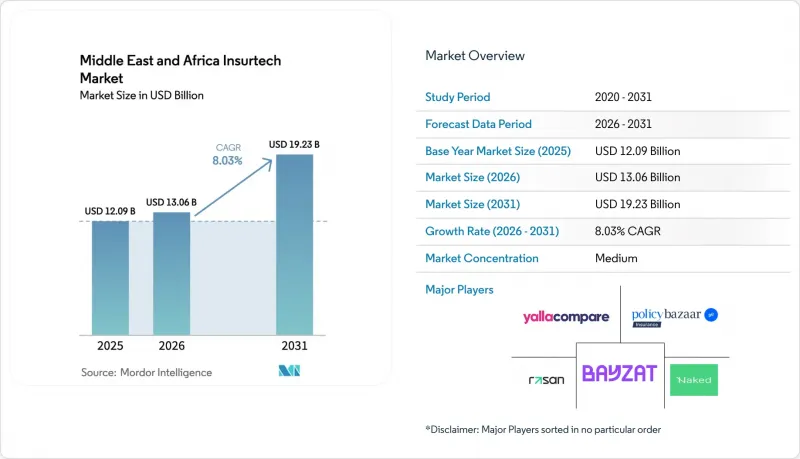
This report is Segmented by Product Line (Life Insurance, Health Insurance, Property & Casualty, Specialty Lines), Distribution Channel (Direct-To-Consumer, Aggregators, Digital Brokers, and More), End User (Retail, SME, Large Enterprise, Government), and Geography (UAE, Saudi Arabia, South Africa, Nigeria, Rest of MEA). The Market Forecasts are Provided in Terms of Value (USD).
Middle East And Africa Insurtech Market Trends and Insights
Mandatory Motor & Health Insurance Expansion
Gulf regulators require universal health cover and third-party motor liability, forcing millions of residents onto digital enrollment rails. Employers in the UAE must prove employee coverage when renewing work visas, while Saudi Arabia levies fines for lapsed motor liability certificates. Insurtech apps that scan Emirates IDs, pull payroll data, and price premiums in seconds are filling distribution gaps left by legacy agents. Automated compliance checks feed government databases, reducing policy-issuance friction and pushing renewal ratios above 90%. Traditional brokers are hurriedly linking to these APIs to defend commercial fleets, yet face margin pressure as self-service adoption grows. The rule-driven expansion, therefore, provides a stable premium floor and predictable claims patterns for tech-enabled carriers. As enforcement broadens, the Middle East and Africa Insurtech market is likely to shift an additional 5 million individual policies onto cloud platforms by 2027.
Low Insurance Penetration & Smartphone Adoption
African countries average sub-3% insurance density against smartphone penetration surpassing 60%. Nigeria embodies the gap-0.5% insurance but 84% mobile-phone access-allowing pay-as-you-go micro-policies priced in daily or weekly increments. Mobile money rails in Kenya and Ghana route premiums and claims instantly, cutting acquisition and servicing expenses by at least 40% versus in-person agents. Real-time usage data captured from telematics, crop sensors, and health wearables improves risk selection, narrowing combined ratios even in high-loss provinces. Social media integration also acts as free marketing, with referrals lifting month-one new-business volumes by double digits. Over the forecast horizon, these dynamics could lift Africa's digital policy fourfold without the fixed cost of branch networks. The smartphone dividend thus remains a foundational driver of the Middle East and Africa Insurtech market.
Regulatory Fragmentation Across MEA
Fifty-four African and sixteen Middle Eastern jurisdictions apply incompatible capital, reporting, and consumer-disclosure requirements. Insurtechs must maintain parallel compliance teams, inflating overhead and delaying multi-market launches. Nigeria's 2024 Insurance Act forces local data residency, while South Africa's twin-peaks framework leans on conduct-of-business supervision, complicating uniform policy wording. Sandbox passports help but rarely cover full-scale operations, leaving post-pilot scaling hamstrung. Without mutual-recognition treaties, cross-border embedded products stall at checkout as carriers scramble for valid licenses. Investors demand extra runway financing to cover lengthy approval cycles, depressing pre-money valuations. The resulting friction subtracts roughly 1.4 percentage points from the otherwise higher potential CAGR in the Middle East and Africa Insurtech market.
Other drivers and restraints analyzed in the detailed report include:
- Pro-Innovation Regulatory Sandboxes
- Growing VC & Insurer Partnerships
- Poor Data Quality for AI Models
For complete list of drivers and restraints, kindly check the Table Of Contents.
Segment Analysis
Health insurance generated 33.68% of 2025 revenue, buoyed by mandatory coverage for expatriates and citizens across Gulf states. Digital enrollment portals, telemedicine tie-ins, and AI triage chatbots raise operational efficiency, letting carriers comply with price caps while preserving margins. Life insurance at 28.35% benefits from booming mortgage markets and Sharia-compliant savings plans that embed family Takaful. Property and casualty lines, especially motor, grew as ride-hailing fleets adopted pay-per-mile telematics to trim premiums.
Specialty lines form the fastest-rising pocket, charting 10.96% CAGR. Cyber sales jump after new breach-notification statutes in Saudi Arabia and Kenya, while marine parametric cover hedges Red Sea shipping delays. Pet insurance finds traction among urban Saudi and Emirati households owning pedigree breeds, and parametric travel cover is embedded inside airline booking engines. The Middle East and Africa Insurtech market size for specialty policies is expected to double from USD 1.23 billion in 2026 to USD 2.35 billion by 2031, reflecting the appetite for targeted risk transfer solutions.
Complete Report Scope:
- By Product Line (Insurance Type)
- Life Insurance
- Health Insurance
- Property & Casualty (Motor, Home, Commercial, Liability)
- Specialty Lines (Cyber, Pet, Marine, Travel)
- By Distribution Channel
- Direct-to-Consumer (Digital)
- Aggregators / Marketplaces
- Digital Brokers / MGAs
- Embedded Insurance Platforms
- Traditional Agents / Brokers (digitally enabled)
- Bancassurance (digitally enabled)
- Other Channels
- By End User
- Retail / Individual
- SME / Commercial
- Large Enterprise / Corporate
- Government / Public Sector
- By Region
- Middle East
- United Arab Emirates
- Saudi Arabia
- South Africa
- Nigeria
- Rest of Middle East And Africa
- Middle East
List of Companies Covered in this Report:
- Rasan (Tameeni / Treza)
- Bayzat
- Policybazaar.ae
- Beema (UAE)
- Lami Technologies
- Yallacompare
- Aqeed
- Souqalmal
- Turaco
- MicroEnsure
- Casava
- Naked Insurance
- Tawuniya
- GIG Gulf (ex-AXA Gulf)
- InsuranceMarket.ae
- Discovery Insure
- Old Mutual iWYZE
- Hollard
- BIMA (Milvik)
- Klaim.ai
Additional Benefits:
- The market estimate (ME) sheet in Excel format
- 3 months of analyst support
TABLE OF CONTENTS
1 Introduction
- 1.1 Study Assumptions & Market Definition
- 1.2 Scope of the Study
2 Research Methodology
3 Executive Summary
4 Market Landscape
- 4.1 Market Overview
- 4.2 Market Drivers
- 4.2.1 Mandatory motor & health insurance expansion
- 4.2.2 Low insurance penetration & smartphone adoption
- 4.2.3 Pro-innovation regulatory sandboxes
- 4.2.4 Growing VC & insurer partnerships
- 4.2.5 Takaful-ready API platforms
- 4.2.6 Cross-border "reinsurance-as-a-service" hubs
- 4.3 Market Restraints
- 4.3.1 Regulatory fragmentation across MEA
- 4.3.2 Poor data quality for AI models
- 4.3.3 Reinsurer capacity squeeze for MGAs
- 4.3.4 Power/connectivity outages in frontier markets
- 4.4 Value / Supply-Chain Analysis
- 4.5 Regulatory Landscape
- 4.6 Technological Outlook
- 4.7 Porter's Five Forces
- 4.7.1 Threat of New Entrants
- 4.7.2 Bargaining Power of Buyers
- 4.7.3 Bargaining Power of Suppliers
- 4.7.4 Threat of Substitutes
- 4.7.5 Competitive Rivalry
5 Market Size & Growth Forecasts
- 5.1 By Product Line (Insurance Type)
- 5.1.1 Life Insurance
- 5.1.2 Health Insurance
- 5.1.3 Property & Casualty (Motor, Home, Commercial, Liability)
- 5.1.4 Specialty Lines (Cyber, Pet, Marine, Travel)
- 5.2 By Distribution Channel
- 5.2.1 Direct-to-Consumer (Digital)
- 5.2.2 Aggregators / Marketplaces
- 5.2.3 Digital Brokers / MGAs
- 5.2.4 Embedded Insurance Platforms
- 5.2.5 Traditional Agents / Brokers (digitally enabled)
- 5.2.6 Bancassurance (digitally enabled)
- 5.2.7 Other Channels
- 5.3 By End User
- 5.3.1 Retail / Individual
- 5.3.2 SME / Commercial
- 5.3.3 Large Enterprise / Corporate
- 5.3.4 Government / Public Sector
- 5.4 By Region
- 5.4.1 Middle East
- 5.4.1.1 United Arab Emirates
- 5.4.1.2 Saudi Arabia
- 5.4.1.3 South Africa
- 5.4.1.4 Nigeria
- 5.4.1.5 Rest of Middle East And Africa
- 5.4.1 Middle East
6 Competitive Landscape
- 6.1 Market Concentration
- 6.2 Strategic Moves
- 6.3 Market Share Analysis
- 6.4 Company Profiles (includes Global level Overview, Market level overview, Core Segments, Financials as available, Strategic Information, Market Rank/Share, Products & Services, Recent Developments)
- 6.4.1 Rasan (Tameeni / Treza)
- 6.4.2 Bayzat
- 6.4.3 Policybazaar.ae
- 6.4.4 Beema (UAE)
- 6.4.5 Lami Technologies
- 6.4.6 Yallacompare
- 6.4.7 Aqeed
- 6.4.8 Souqalmal
- 6.4.9 Turaco
- 6.4.10 MicroEnsure
- 6.4.11 Casava
- 6.4.12 Naked Insurance
- 6.4.13 Tawuniya
- 6.4.14 GIG Gulf (ex-AXA Gulf)
- 6.4.15 InsuranceMarket.ae
- 6.4.16 Discovery Insure
- 6.4.17 Old Mutual iWYZE
- 6.4.18 Hollard
- 6.4.19 BIMA (Milvik)
- 6.4.20 Klaim.ai
7 Market Opportunities & Future Outlook
- 7.1 Embedded Insurance Solutions and Seamless Customer Integration
- 7.2 AI and IoT Advancements and Enhanced Risk Management Strategies

