PUBLISHER: Mordor Intelligence | PRODUCT CODE: 2157070

PUBLISHER: Mordor Intelligence | PRODUCT CODE: 2157070
Indonesia Last Mile Delivery - Market Share Analysis, Industry Trends & Statistics, Growth Forecasts (2026 - 2031)
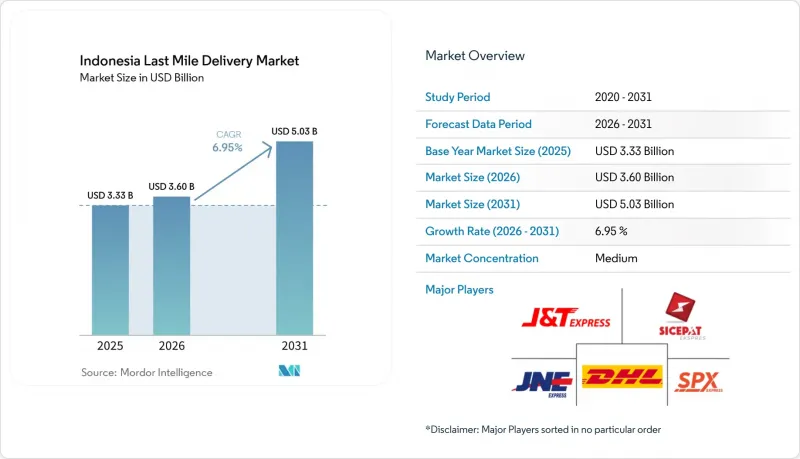
According to Mordor Intelligence, the Indonesia last mile delivery market size was valued at USD 3.33 billion in 2025 and estimated to grow from USD 3.60 billion in 2026 to reach USD 5.03 billion by 2031, at a CAGR of 6.95% during the forecast period (2026-2031).
Video commerce processed 2.6 billion transactions in 2025, following 90% growth, and it increased the frequency of smaller, time-sensitive orders. This report is Segmented by Service (Standard, Same Day, Next Day), by Business (B2B, B2C, C2C), by Product Type (Fashion and Lifestyle, Foods and Beverages, Personal Care, Furniture, Electronics, Others), by City Tier (Tier 1, Tier 2, Tier 3 and Below), and by City (Jakarta, Bandung, Surabaya, Medan, Tasikmalaya, Yogyakarta, Semarang, and More). The Market Forecasts are Provided in Terms of Value (USD).
Indonesia Last Mile Delivery Market Trends and Insights
E-Commerce And Marketplace Growth Accelerating Parcel Delivery Demand
Indonesia's e-commerce sector expanded strongly during 2025, with marketplace-led platforms accounting for a significant share of online sales and concentrating courier demand within large order flows. The rapid adoption of video commerce also increased transaction frequency, resulting in more frequent and smaller shipments compared with conventional online shopping. This shift supports demand for flexible fulfillment, parcel consolidation, and last mile delivery capabilities across Indonesia. Live-stream selling requires prompt pickup windows and shorter dispatch intervals after orders are confirmed. Carriers with integrated pickup scheduling and seller dashboards are better placed than counter-based models to process this order pattern. The Indonesia last mile delivery market, therefore, depends increasingly on the ability to connect seller workflows, parcel handover, and shipment tracking within the same operating process.
Rising Delivery Speed Expectations Driving Urban Convenience Demand
Indonesia's food delivery GMV reached USD 6.4 billion in 2025 and added USD 1 billion in value during the year. Consumers who use rapid food delivery are applying similar delivery expectations to non-food orders. This shift is most visible in Jakarta, Surabaya, and other Tier 1 cities, where order density supports shorter routes. Dark stores and micro-fulfillment operations have improved the practical reach of rapid delivery services. Same day delivery is forecast to register at a 9.12% CAGR through 2031, ahead of other service tiers. In the Indonesia last mile delivery market, fast delivery is becoming a core marketplace requirement in dense urban locations rather than a limited premium option.
Archipelagic Geography Increasing Inter-Island Delivery Complexity And Costs
Indonesia's 17,508-island geography keeps delivery costs on outer-island routes 20-40% above Java averages. Shipments to eastern Indonesia often require a motorcycle, a truck, sea freight, and another motorcycle movement. These handoffs add 3-5 touch points to a parcel route and increase the chance of delay, damage, or loss. The resulting service risk limits the service levels that providers can commit to in remote areas. Government plans for shared inter-carrier infrastructure and consolidated sorting capacity to address the need, but their timeline extends beyond the short term. The Indonesia last mile delivery market will therefore continue to face higher charges and lower service consistency in Papua, Maluku, Nusa Tenggara, and other outer-island routes.
Other drivers and restraints analyzed in the detailed report include:
- Digital Payments And Merchant Integration Streamlining Delivery Operations
- Logistics Infrastructure Investment Improving Nationwide Delivery Connectivity
- Fuel Volatility, Price Competition, And Operating Complexity Compressing Delivery Margins
For complete list of drivers and restraints, kindly check the Table Of Contents.
Segment Analysis
Standard delivery held 51.28% of Indonesia last mile delivery market size in 2025, while same day delivery is forecast to register at a 9.12% CAGR through 2031. Standard services retain the largest role because they offer lower package costs and predictable routing cycles. Their operating model is compatible with consolidated mid-mile truck movements and routine marketplace demand. This makes standard service suitable for non-perishable products where buyers accept a longer delivery window. It also allows carriers to use established sorting capacity across large order volumes. Indonesia's last mile delivery market size associated with standard delivery remains supported by the need for economical fulfillment across diverse consumer categories.
Same day delivery is supported by dense urban fulfillment and demand for faster order completion. Dark stores can position stock closer to buyers and reduce the travel distance from pickup to delivery. This service can command a higher tariff where route density is sufficient to support the cost. Next-day delivery sits between the two models for customers who want faster dispatch but do not want to pay for same day service. Its position is under pressure because sameday services compete at the premium end, while upgraded standard delivery improves at the other end. The service mix will depend on whether carriers can match delivery speed with reliable capacity and manageable route costs.
B2C represented 75.32% of Indonesia last mile delivery market share in 2025, while C2C is projected to register at a 13.44% CAGR through 2031. Marketplace platforms generate the order density that makes B2C the dominant business model. Shopee's 54% share of Indonesia's 2025 e-commerce GMV illustrates the influence of a major platform on carrier volumes. Carrier selection rules on large platforms can shape national order distribution. B2C delivery also benefits from repeatable collection patterns and relatively standardized shipping requirements. The Indonesia last mile delivery industry relies heavily on these platform relationships because they coordinate seller demand at scale.
B2B services support scheduled flows among manufacturers, distributors, sellers, and fulfillment locations. SAPX Express is pursuing government distribution programs, including Sekolah Rakyat and Koperasi Merah Putih initiatives. C2C activity is growing through social commerce on WhatsApp, Instagram, and TikTok. Individual sellers use these channels to ship directly to buyers without marketplace intermediation. Such orders can be irregular and geographically dispersed, which favors platforms that aggregate multiple carrier options. The Indonesia last mile delivery market may therefore require different service designs for recurring marketplace demand and lower-density seller-to-buyer shipments.
Complete Report Scope:
- By Service
- Standard Delivery
- Same Day Delivery
- Next Day Delivery
- By Business
- B2B (Business-to-Business)
- B2C (Business-to-Consumer)
- C2C (Customer-to-Customer)
- By Product Type
- Foods and Beverages
- Personal and Household Care
- Fashion and Lifestyle (accessories, apparel, footwear)
- Furniture
- Consumer Electronics and Household Appliances
- Other Products
- By City Tier
- Tier 1
- Tier 2
- Tier 3 and Below
- By City
- Jakarta
- Bandung
- Surabaya
- Medan
- Tasikmalaya
- Yogyakarta
- Semarang
- Denpasar
- Makassar
- Rest of Cities
List of Companies Covered in this Report:
- J&T Express
- SPX Express
- JNE Express
- SiCepat Ekspres
- Ninja Xpress
- Pos Indonesia
- Lion Parcel
- AnterAja
- TIKI
- GrabExpress
- GoSend (Gojek)
- Lalamove Indonesia
- Paxel
- ID Express
- SAPX Express
- Wahana Express
- DHL Group
- SF Express Indonesia
- RPX / PT Antareja Prima Antaran
- KAI Logistik / KALOG Express
- Pandu Logistics
- Borzo Indonesia
Additional Benefits:
- The market estimate (ME) sheet in Excel format
- 3 months of analyst support
TABLE OF CONTENTS
1 INTRODUCTION
- 1.1 Study Assumptions and Market Definition
- 1.2 Scope of the Study
2 RESEARCH METHODOLOGY
3 EXECUTIVE SUMMARY
- 3.1 Market Size, Growth, and Forecast Outlook
- 3.2 Key Demand Drivers and Last Mile Delivery Trends
- 3.3 Major Delivery Corridors and Demand Concentration
- 3.4 Competitive Landscape and Leading Last Mile Providers
4 MARKET LANDSCAPE
- 4.1 Market Overview and Importance of Last Mile Delivery
- 4.2 Market Drivers
- 4.2.1 E-commerce and Marketplace Growth Accelerating Parcel Delivery Demand
- 4.2.2 Rising Delivery Speed Expectations Driving Urban Convenience Demand
- 4.2.3 Digital Payments and Merchant Integration Streamlining Delivery Operations
- 4.2.4 Logistics Infrastructure Investment Improving Nationwide Delivery Connectivity
- 4.2.5 Digital Traceability Standards Improving Shipment Visibility and Compliance
- 4.2.6 Network Sharing Expanding Delivery Coverage Across Remote Areas
- 4.3 Market Restraints
- 4.3.1 Archipelagic Geography Increasing Inter-Island Delivery Complexity and Costs
- 4.3.2 Fuel Volatility and Price Competition Compressing Delivery Margins
- 4.3.3 Remote-Zone Delivery Costs Challenging Sustainable Service-Level Economics
- 4.3.4 Motorcycle Payload Limits and COD Reconciliation Increasing Complexity
- 4.4 Value Chain Structure and Last Mile Delivery Flow Analysis
- 4.5 Regulatory Framework Governing Courier and Delivery Services
- 4.6 Technology Adoption in Last Mile Delivery Operations
- 4.7 Urban Delivery Network and Coverage Structure Analysis
- 4.8 Delivery Pricing and Service-Level Benchmarking Analysis
- 4.9 Delivery Hub and Fulfillment Network Expansion Analysis
- 4.10 Porter's Five Forces Analysis
- 4.10.1 Threat of New Entrants
- 4.10.2 Bargaining Power of Buyers
- 4.10.3 Bargaining Power of Suppliers
- 4.10.4 Threat of Substitute Services
- 4.10.5 Intensity of Competitive Rivalry
- 4.11 Impact of Geo-Political Events on Supply Chain Shifts
5 MARKET SIZE AND GROWTH FORECASTS
- 5.1 By Service
- 5.1.1 Standard Delivery
- 5.1.2 Same Day Delivery
- 5.1.3 Next Day Delivery
- 5.2 By Business
- 5.2.1 B2B (Business-to-Business)
- 5.2.2 B2C (Business-to-Consumer)
- 5.2.3 C2C (Customer-to-Customer)
- 5.3 By Product Type
- 5.3.1 Foods and Beverages
- 5.3.2 Personal and Household Care
- 5.3.3 Fashion and Lifestyle (accessories, apparel, footwear)
- 5.3.4 Furniture
- 5.3.5 Consumer Electronics and Household Appliances
- 5.3.6 Other Products
- 5.4 By City Tier
- 5.4.1 Tier 1
- 5.4.2 Tier 2
- 5.4.3 Tier 3 and Below
- 5.5 By City
- 5.5.1 Jakarta
- 5.5.2 Bandung
- 5.5.3 Surabaya
- 5.5.4 Medan
- 5.5.5 Tasikmalaya
- 5.5.6 Yogyakarta
- 5.5.7 Semarang
- 5.5.8 Denpasar
- 5.5.9 Makassar
- 5.5.10 Rest of Cities
6 COMPETITIVE LANDSCAPE
- 6.1 Market Concentration
- 6.2 Strategic Moves
- 6.3 Market Share Analysis
- 6.4 Company Profiles (includes Global Level Overview, Market Level Overview, Core Segments, Financials as available, Strategic Information, Geographic Coverage, Products and Services, Recent Developments)
- 6.4.1 J&T Express
- 6.4.2 SPX Express
- 6.4.3 JNE Express
- 6.4.4 SiCepat Ekspres
- 6.4.5 Ninja Xpress
- 6.4.6 Pos Indonesia
- 6.4.7 Lion Parcel
- 6.4.8 AnterAja
- 6.4.9 TIKI
- 6.4.10 GrabExpress
- 6.4.11 GoSend (Gojek)
- 6.4.12 Lalamove Indonesia
- 6.4.13 Paxel
- 6.4.14 ID Express
- 6.4.15 SAPX Express
- 6.4.16 Wahana Express
- 6.4.17 DHL Group
- 6.4.18 SF Express Indonesia
- 6.4.19 RPX / PT Antareja Prima Antaran
- 6.4.20 KAI Logistik / KALOG Express
- 6.4.21 Pandu Logistics
- 6.4.22 Borzo Indonesia
7 MARKET OPPORTUNITIES AND FUTURE OUTLOOK
- 7.1 White-Space Opportunities and Unmet Last Mile Delivery Needs
- 7.2 High-Potential Customer Segments and Urban Growth Opportunities
- 7.3 Strategic Growth Priorities Across Last Mile Delivery Ecosystem
- 7.4 Future Market Outlook and Emerging Delivery Demand Pockets
8 APPENDIX

