PUBLISHER: Mordor Intelligence | PRODUCT CODE: 2155310

PUBLISHER: Mordor Intelligence | PRODUCT CODE: 2155310
E-commerce Last-mile Delivery - Market Share Analysis, Industry Trends & Statistics, Growth Forecasts (2026 - 2031)
According to Mordor Intelligence, the global e-commerce last-mile delivery market was valued at USD 207.92 billion in 2025 and is expected to grow to USD 231.61 billion in 2026, reaching USD 387.69 billion by 2031, at a CAGR of 10.85% over 2026-2031.
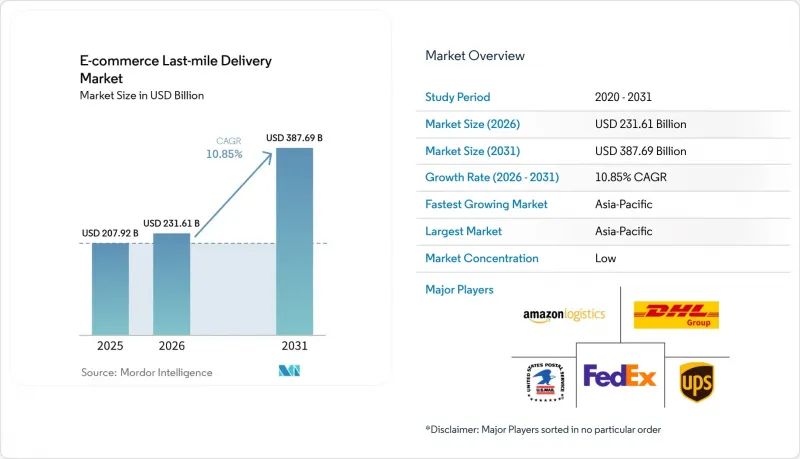
The global e-commerce last-mile delivery market is gaining momentum from higher parcel density in urban corridors, faster same-day infrastructure rollout, and wider adoption of route optimization tools across carrier networks. This report is Segmented by Delivery Type (Standard, Same-Day, and Next-Day), by Delivery Model (B2C, B2B, and C2C), by City Tier (Tier 1, Tier 2, and More), by Product Type (Foods and Beverages, Personal Care, Fashion and Lifestyle, Furniture, and More), and by Geography (North America, South America, Asia-Pacific, Europe, and MEA). The Market Forecasts are Provided in Terms of Value (USD).
Global E-commerce Last-mile Delivery Market Trends and Insights
E-Commerce Order Density Growth in Urban Corridors
Rising order concentration in cities is lowering per-stop delivery cost in the global e-commerce last-mile delivery market. Dense routes improve vehicle utilization and make route planning more predictable across short delivery radii. India's quick-commerce platforms operated nearly 1,900 dark stores by early 2026, and the count was projected to exceed 5,000 by the end of the year. Those networks process orders within 10-15 minutes, which means retailers need hyper-local fulfillment capacity rather than a conventional hub-and-spoke model. Amazon's May 2026 launch of Amazon Supply Chain Services shows that large carriers now view logistics networks as commercial products that can serve both outside brands and captive retail volume. In the global e-commerce last-mile delivery market, this change is raising the pressure on carriers that still rely on legacy cost structures and slower network redesign.
Same-Day and Next-Day Service Penetration
Same-day and next-day delivery have moved from premium options to standard expectations in many urban markets within the global e-commerce last-mile delivery market. That shift is forcing carriers to move inventory closer to end users and tighten control over delivery time windows. Aramex signed a master services agreement with Shipsy in April 2025 to deploy AI-powered route optimization, territory management, and time-slot tools for its same-day service rollout. The strongest pull is coming from use cases where urgency matters more than shipping price, especially food, returns, and refill-driven categories. Geopost reported 11% growth in temperature-controlled activity across 8 European countries in 2025, which supports the role of fast delivery in perishable and sensitive shipments. In the global e-commerce last-mile delivery market, faster delivery is no longer only a service upgrade; it is becoming a network design rule.
Urban Curb Access Constraints and Delivery Slot Scarcity
Urban access rules are making it harder to scale e-commerce last-mile delivery profitably in dense city centers. Low-emission zones, restricted time windows, and vehicle limits raise route complexity and reduce delivery flexibility. A 2026 Springer Nature study on urban last-mile routing showed that Zero Emission Zone enforcement can force operators to dedicate electric vehicle fleets to restricted routes before the cost savings of electrification are fully realized. That creates a front-loaded capital burden for fleets that still operate mixed vehicle bases across several jurisdictions. The issue is more severe where charging access, curb space, and local operating rules change from one city to another. In the global e-commerce last-mile delivery market, these frictions are limiting service flexibility even when parcel demand remains strong.
Other drivers and restraints analyzed in the detailed report include:
- Cross-Border Parcel Network Expansion
- Micro-Fulfillment and Dark Store Proximity Economics
- Driver Shortage and High Last-Mile Labor Intensity
For complete list of drivers and restraints, kindly check the Table Of Contents.
Segment Analysis
Standard delivery accounted for 58.20% of the global e-commerce last-mile delivery market share in 2025, indicating that price-sensitive consumers and bulk-oriented shippers still value predictable, lower-cost service windows. The global e-commerce last-mile delivery market still depends on this base because standard volumes provide the density that supports broader network utilization. Standard service remains especially relevant when delivery urgency is low, and parcel baskets are larger or less time-sensitive. Next-day delivery continues to sit at the midpoint of the service spectrum, benefiting from normalized delivery expectations and expanding suburban fulfillment coverage.
Same-day delivery is projected to expand at a 14.30% CAGR through 2031, and that growth requires inventory to be placed within a short operating radius of the end customer. Carriers, therefore, need dark stores, micro-fulfillment nodes, and smarter dispatching rather than only more long-haul capacity. Aramex addressed this in April 2025 by deploying Shipsy's AI-powered territory and route optimization tools to support its same-day product rollout. Geopost's out-of-home volumes in Europe grew 31% in 2025, indicating that parcel shops and lockers are taking a share of the demand that would otherwise require costly doorstep service. That moderation effect matters because same-day networks need high utilization to remain profitable, and out-of-home options help balance service speed with delivery cost discipline.
B2C accounted for 66.56% of the global e-commerce last-mile delivery market size in 2025, reflecting the central role of retailers, fashion platforms, and electronics sellers in building route density across the market. The consumer side of the global e-commerce last-mile delivery market remains the foundational parcel flow on which most carrier utilization models are built. B2B volumes are also rising as brands replenish smaller and more distributed fulfillment nodes that support omnichannel and fast-delivery models. Platforms such as Vinted, Poshmark, and Shopee fit this pattern because they generate large volumes of small, repeat individual shipments.
C2C is projected to grow at a 16.97% CAGR through 2031, giving it one of the clearest expansion paths in the global e-commerce last-mile delivery market. These parcels are usually light, dimensionally standardized, and suited to residential or out-of-home collection networks rather than heavy-touch delivery models. That makes C2C structurally compatible with locker and parcel shop systems that lower failed delivery rates and increase stop efficiency. B2B, while less visible, is also becoming more important because replenishment to distributed storage locations requires more frequent, time-sensitive movement than traditional bulk restocking.
Complete Report Scope:
- By Delivery Type
- Standard Delivery
- Same-Day Delivery
- Next-Day Delivery
- By Delivery Model
- Business-to-Consumer (B2C)
- Business-to-Business (B2B)
- Consumer-to-Consumer (C2C)
- By City Tier
- Tier 1
- Tier 2
- Tier 3 and Below
- By Product Type
- Foods and Beverages
- Personal and Household Care
- Fashion and Lifestyle (Accessories, Apparel, Footwear)
- Furniture
- Consumer Electronics and Household Appliances
- Other Products
- By Region/Country
- North America
- United States
- Canada
- Mexico
- South America
- Brazil
- Peru
- Chile
- Argentina
- Rest of South America
- Asia-Pacific
- China
- Japan
- India
- South Korea
- Australia
- South East Asia
- Rest of Asia-Pacific
- Europe
- United Kingdom
- Germany
- France
- Spain
- Italy
- BENELUX (Belgium, Netherlands, and Luxembourg)
- NORDICS (Denmark, Finland, Iceland, Norway, and Sweden)
- Rest of Europe
- Middle East and Africa
- United Arab Emirates
- Saudi Arabia
- South Africa
- Nigeria
- Rest of the Middle East And Africa
- North America
Geography Analysis
Asia-Pacific accounted for 38.41% of the global e-commerce last-mile delivery market share in 2025 and is also the fastest-growing region, with a 11.93% CAGR through 2031. The global e-commerce last-mile delivery market is particularly dynamic in Asia-Pacific, where scale and growth reinforce each other rather than moving in opposite directions. China's leading logistics operators are extending their domestic operating models into Southeast Asia, Europe, and the Americas, thereby shrinking the historical advantage of slower, more fragmented delivery systems. Cainiao opened a United States-Mexico trade lane in early 2026 and set up a dedicated logistics technology office in Japan while deploying its ZeeBot warehouse robot in Guangdong operations. Australia Post expanded its On demand same-day service to 372 new suburbs across 68 postcodes from July 2026, demonstrating that regional strategy in Asia-Pacific also includes large geographies that need flexible service models rather than just dense metro playbooks.
North America remains a critical operating theater because the global e-commerce last-mile delivery market there is being reshaped through both collaboration and direct competition. The United States Postal Service is becoming increasingly central as shared final-mile infrastructure for private carriers seeking broad national coverage without duplicating every low-density route. DHL eCommerce signed an exclusive multi-year agreement worth more than USD 10 billion with USPS in May 2026, covering final-mile delivery to more than 41,550 ZIP Codes and 170 million delivery points. Canada Post began preliminary work on a multi-year transformation in April 2026, including plans to move approximately 136,000 addresses from door-to-door service to community mailboxes in late 2026 or early 2027. These moves show that North American players are balancing reach, cost, and delivery density through hybrid models rather than relying on a single ownership structure for every route.
Europe presents the most layered competitive landscape in the global e-commerce last-mile delivery market, as pan-European integrators, national postal systems, and Chinese entrants compete for the same parcel pools. FedEx's February 2026 move, in partnership with its consortium, to acquire InPost was designed to tie residential parcel economics more closely to locker infrastructure across Europe. Geopost's network passed 150,000 parcel shops and lockers in 2025, which shows how strongly out-of-home delivery is being built into the regional operating model. The Middle East and South America remain smaller in absolute terms. Still, both regions are important for future growth because fast urban adoption and cross-border demand can support network expansion when service models are adapted to local infrastructure realities.
- Amazon Logistics
- United Parcel Service (UPS)
- FedEx Corporation
- DHL Group
- United States Postal Service (USPS)
- Geopost (DPDgroup)
- GLS Group
- JD Logistics
- SF Express
- Cainiao Network
- Yamato Holdings
- J&T Express
- Delhivery
- Aramex
- Ninja Van
- Australia Post
- Canada Post
- Poste Italiane
- Sagawa Express
- Blue Dart Express
- InPost SA
- XpressBees
Additional Benefits:
- The market estimate (ME) sheet in Excel format
- 3 months of analyst support
TABLE OF CONTENTS
1 Introduction
- 1.1 Study Assumptions and Market Definition
- 1.2 Scope of the Study
2 Research Methodology
3 Executive Summary
4 Market Landscape
- 4.1 Market Overview and Role of Last-Mile Delivery in E-Commerce Logistics
- 4.2 E-Commerce Spending Trends
- 4.3 Market Drivers
- 4.3.1 E-Commerce Order Density Growth in Urban Corridors
- 4.3.2 Same-Day and Next-Day Service Penetration
- 4.3.3 Cross-Border Parcel Network Expansion
- 4.3.4 Retailer-Owned Delivery Networks and Private Fleets
- 4.3.5 Delivery-Orchestration Software and Route Optimization Adoption
- 4.3.6 Micro-Fulfillment and Dark Store Proximity Economics
- 4.4 Market Restraints
- 4.4.1 Urban Curb Access Constraints and Delivery Slot Scarcity
- 4.4.2 Driver Shortage and High Last-Mile Labor Intensity
- 4.4.3 Failed Delivery, Return, and Reverse Logistics Costs
- 4.4.4 Residential Electrification and Depot Charging Readiness Gaps
- 4.5 Regulatory Framework
- 4.6 Value Chain and Distribution Channel Architecture Analysis
- 4.7 Technology Innovations Outlook
- 4.8 Porter's Five Forces Analysis
- 4.8.1 Threat of New Entrants
- 4.8.2 Bargaining Power of Suppliers
- 4.8.3 Bargaining Power of Buyers
- 4.8.4 Threat of Substitutes
- 4.8.5 Rivalry Among Competitors
- 4.9 Evolution of E-Commerce Last-Mile Delivery Requirements
- 4.10 Pricing and Cost Structure Analysis
- 4.11 Consumer Behavior and Delivery Preferences Analysis
- 4.12 Sustainable Delivery Solutions and Green Logistics Initiatives
- 4.13 Impact of Geo-Political Events on Supply Chain Shifts
5 Market Size and Growth Forecasts (Value, 2026-2031)
- 5.1 By Delivery Type
- 5.1.1 Standard Delivery
- 5.1.2 Same-Day Delivery
- 5.1.3 Next-Day Delivery
- 5.2 By Delivery Model
- 5.2.1 Business-to-Consumer (B2C)
- 5.2.2 Business-to-Business (B2B)
- 5.2.3 Consumer-to-Consumer (C2C)
- 5.3 By City Tier
- 5.3.1 Tier 1
- 5.3.2 Tier 2
- 5.3.3 Tier 3 and Below
- 5.4 By Product Type
- 5.4.1 Foods and Beverages
- 5.4.2 Personal and Household Care
- 5.4.3 Fashion and Lifestyle (Accessories, Apparel, Footwear)
- 5.4.4 Furniture
- 5.4.5 Consumer Electronics and Household Appliances
- 5.4.6 Other Products
- 5.5 By Region/Country
- 5.5.1 North America
- 5.5.1.1 United States
- 5.5.1.2 Canada
- 5.5.1.3 Mexico
- 5.5.2 South America
- 5.5.2.1 Brazil
- 5.5.2.2 Peru
- 5.5.2.3 Chile
- 5.5.2.4 Argentina
- 5.5.2.5 Rest of South America
- 5.5.3 Asia-Pacific
- 5.5.3.1 China
- 5.5.3.2 Japan
- 5.5.3.3 India
- 5.5.3.4 South Korea
- 5.5.3.5 Australia
- 5.5.3.6 South East Asia
- 5.5.3.7 Rest of Asia-Pacific
- 5.5.4 Europe
- 5.5.4.1 United Kingdom
- 5.5.4.2 Germany
- 5.5.4.3 France
- 5.5.4.4 Spain
- 5.5.4.5 Italy
- 5.5.4.6 BENELUX (Belgium, Netherlands, and Luxembourg)
- 5.5.4.7 NORDICS (Denmark, Finland, Iceland, Norway, and Sweden)
- 5.5.4.8 Rest of Europe
- 5.5.5 Middle East and Africa
- 5.5.5.1 United Arab Emirates
- 5.5.5.2 Saudi Arabia
- 5.5.5.3 South Africa
- 5.5.5.4 Nigeria
- 5.5.5.5 Rest of the Middle East And Africa
- 5.5.1 North America
6 Competitive Landscape
- 6.1 Market Concentration
- 6.2 Key Strategic Moves
- 6.3 Market Share Analysis
- 6.4 Company Profiles (includes Global level Overview, Market level overview, Core Segments, Financials as available, Strategic Information, Geographic Presence, Products and Services, and Recent Developments)
- 6.4.1 Amazon Logistics
- 6.4.2 United Parcel Service (UPS)
- 6.4.3 FedEx Corporation
- 6.4.4 DHL Group
- 6.4.5 United States Postal Service (USPS)
- 6.4.6 Geopost (DPDgroup)
- 6.4.7 GLS Group
- 6.4.8 JD Logistics
- 6.4.9 SF Express
- 6.4.10 Cainiao Network
- 6.4.11 Yamato Holdings
- 6.4.12 J&T Express
- 6.4.13 Delhivery
- 6.4.14 Aramex
- 6.4.15 Ninja Van
- 6.4.16 Australia Post
- 6.4.17 Canada Post
- 6.4.18 Poste Italiane
- 6.4.19 Sagawa Express
- 6.4.20 Blue Dart Express
- 6.4.21 InPost SA
- 6.4.22 XpressBees
7 Market Opportunities and Future Outlook
- 7.1 White-space and Unmet-Need Assessment

