PUBLISHER: Mordor Intelligence | PRODUCT CODE: 2116367

PUBLISHER: Mordor Intelligence | PRODUCT CODE: 2116367
France Automotive Lubricants - Market Share Analysis, Industry Trends & Statistics, Growth Forecasts (2026 - 2031)
According to Mordor Intelligence, the France automotive lubricants market size was valued at 289.15 million liters in 2025 and estimated to grow from 286.06 million liters in 2026 to reach 271.04 million liters by 2031, at a CAGR of -1.07% during the forecast period (2026-2031).
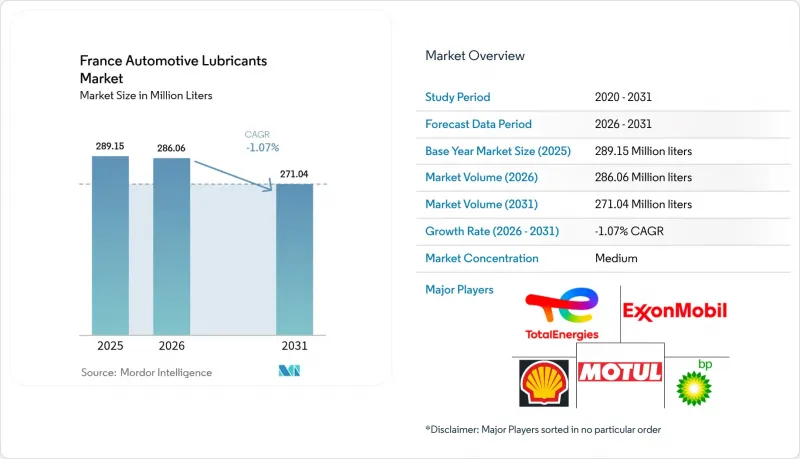
This report is Segmented by Product Type (Automotive Engine Oil, Manual Transmission Fluids, Automatic Transmission Fluids, Brake Fluids, Automotive Greases, and Other Product Types) and Vehicle Type (Passenger Vehicles, Commercial Vehicles, and Two-Wheelers). The Market Forecasts are Provided in Terms of Volume (Litres).
France Automotive Lubricants Market Trends and Insights
Post-COVID rebound in new-vehicle registrations
Commercial vehicle registrations in 2024 grew. The uptick in logistics trucks and vans is driven by the expansion of e-commerce and the reshoring of supply chains. Heavy-duty lubricants, therefore, maintain relevance as fleet operators prioritize uptime and reliability. Longer replacement cycles, typically five to seven years, help stabilize lubricant demand even as the total light-duty fleet electrifies more rapidly. Suppliers are channeling resources toward premium diesel engine oils, long-life coolants, and axle fluids specifically designed for high-load applications. As passenger car volumes dip, commercial fleets become the focal customer group across the France automotive lubricants market.
Stricter Euro-7 limits driving low-viscosity formulations
Euro-7 standards, effective in November 2026, introduce particle-number thresholds down to 10 nm and mandate emissions durability over extended lifespans. To comply, French OEMs are homologating 0W-20 and 0W-16 grades that cut friction and improve fuel economy by up to 2%. These light viscosities also carry low-SAPS additive packages to protect after-treatment systems. Synthetic base oils with high oxidative stability now dominate new-fill factory approvals, prompting blenders to reformulate portfolios. The regulation thereby elevates the value proposition of premium synthetics within the France automotive lubricants market.
OEM-mandated extended drain intervals
Premium European brands now approve 30,000-kilometer service intervals, cutting annual oil demand. The specifications require robust oxidative resistance and TBN retention, spurring a shift toward mid-SAPS and full-SAPS synthetics. French OEMs follow the pattern to lower warranty expenses. Workshops consequently see fewer visits and compensate by upselling higher-grade oils and ancillary services. While per-liter margins improve, the restraint remains the largest drag on volumes in the France automotive lubricants market.
Other drivers and restraints analyzed in the detailed report include:
- Boom in last-mile delivery fleets
- Expansion of car-sharing and subscription fleets
- Rise of sealed, oil-free e-axles
For complete list of drivers and restraints, kindly check the Table Of Contents.
Segment Analysis
The French automotive lubricants market size for engine oils accounts for 58.25% of the total volume. A large ICE parc with an average age of 9.2 years supports baseline demand. Euro-7 promotes the mix toward 0W-20 and 0W-16 grades, thereby increasing synthetic oil penetration. Power steering fluids decline as EPS becomes universal, while brake fluids remain stable due to mandatory change intervals. Automatic transmission fluids post the steepest fall at -0.91% as sealed dual-clutch units proliferate.
Synthetic engine oils capture a growing share by meeting low-SAPS and volatility limits that safeguard particulate filters. Blenders deploy Group III+ and poly-alpha-olefin base stocks to ensure oxidation stability over 20,000- to 30,000-kilometer intervals. Long-life formulations enable workshops to compensate for fewer oil changes by charging premium rates. Re-refined content also rises, driven by incentives from the circular economy. Greases enjoy steady demand for wheel bearings, chassis points, and EV motor bearings, balancing reductions elsewhere within the France automotive lubricants market.
Complete Report Scope:
- By Product Type
- Automotive Engine Oil
- 0W-XX
- 5W-XX
- 10W-XX
- 15W-XX
- Monogrades
- Other Grades
- Manual Transmission Fluids (MTF)
- Automatic Transmission Fluids (ATF)
- Brake Fluids
- Automotive Greases
- Other Product Types (Power Steering Fluid etc.)
- Automotive Engine Oil
- By Vehicle Type
- Passenger Vehicles
- Commercial Vehicles
- Two-Wheelers
List of Companies Covered in this Report:
- AMSOIL INC
- BP p.l.c.
- Chevron Corporation
- Eni SpA
- Exxon Mobil Corporation
- FUCHS
- Gulf Oil International
- IGOL
- LIQUI MOLY
- Millers Oils
- MOTOREX
- Motul
- PETRONAS Lubricants International
- Saudi Arabian Oil Co.
- Shell plc
- TotalEnergies
- Wolf Oil Corporation
Additional Benefits:
- The market estimate (ME) sheet in Excel format
- 3 months of analyst support
TABLE OF CONTENTS
1 Introduction
- 1.1 Study Assumptions and Market Definition
- 1.2 Scope of the Study
2 Research Methodology
3 Executive Summary
4 Market Landscape
- 4.1 Market Overview
- 4.2 Market Drivers
- 4.2.1 Post-COVID rebound in French new-vehicle registrations
- 4.2.2 Stricter Euro-7 limits driving low-viscosity formulations
- 4.2.3 Boom in last-mile delivery fleets
- 4.2.4 Expansion of car-sharing and subscription fleets
- 4.2.5 Circular-economy law accelerating re-refined base-oil adoption
- 4.3 Market Restraints
- 4.3.1 OEM-mandated extended drain intervals
- 4.3.2 Rise of sealed, oil-free e-axles
- 4.3.3 Telematics-based predictive maintenance reducing oil changes
- 4.4 Value Chain and Distribution Channel Analysis
- 4.5 Porter's Five Forces
- 4.5.1 Threat of New Entrants
- 4.5.2 Bargaining Power of Suppliers
- 4.5.3 Bargaining Power of Buyers
- 4.5.4 Threat of Substitutes
- 4.5.5 Industry Rivalry
- 4.6 Regulatory Framework
- 4.7 Automotive Industry Trends
5 Market Size and Growth Forecasts (Volume)
- 5.1 By Product Type
- 5.1.1 Automotive Engine Oil
- 5.1.1.1 0W-XX
- 5.1.1.2 5W-XX
- 5.1.1.3 10W-XX
- 5.1.1.4 15W-XX
- 5.1.1.5 Monogrades
- 5.1.1.6 Other Grades
- 5.1.2 Manual Transmission Fluids (MTF)
- 5.1.3 Automatic Transmission Fluids (ATF)
- 5.1.4 Brake Fluids
- 5.1.5 Automotive Greases
- 5.1.6 Other Product Types (Power Steering Fluid etc.)
- 5.1.1 Automotive Engine Oil
- 5.2 By Vehicle Type
- 5.2.1 Passenger Vehicles
- 5.2.2 Commercial Vehicles
- 5.2.3 Two-Wheelers
6 Competitive Landscape
- 6.1 Market Concentration
- 6.2 Strategic Moves
- 6.3 Market Share (%)/Ranking Analysis
- 6.4 Company Profiles (includes Global level Overview, Market level overview, Core Segments, Financials as available, Production Capacity, Strategic Information, Market Rank/Share for key companies, Products and Services, and Recent Developments)
- 6.4.1 AMSOIL INC
- 6.4.2 BP p.l.c.
- 6.4.3 Chevron Corporation
- 6.4.4 Eni SpA
- 6.4.5 Exxon Mobil Corporation
- 6.4.6 FUCHS
- 6.4.7 Gulf Oil International
- 6.4.8 IGOL
- 6.4.9 LIQUI MOLY
- 6.4.10 Millers Oils
- 6.4.11 MOTOREX
- 6.4.12 Motul
- 6.4.13 PETRONAS Lubricants International
- 6.4.14 Saudi Arabian Oil Co.
- 6.4.15 Shell plc
- 6.4.16 TotalEnergies
- 6.4.17 Wolf Oil Corporation
7 Market Opportunities and Future Outlook
- 7.1 White-space and Unmet-need Assessment
8 Key Strategic Questions for CEOs

