PUBLISHER: Mordor Intelligence | PRODUCT CODE: 2116383

PUBLISHER: Mordor Intelligence | PRODUCT CODE: 2116383
China Automotive Lubricants - Market Share Analysis, Industry Trends & Statistics, Growth Forecasts (2026 - 2031)
According to Mordor Intelligence, the China automotive lubricants market size is expected to grow from 3.48 Billion Liters in 2025 to 3.49 Billion Liters in 2026 and is forecast to reach 3.52 Billion Liters by 2031 at 0.17% CAGR over 2026-2031.
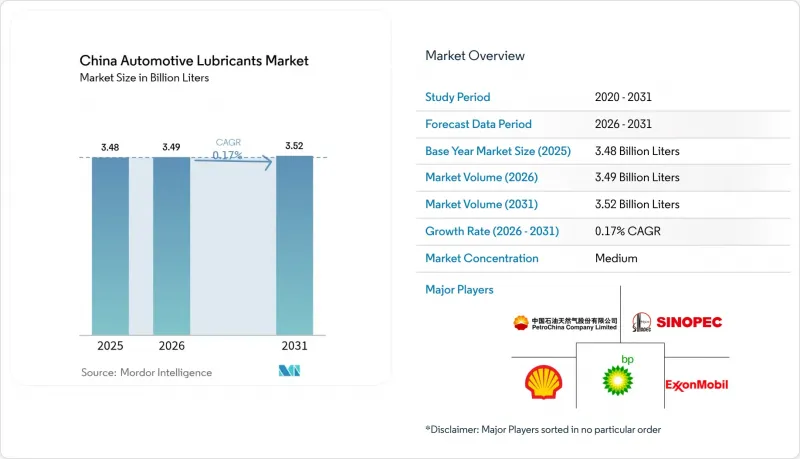
This report is Segmented by Product Type (Automotive Engine Oil, Manual Transmission Fluids, Automatic Transmission Fluids, Brake Fluids, Automotive Greases, and Other Product Types) and Vehicle Type (Passenger Vehicles, Commercial Vehicles, and Two-Wheelers). The Market Forecasts are Provided in Terms of Volume (Litres).
China Automotive Lubricants Market Trends and Insights
Preference Shift to OEM-Approved Synthetics
Automakers now specify low-ash API SP or ILSAC GF-7 oils that protect gasoline particulate filters and mitigate low-speed pre-ignition. The new ILSAC standard, effective March 2025, requires suppliers to reformulate with higher-purity synthetic basestocks and advanced antioxidant packages. Consumers in Tier-1 cities value extended drain intervals and fuel-economy benefits, driving rapid penetration of 0W-20 and 5W-30 grades. Higher certification costs raise barriers to entry, favoring incumbents with robust research and development (R&D) capacities. As warranty compliance becomes a key purchase trigger, premium synthetics command pricing power that offsets the volume softness caused by electrification.
Electrified-powertrain lubricant reformulations
Hybrid and electric platforms impose intermittent combustion cycles, elevated thermal loads, and coolant contamination risks that legacy oils cannot manage. Suppliers are developing ester-rich synthetics with modified additive chemistries to stabilize viscosity during repeat start-stop events and maintain dielectric strength near high-voltage components. A 2025 white paper from Lubrizol identifies viscosity shear control, copper corrosion resistance, and multi-fuel compatibility as key research priorities. These demands reward companies that can invest in tribology modeling and battery-coolant interaction studies, tilting the competitive advantage toward technology-led multinationals and well-capitalized domestic innovators.
Rising EV parc cannibalizing ICE oil demand
With fully electric cars expected to reach a 50% sales share in 2024, engine oil volumes in metropolitan centers are declining. E-scooters already hold a 25% share of two-wheel mobility, and forecasts indicate a near doubling by 2029, potentially sidelining small-engine lubricants. Logistics operators are piloting battery-electric vans that eliminate the need for crankcase oil, although they introduce a minor demand for gear-reducer fluids and dielectric coolants. Regional charging-infrastructure density correlates strongly with engine oil declines, forcing suppliers to hedge with EV-specific SKUs and service bundles that preserve wallet share even as liters fall.
Other drivers and restraints analyzed in the detailed report include:
- E-commerce aftermarket reach to Tier-3 cities
- Stricter China VI-B emission limits
- Counterfeit lubricant proliferation
For complete list of drivers and restraints, kindly check the Table Of Contents.
Segment Analysis
Automotive engine oil retained 63.70% of 2025 demand, underscoring its centrality to the China automotive lubricants market. The segment's resilience stems from China VI-B regulations that favor low-viscosity synthetics, lifting premium mix and price realization even as volume inches down. Semi-synthetic conversion is largely complete in Tier 1 workshops, but Tier 3 penetration remains an upside lever. On the other hand, automatic transmission fluids (ATF) claim only mid-single-digit volumes yet lead growth at a 0.23% CAGR through 2031, thanks to the uptake of CVT and dual-clutch technology in hybrids. Brake fluids and greases occupy niche but technology-intensive roles, with EV motor-bearing greases and DOT 4-plus brake fluids showing incremental upside. Power-steering fluids trend lower as electric systems proliferate, partially offset by the nascent demand for dielectric coolants in high-voltage battery packs, which fall outside traditional lubricant categories. Suppliers that package engine oils with ATF and emerging EV fluids stand to deepen wallet share while buffering against volume erosion in legacy lines.
The competitive hierarchy by product favors players with both API / ACEA certifications and local OEM endorsements. Synthetic formulations employing Group III+ or GTL basestocks enjoy an expanding proportion of the China automotive lubricants market share due to better oxidative stability and fuel-economy edge. Technical service, used-oil analysis, and drain-interval advisory increasingly differentiate offers in workshops and fleet depots, steering the market away from commodity barrels toward integrated aftersales ecosystems. This pivot stresses the importance of investment in additive science, bench testing, and field validation-capabilities concentrated among multinationals and the largest domestic refiners.
Complete Report Scope:
- By Product Type
- Automotive Engine Oil
- 0W-XX
- 5W-XX
- 10W-XX
- 15W-XX
- Monogrades
- Other Grades
- Manual Transmission Fluids (MTF)
- Automatic Transmission Fluids (ATF)
- Brake Fluids
- Automotive Greases
- Other Product Types (Power Steering Fluid etc.)
- Automotive Engine Oil
- By Vehicle Type
- Passenger Vehicles
- Commercial Vehicles
- Two-Wheelers
List of Companies Covered in this Report:
- BP p.l.c.
- Chevron Corporation
- China National Petroleum Corporation
- China Petrochemical Corporation
- ENEOS Corporation
- Exxon Mobil Corporation
- FUCHS
- Gulf Oil
- Idemitsu Kosan Co., Ltd
- Jiangsu Gaoke Petrochemical Co., Ltd
- Jiangsu Lopal Tech Co., Ltd
- LUKOIL
- PetroChina Company Limited
- Qingdao COPTON Technology Co., Ltd
- Saudi Arabian Oil Co.
- Shell plc
- SK Enmove
- Tongyi Petrochemical Co., Ltd
- TotalEnergies
Additional Benefits:
- The market estimate (ME) sheet in Excel format
- 3 months of analyst support
TABLE OF CONTENTS
1 Introduction
- 1.1 Study Assumptions and Market Definition
- 1.2 Scope of the Study
2 Research Methodology
3 Executive Summary
4 Market Landscape
- 4.1 Market Overview
- 4.2 Market Drivers
- 4.2.1 Preference shift to OEM-approved synthetics
- 4.2.2 Electrified-powertrain lubricant reformulations
- 4.2.3 E-commerce aftermarket reach to Tier-3 cities
- 4.2.4 Stricter China VI-B emission limits
- 4.2.5 Localized OEM factory-fill partnerships
- 4.3 Market Restraints
- 4.3.1 Rising EV parc cannibalizing ICE oil demand
- 4.3.2 Counterfeit lubricant proliferation
- 4.3.3 Extended oil-change intervals via IIOT sensors
- 4.4 Value Chain and Distribution Channel Analysis
- 4.5 Porter's Five Forces
- 4.5.1 Threat of New Entrants
- 4.5.2 Bargaining Power of Suppliers
- 4.5.3 Bargaining Power of Buyers
- 4.5.4 Threat of Substitutes
- 4.5.5 Industry Rivalry
- 4.6 Regulatory Framework
- 4.7 Automotive Industry Trends
5 Market Size and Growth Forecasts (Volume)
- 5.1 By Product Type
- 5.1.1 Automotive Engine Oil
- 5.1.1.1 0W-XX
- 5.1.1.2 5W-XX
- 5.1.1.3 10W-XX
- 5.1.1.4 15W-XX
- 5.1.1.5 Monogrades
- 5.1.1.6 Other Grades
- 5.1.2 Manual Transmission Fluids (MTF)
- 5.1.3 Automatic Transmission Fluids (ATF)
- 5.1.4 Brake Fluids
- 5.1.5 Automotive Greases
- 5.1.6 Other Product Types (Power Steering Fluid etc.)
- 5.1.1 Automotive Engine Oil
- 5.2 By Vehicle Type
- 5.2.1 Passenger Vehicles
- 5.2.2 Commercial Vehicles
- 5.2.3 Two-Wheelers
6 Competitive Landscape
- 6.1 Market Concentration
- 6.2 Strategic Moves
- 6.3 Market Share (%)**/Ranking Analysis
- 6.4 Company Profiles (includes Global level Overview, Market level overview, Core Segments, Financials as available, Production Capacity, Strategic Information, Market Rank/Share for key companies, Products and Services, and Recent Developments)
- 6.4.1 BP p.l.c.
- 6.4.2 Chevron Corporation
- 6.4.3 China National Petroleum Corporation
- 6.4.4 China Petrochemical Corporation
- 6.4.5 ENEOS Corporation
- 6.4.6 Exxon Mobil Corporation
- 6.4.7 FUCHS
- 6.4.8 Gulf Oil
- 6.4.9 Idemitsu Kosan Co., Ltd
- 6.4.10 Jiangsu Gaoke Petrochemical Co., Ltd
- 6.4.11 Jiangsu Lopal Tech Co., Ltd
- 6.4.12 LUKOIL
- 6.4.13 PetroChina Company Limited
- 6.4.14 Qingdao COPTON Technology Co., Ltd
- 6.4.15 Saudi Arabian Oil Co.
- 6.4.16 Shell plc
- 6.4.17 SK Enmove
- 6.4.18 Tongyi Petrochemical Co., Ltd
- 6.4.19 TotalEnergies
7 Market Opportunities and Future Outlook
- 7.1 White-space and Unmet-need Assessment
8 Key Strategic Questions for CEOs

