PUBLISHER: Mordor Intelligence | PRODUCT CODE: 2116376

PUBLISHER: Mordor Intelligence | PRODUCT CODE: 2116376
North America Automotive Lubricants - Market Share Analysis, Industry Trends & Statistics, Growth Forecasts (2026 - 2031)
According to Mordor Intelligence, the North America automotive lubricants market size was valued at 4.58 Billion Liters in 2025 and estimated to grow from 4.62 Billion Liters in 2026 to reach 4.81 Billion Liters by 2031, at a CAGR of 0.82% during the forecast period (2026-2031).
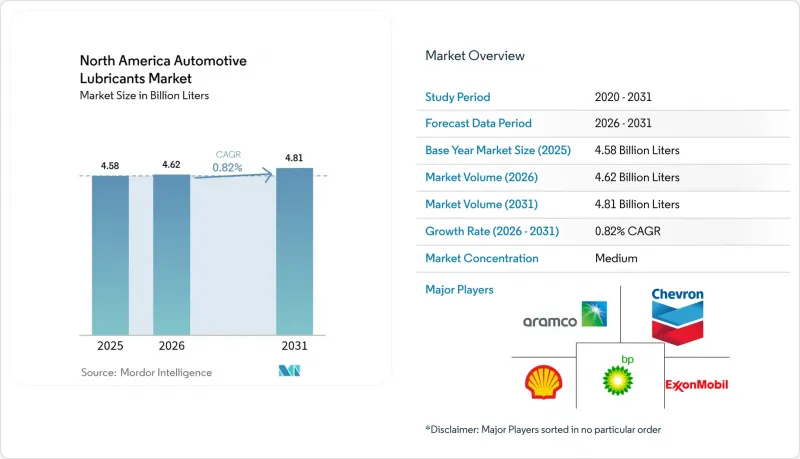
This report is Segmented by Product Type (Automotive Engine Oil, Manual Transmission Fluids, Automatic Transmission Fluids, Brake Fluids, Automotive Greases, and Other Product Types), Vehicle Type (Passenger Vehicles, Commercial Vehicles, and Two-Wheelers), and Geography (United States, Canada, Mexico). The Market Forecasts are Provided in Terms of Volume (Litres).
North America Automotive Lubricants Market Trends and Insights
ICE Parc Renewal Cycle Keeps Base-Oil Demand Steady
The high average vehicle age continues to underpin a large portion of older internal combustion engine cars and trucks that require more frequent oil changes and higher-viscosity blends. In 2023, motor gasoline sales in Canada reached 12.7 billion litres, with 90.8% distributed through service stations, underscoring the entrenched maintenance needs of conventional powertrains. Vehicles exceeding 12 years of age typically follow 3,000- to 5,000-mile service intervals, counterbalancing the extended drain schedules of newer engines. Demand for conventional and high-mileage oils, therefore, remains resilient as owners of aging vehicles seek formulations that mitigate wear, manage seal swelling, and control deposits beyond 75,000 miles. This trend prolongs baseline engine-oil volumes even as fleet electrification advances.
Electrified Light-Duty Fleet Still Requires Specialty E-Fluids
Electric vehicles eliminate crankcase oil yet introduce fresh opportunities in dielectric coolants and e-axle lubricants. Petro-Canada launched its EVR range in 2024 to serve OEM and Tier-1 battery and gearbox applications. Castrol's ON series and Valvoline's hybrid-optimized synthetics follow similar strategies that shift the conversation from liter-based sales to premium chemistry. Mexican EV production increased from 6,717 units in 2020 to 206,870 units in 2024, with 95% of the units exported, thereby tying regional e-vehicle demand to cross-border trade flows. Thermal management for batteries and power electronics requires precise control of conductivity, which favors suppliers with advanced additive expertise and close OEM ties.
Longer Drain Intervals in New Engines
ILSAC GF-7 licensing, first issued in March 2025, supports 7,500-10,000-mile oil changes, cutting annual lubricant volume per vehicle by up to 50% compared with legacy schedules. Low-viscosity 0W-16 and 0W-20 grades further extend service windows while boosting fuel economy. Fleet operators are increasingly deploying oil-analysis services to extend intervals even longer, thereby magnifying the impact on consumption. API's aftermarket audit program now monitors bulk and packaged oils for viscosity retention and oxidative stability, putting pressure on producers that cannot meet extended-service claims.
Other drivers and restraints analyzed in the detailed report include:
- Tier-III Heavy-Duty Emissions Norms Raise Lubricant Performance Requirements
- Mexico OEM Capacity Additions Spur Factory-Fill Volumes
- EV Penetration in Light-Duty Segment
For complete list of drivers and restraints, kindly check the Table Of Contents.
Segment Analysis
The engine oil category retained a 59.65% share of the North America automotive lubricants market in 2025, underscoring its role as the largest revenue contributor. Within this space, high-mileage formulations and synthetics command premium price points that help offset the volume drag from longer drain times. Automatic transmission fluids represent the fastest-growing product line, with a 0.98% CAGR, driven by the increasing demand for multi-speed automatics, dual-clutch units, and hybrid gearsets that require tailor-made friction characteristics. The North America automotive lubricants market size for transmission fluids is projected to expand steadily as OEM design complexity increases. Brake fluids maintain a steady demand due to the integration of advanced driver assistance systems, which place higher temperature stress on hydraulics.
EV-specific e-fluids remain a small but growing segment, capturing value through sophisticated chemistry rather than the volume of gallons moved. Castrol, Valvoline, and Petro-Canada have all launched dielectric coolants and e-axle lubes designed to preserve copper windings and power electronics under high voltage. Manual gearbox oils and power steering fluids are trending downward as electric power steering architectures eliminate hydraulic systems. Greases, meanwhile, capture incremental growth from high-speed electric motor bearings requiring tighter shear-stability control. Across each sub-category, OEM approvals increasingly dictate specification, pushing suppliers to secure factory fill endorsements to protect downstream aftermarket pull-through.
Complete Report Scope:
- By Product Type
- Automotive Engine Oil
- 0W-XX
- 5W-XX
- 10W-XX
- 15W-XX
- Monogrades
- Other Grades
- Manual Transmission Fluids (MTF)
- Automatic Transmission Fluids (ATF)
- Brake Fluids
- Automotive Greases
- Other Product Types (Power Steering Fluid etc.)
- Automotive Engine Oil
- By Vehicle Type
- Passenger Vehicles
- Commercial Vehicles
- Two-Wheelers
- By Geography
- United States
- Canada
- Mexico
List of Companies Covered in this Report:
- AMSOIL INC.
- BP plc
- Chevron Corporation
- CITGO Petroleum Lubricants
- Exxon Mobil Corporation
- FUCHS
- HollyFrontier (Petro-Canada Lubricants)
- Idemitsu Lubricants America
- LIQUI MOLY
- Lucas Oil Products, Inc.
- Motul
- PETRONAS lubricant International
- Phillips 66 Company
- Roshfrans
- Saudi Arabian Oil Co.
- Shell plc
- TotalEnergies
Additional Benefits:
- The market estimate (ME) sheet in Excel format
- 3 months of analyst support
TABLE OF CONTENTS
1 Introduction
- 1.1 Study Assumptions and Market Definition
- 1.2 Scope of the Study
2 Research Methodology
3 Executive Summary
4 Market Landscape
- 4.1 Market Overview
- 4.2 Market Drivers
- 4.2.1 ICE parc renewal cycle keeps base-oil demand steady
- 4.2.2 Electrified light-duty fleet still requires specialty e-fluids
- 4.2.3 Tier-III heavy-duty emissions norms raise lubricant performance requirements
- 4.2.4 Mexico's OEM capacity additions (2024-27) spur factory-fill volumes
- 4.2.5 OEM-branded aftersales programs gain share
- 4.3 Market Restraints
- 4.3.1 Longer drain intervals in new engines
- 4.3.2 EV penetration in light-duty segment
- 4.3.3 Consolidation of quick-lube chains squeezes independent distributors
- 4.4 Value Chain and Distribution Channel Analysis
- 4.5 Porter's Five Forces
- 4.5.1 Threat of New Entrants
- 4.5.2 Bargaining Power of Suppliers
- 4.5.3 Bargaining Power of Buyers
- 4.5.4 Threat of Substitutes
- 4.5.5 Industry Rivalry
- 4.6 Regulatory Framework
- 4.7 Automotive Industry Trends
5 Market Size and Growth Forecasts (Volume)
- 5.1 By Product Type
- 5.1.1 Automotive Engine Oil
- 5.1.1.1 0W-XX
- 5.1.1.2 5W-XX
- 5.1.1.3 10W-XX
- 5.1.1.4 15W-XX
- 5.1.1.5 Monogrades
- 5.1.1.6 Other Grades
- 5.1.2 Manual Transmission Fluids (MTF)
- 5.1.3 Automatic Transmission Fluids (ATF)
- 5.1.4 Brake Fluids
- 5.1.5 Automotive Greases
- 5.1.6 Other Product Types (Power Steering Fluid etc.)
- 5.1.1 Automotive Engine Oil
- 5.2 By Vehicle Type
- 5.2.1 Passenger Vehicles
- 5.2.2 Commercial Vehicles
- 5.2.3 Two-Wheelers
- 5.3 By Geography
- 5.3.1 United States
- 5.3.2 Canada
- 5.3.3 Mexico
6 Competitive Landscape
- 6.1 Market Concentration
- 6.2 Strategic Moves
- 6.3 Market Share (%)**/Ranking Analysis
- 6.4 Company Profiles (includes Global level Overview, Market level overview, Core Segments, Financials as available, Production Capacity, Strategic Information, Market Rank/Share for key companies, Products and Services, and Recent Developments)
- 6.4.1 AMSOIL INC.
- 6.4.2 BP plc
- 6.4.3 Chevron Corporation
- 6.4.4 CITGO Petroleum Lubricants
- 6.4.5 Exxon Mobil Corporation
- 6.4.6 FUCHS
- 6.4.7 HollyFrontier (Petro-Canada Lubricants)
- 6.4.8 Idemitsu Lubricants America
- 6.4.9 LIQUI MOLY
- 6.4.10 Lucas Oil Products, Inc.
- 6.4.11 Motul
- 6.4.12 PETRONAS lubricant International
- 6.4.13 Phillips 66 Company
- 6.4.14 Roshfrans
- 6.4.15 Saudi Arabian Oil Co.
- 6.4.16 Shell plc
- 6.4.17 TotalEnergies
7 Market Opportunities and Future Outlook
- 7.1 White-space and Unmet-need Assessment
8 Key Strategic Questions for CEOs

