PUBLISHER: Mordor Intelligence | PRODUCT CODE: 2116410

PUBLISHER: Mordor Intelligence | PRODUCT CODE: 2116410
Africa Automotive Lubricants - Market Share Analysis, Industry Trends & Statistics, Growth Forecasts (2026 - 2031)
According to Mordor Intelligence, Africa automotive lubricants market size in 2026 is estimated at 1.58 Billion Liters, growing from 2025 value of 1.54 Billion Liters with 2031 projections showing 1.81 Billion Liters, growing at 2.74% CAGR over 2026-2031.
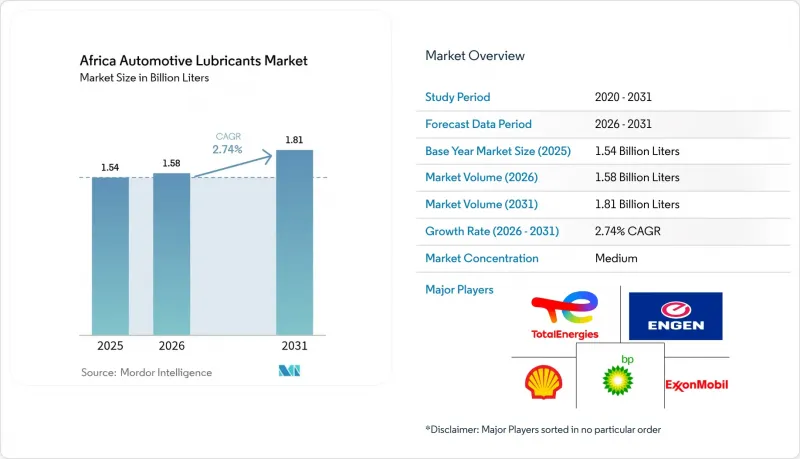
This report is Segmented by Product Type (Automotive Engine Oil, Manual Transmission Fluids, Automatic Transmission Fluids, Brake Fluids, Automotive Greases, and Other Product Types), Vehicle Type (Passenger Vehicles, Commercial Vehicles, and Two-Wheelers), and Geography (Egypt, Morocco, Nigeria, South Africa, and Rest of Africa). The Market Forecasts are Provided in Terms of Volume (Litres).
Africa Automotive Lubricants Market Trends and Insights
Rising Vehicle Parc and Used-Vehicle Imports Drive Sustained Demand
Ongoing fleet expansion underpins stable lubricant off-take across the Africa Automotive Lubricants market. Most African countries continue to rely on second-hand imports, keeping the median vehicle age above 12 years and cementing regular oil-change cycles. Kenya's eight-year import age ceiling, coupled with differentiated excise tiers, is encouraging a gradual shift toward newer models that specify low-viscosity synthetics, thereby broadening the demand for premium-grade products. Tanzania and Ghana are following similar policy paths, balancing incremental electric-vehicle incentives with the recognition that internal-combustion engines will continue to dominate through 2030. Rwanda's registered vehicle stock surpassed 270,000 units in 2024, 40% of which are motorcycles, demonstrating that two-wheelers remain a material volume contributor. Morocco's automotive manufacturing ecosystem, which accounts for 22% of GDP, generates incremental factory-fill requirements and heightens lubricant quality expectations.
Commercial Transport & Logistics Activity Expansion
Trade liberalization under AfCFTA has lifted intra-African merchandise trade volumes by 7.7% year-on-year in 2024, driving heavier utilization of trucks, buses, and construction machinery. South Africa's cross-border corridors now support average daily heavy-truck flows exceeding 6,000 units, intensifying the need for high-detergency engine oils and long-drain transmission fluids. Nigeria's Lagos-Kano rail modernization and the USD 25 billion Nigeria-Morocco Gas Pipeline are driving demand for industrial greases and hydraulic fluids during the construction phases. Ghana's USD 12 billion Petroleum Hub, under development since 2024, is set to anchor future storage and blending facilities, bridging supply gaps in West Africa.
Counterfeit Lubricant Penetration Undermines Market Growth
Counterfeit volumes are estimated to be more than 20% of the total supply in several West and East African countries, eroding legitimate brand revenues and tarnishing end-user trust. Kenya's Anti-Counterfeit Authority pegs direct annual tax losses at KES 2.1 billion. Sophisticated falsification of labels, QR codes, and tamper-evident seals blurs authenticity checks at the retail level, particularly in informal markets. Brand owners are responding with blockchain-enabled track-and-trace programs, serialized closures, and nationwide "clean trade" campaigns. Regulatory bodies are stepping up field raids, but judicial backlogs and low conviction rates continue to dilute deterrence.
Other drivers and restraints analyzed in the detailed report include:
- Shift Toward Higher-Grade & Synthetic Oils Under Emission Standards Evolution
- AfCFTA Trade Facilitation & Supply-Chain Optimization
- Crude-Oil Price Volatility Disrupts Supply-Chain Economics
For complete list of drivers and restraints, kindly check the Table Of Contents.
Segment Analysis
Automotive engine oil retained dominance at 46.96% of the Africa Automotive Lubricants market in 2025, underscoring its indispensable role in routine maintenance for an aging fleet. Automatic transmission fluid is projected to expand at a 3.44% CAGR, the fastest among all product groups, reflecting the rising share of automatic gearboxes in light-duty imports and premium commercial trucks. Manual transmission and axle oil demand will remain stable but cede an incremental share to ATF. Brake fluids and greases posted low-single-digit growth, driven by increased safety inspections and the refurbishment of heavy equipment. The transition to 5W-30 and 0W-20 multigrades, alongside OEM-specific approvals such as Ford WSS-M2C952-A1, exemplifies the shift toward low-viscosity synthetics for improved fuel efficiency.
Monograde SAE 40 remains relevant in stationary engines and older minibuses, particularly outside major urban centers, but its proportional contribution is expected to decline. Factory-fill opportunities in Morocco's burgeoning EV supply chain are opening specialty niches for thermal-management fluids and e-axle greases, with volumes small today yet growing at double-digit rates as local OEM assembly scales.
Complete Report Scope:
- By Product Type
- Automotive Engine Oil
- 0W-XX
- 5W-XX
- 10W-XX
- 15W-XX
- Monogrades
- Other Grades
- Manual Transmission Fluids (MTF)
- Automatic Transmission Fluids (ATF)
- Brake Fluids
- Automotive Greases
- Other Product Types (Power Steering Fluid etc.)
- Automotive Engine Oil
- By Vehicle Type
- Passenger Vehicles
- Commercial Vehicles
- Two-Wheelers
- By Geography
- Egypt
- Morocco
- Nigeria
- South Africa
- Rest of Africa
List of Companies Covered in this Report:
- Afriquia
- Astron Energy Pty Ltd
- BP p.l.c.
- Chevron Corporation
- Coperative Soceite des Petroleum
- Engen Petroleum Ltd
- Exxon Mobil Corporation
- FUCHS
- Kenol & Kobil
- Misr Petroleum
- Oando PLC
- OLA Energy
- Petromin Corporation
- Puma Energy
- Sasol Ltd
- Saudi Arabian Co. Ltd
- Shell plc
- TotalEnergies
Additional Benefits:
- The market estimate (ME) sheet in Excel format
- 3 months of analyst support
TABLE OF CONTENTS
1 Introduction
- 1.1 Study Assumptions and Market Definition
- 1.2 Scope of the Study
2 Research Methodology
3 Executive Summary
4 Market Landscape
- 4.1 Market Overview
- 4.2 Market Drivers
- 4.2.1 Rising vehicle parc and used-vehicle imports
- 4.2.2 Growth in commercial transport and logistics activity
- 4.2.3 Shift toward higher-grade and synthetic oils under tightening emission norms
- 4.2.4 AfCFTA accelerating intra-Africa lubricant trade and supply-chain optimisation
- 4.2.5 Expansion of local blending capacity and distributor networks
- 4.3 Market Restraints
- 4.3.1 Counterfeit and low-quality lubricant penetration
- 4.3.2 Crude-oil price volatility impacting feedstock costs
- 4.3.3 Under-developed used-oil collection & rerefining ecosystem
- 4.4 Value Chain and Distribution Channel Analysis
- 4.5 Porter's Five Forces
- 4.5.1 Threat of New Entrants
- 4.5.2 Bargaining Power of Suppliers
- 4.5.3 Bargaining Power of Buyers
- 4.5.4 Threat of Substitutes
- 4.5.5 Industry Rivalry
- 4.6 Regulatory Framework
- 4.7 Automotive Industry Trends
5 Market Size and Growth Forecasts (Volume)
- 5.1 By Product Type
- 5.1.1 Automotive Engine Oil
- 5.1.1.1 0W-XX
- 5.1.1.2 5W-XX
- 5.1.1.3 10W-XX
- 5.1.1.4 15W-XX
- 5.1.1.5 Monogrades
- 5.1.1.6 Other Grades
- 5.1.2 Manual Transmission Fluids (MTF)
- 5.1.3 Automatic Transmission Fluids (ATF)
- 5.1.4 Brake Fluids
- 5.1.5 Automotive Greases
- 5.1.6 Other Product Types (Power Steering Fluid etc.)
- 5.1.1 Automotive Engine Oil
- 5.2 By Vehicle Type
- 5.2.1 Passenger Vehicles
- 5.2.2 Commercial Vehicles
- 5.2.3 Two-Wheelers
- 5.3 By Geography
- 5.3.1 Egypt
- 5.3.2 Morocco
- 5.3.3 Nigeria
- 5.3.4 South Africa
- 5.3.5 Rest of Africa
6 Competitive Landscape
- 6.1 Market Concentration
- 6.2 Strategic Moves
- 6.3 Market Share (%)**/Ranking Analysis
- 6.4 Company Profiles (includes Global level Overview, Market level overview, Core Segments, Financials as available, Production Capacity, Strategic Information, Market Rank/Share for key companies, Products and Services, and Recent Developments)
- 6.4.1 Afriquia
- 6.4.2 Astron Energy Pty Ltd
- 6.4.3 BP p.l.c.
- 6.4.4 Chevron Corporation
- 6.4.5 Coperative Soceite des Petroleum
- 6.4.6 Engen Petroleum Ltd
- 6.4.7 Exxon Mobil Corporation
- 6.4.8 FUCHS
- 6.4.9 Kenol & Kobil
- 6.4.10 Misr Petroleum
- 6.4.11 Oando PLC
- 6.4.12 OLA Energy
- 6.4.13 Petromin Corporation
- 6.4.14 Puma Energy
- 6.4.15 Sasol Ltd
- 6.4.16 Saudi Arabian Co. Ltd
- 6.4.17 Shell plc
- 6.4.18 TotalEnergies
7 Market Opportunities and Future Outlook
- 7.1 White-space and Unmet-need Assessment
8 Key Strategic Questions for CEOs

