PUBLISHER: Mordor Intelligence | PRODUCT CODE: 2116525

PUBLISHER: Mordor Intelligence | PRODUCT CODE: 2116525
Cerebral Palsy Treatment - Market Share Analysis, Industry Trends & Statistics, Growth Forecasts (2026 - 2031)
According to Mordor Intelligence, the cerebral palsy treatment market size was valued at USD 3.64 billion in 2025 and estimated to grow from USD 3.76 billion in 2026 to reach USD 4.39 billion by 2031, at a CAGR of 3.18% during the forecast period (2026-2031).
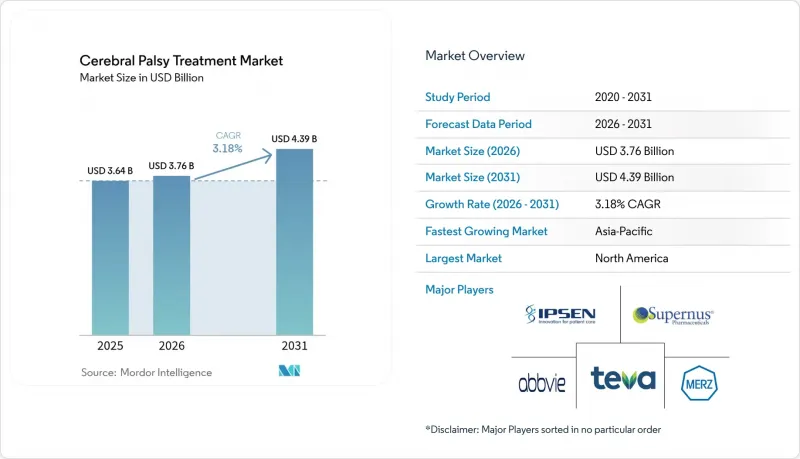
This report is Segmented by Treatment Type (Surgery, Medication), Type of Cerebral Palsy (Spastic CP, Dyskinetic CP, Ataxic CP, Mixed/Other), Age Group (Paediatric, Adolescent, Adult), End User (Hospitals, Specialty Clinics, Rehabilitation Centres, Home-Care Settings), and Geography (North America, Europe, and More). The Market Forecasts are Provided in Terms of Value (USD).
Global Cerebral Palsy Treatment Market Trends and Insights
Rising Diagnosis Rates via Neonatal Screening
Universal neonatal screening now incorporates General Movement Assessment and Hammersmith Infant Neurological Examination protocols capable of predicting cerebral palsy with more than 95% accuracy in infants under five months. Earlier identification accelerates therapy initiation during peak neuroplasticity windows, which improves gross-motor outcomes and lowers long-term care costs. Systematic reviews of wearable accelerometers confirm high sensitivity and specificity for early motor-development assessment. Governments that link metabolic newborn screening with neuro-developmental referral networks report declining disability burden and reduced surgical demand in later childhood. These successes explain why neonatal screening programs are spreading from the United States and Western Europe to high-volume maternity hospitals in Nepal and Indonesia.
Broader Reimbursement for Botulinum-Toxin Injections
Recent Centers for Medicare & Medicaid Services regulations cover botulinum-toxin use in upper and lower limb spasticity, removing previous age and dosage caps. Long-acting formulations such as daxibotulinumtoxinA extend clinical benefit to 28 weeks, cutting annual injection frequency in half and heightening compliance. Expanded coverage drives hospital formularies to stock Dysport, Botox, and Xeomin, fostering competitive pricing. European payers are adopting similar protocols, and pilot reimbursement schemes in India and Brazil earmark subsidies for pediatric spasticity care. Cumulative uptake helps sustain the cerebral palsy treatment market even as drug prices moderate in mature economies.
Expansion of Pediatric Neuro-Rehab Centers in APAC
Across Asia-Pacific, governments and private investors co-fund centers that integrate robotics, virtual-reality therapy, and AI-based motion capture. Hope Abilitation Medical Center exemplifies the model, offering interdisciplinary care that bundles physiotherapy, speech therapy, and feeding programs under one roof. These hubs recruit international clinicians, embed tele-consult platforms to reach rural districts, and attract medical tourists from the Gulf and Africa. Regional birth-rate trends guarantee a sustained pediatric caseload, while insurance schemes in Singapore, South Korea, and the United Arab Emirates now reimburse intensive neuro-rehab sessions. Collectively, these initiatives give the cerebral palsy treatment market its highest regional CAGR through 2030.
Other drivers and restraints analyzed in the detailed report include:
- Mini-Pump Intrathecal Baclofen Clearances
- High Therapy Cost over Patient Lifetime
- Long-Term Safety Concerns with Repeat Botulinum-Toxin
For complete list of drivers and restraints, kindly check the Table Of Contents.
Segment Analysis
Medication interventions anchored by botulinum-toxin injections delivered 58.61% of 2025 revenue in the cerebral palsy treatment market. Combination regimens that pair abobotulinumtoxinA with selective physiotherapy reduce spasticity scores within four weeks, reinforcing the clinical status quo. Anticonvulsants and antidepressants address comorbid seizures and mood disorders, enlarging pharmacy baskets and supporting steady prescription renewals. The cerebral palsy treatment market size for surgical procedures is forecast to climb at a 3.82% CAGR, reflecting breakthroughs in minimally invasive selective dorsal rhizotomy and adaptive deep-brain stimulation.
Robotic guidance platforms shorten operative time and enhance precision, reducing postoperative infection rates. Intrathecal baclofen pump implantation straddles medical and surgical domains, delivering 99% device survival at seven years. Spinal neuromodulation trials using percutaneous leads report Ashworth scale improvements from 3.0 to 1.14, sparking interest among payers seeking long-term cost offsets.
Spastic presentations commanded 68.15% cerebral palsy treatment market share in 2025, ensuring that tone-modulating drugs and neurosurgical options receive disproportionate investment. Continuous infusion of baclofen via micro-pumps stabilizes lower limb posture and reduces surgical hip relocations. Dyskinetic presentations expand at 4.19% CAGR because deep-brain stimulation and novel cerebellar targets now show Phase II promise.
Ataxic subtypes, though numerically smaller, benefit from balance-training robots and transcranial direct-current stimulation under early feasibility studies. Mixed phenotypes often require sequential therapy layering, driving multidrug use and complex care pathways that add to the cerebral palsy treatment industry revenue base.
Complete Report Scope:
- By Treatment Type
- Surgery
- Medication
- AntiCholinergic aganet
- Botulinum-Toxin Injections
- Anticonvulsants
- Antidepressants
- Antispastic
- Other Medication
- By Type of Cerebral Palsy
- Spastic CP
- Dyskinetic CP
- Ataxic CP
- Mixed/Other
- By Age Group
- Paediatric (0-13 yrs)
- Adolescent (14-17 yrs)
- Adult (18 yrs +)
- By End User
- Hospitals
- Specialty Clinics
- Rehabilitation Centres
- Home-Care Settings
- By Geography
- North America
- United States
- Canada
- Mexico
- Europe
- Germany
- United Kingdom
- France
- Italy
- Spain
- Rest of Europe
- Asia-Pacific
- China
- India
- Japan
- South Korea
- Australia
- Rest of Asia-Pacific
- South America
- Brazil
- Argentina
- Rest of South America
- Middle East and Africa
- GCC
- South Africa
- Rest of Middle East and Africa
- North America
Geography Analysis
North America held 41.85% of 2025 revenue thanks to comprehensive reimbursement, world-class research hospitals, and early adoption of AI-enabled diagnostics. FDA Breakthrough Device designations accelerate time-to-market for neuromodulation and brain-computer interface products, reinforcing the region's innovation edge. Nonetheless, rural clinics face specialist shortages that impede consistent access, and cost pressures prompt insurers to renegotiate hospital contracts.
Europe follows with integrated public health systems that prioritize early intervention and multidisciplinary care. CE-marking harmonization enables cross-border device sales, and national formularies have added Dysport pediatric indications, widening market reach. Outcome-registry initiatives support value-based payment models that favor technologies with clear functional-gain metrics.
Asia-Pacific delivers the fastest regional CAGR at 4.41% to 2031 as governments invest in pediatric neuro-rehabilitation hubs and expand insurance coverage. High birth rates in India, Indonesia, and the Philippines guarantee a steady patient pipeline, while medical-tourism corridors to Singapore and the United Arab Emirates attract international clientele. Newborn metabolic screening programs in Nepal illustrate the preventive shift underway. South America and the Middle East & Africa remain nascent yet draw investment through public-private partnerships aimed at robotics deployment and tele-medicine networks.
- Ipsen
- Abbvie
- Merz Pharma
- DIH (Hocoma)
- Tyromotion
- Ossur
- Zimmer Biomet
- Stryker
- Orthofix
- Ottobock
- Ekso Bionics
- BioSerenity
- MicroPort NeuroTech
- Neuralink
- Natus Medical
- Teva Pharmaceutical Industries
- Sanofi
- Novartis
- Pfizer
Additional Benefits:
- The market estimate (ME) sheet in Excel format
- 3 months of analyst support
TABLE OF CONTENTS
1 Introduction
- 1.1 Study Assumptions & Market Definition
- 1.2 Scope of the Study
2 Research Methodology
3 Executive Summary
4 Market Landscape
- 4.1 Market Overview
- 4.2 Market Drivers
- 4.2.1 Rising diagnosis rates due to universal neonatal screening
- 4.2.2 Wider reimbursement for botulinum-toxin injections
- 4.2.3 Mini-pump intrathecal baclofen gaining FDA/CE clearances
- 4.2.4 Growth of paediatric neuro-rehab centres in Asia-Pacific
- 4.2.5 AI-guided gait analysis enabling personalised orthotics (under-reported)
- 4.2.6 Spinal neuromodulation + ABNT showing Phase II efficacy (under-reported)
- 4.3 Market Restraints
- 4.3.1 High therapy cost for life-long care
- 4.3.2 Long-term safety concerns with repeat botulinum-toxin use
- 4.3.3 Shortage of multidisciplinary CP-specialist teams
- 4.3.4 Limited commercial incentive for adult-onset CP therapies (under-reported)
- 4.4 Value / Supply-Chain Analysis
- 4.5 Regulatory Landscape
- 4.6 Technological Outlook
- 4.7 Porter's Five Forces
- 4.7.1 Threat of New Entrants
- 4.7.2 Bargaining Power of Buyers
- 4.7.3 Bargaining Power of Suppliers
- 4.7.4 Threat of Substitutes
- 4.7.5 Competitive Rivalry
5 Market Size & Growth Forecasts (Value, USD)
- 5.1 By Treatment Type
- 5.1.1 Surgery
- 5.1.2 Medication
- 5.1.2.1 AntiCholinergic aganet
- 5.1.2.2 Botulinum-Toxin Injections
- 5.1.2.3 Anticonvulsants
- 5.1.2.4 Antidepressants
- 5.1.2.5 Antispastic
- 5.1.2.6 Other Medication
- 5.2 By Type of Cerebral Palsy
- 5.2.1 Spastic CP
- 5.2.2 Dyskinetic CP
- 5.2.3 Ataxic CP
- 5.2.4 Mixed/Other
- 5.3 By Age Group
- 5.3.1 Paediatric (0-13 yrs)
- 5.3.2 Adolescent (14-17 yrs)
- 5.3.3 Adult (18 yrs +)
- 5.4 By End User
- 5.4.1 Hospitals
- 5.4.2 Specialty Clinics
- 5.4.3 Rehabilitation Centres
- 5.4.4 Home-Care Settings
- 5.5 By Geography
- 5.5.1 North America
- 5.5.1.1 United States
- 5.5.1.2 Canada
- 5.5.1.3 Mexico
- 5.5.2 Europe
- 5.5.2.1 Germany
- 5.5.2.2 United Kingdom
- 5.5.2.3 France
- 5.5.2.4 Italy
- 5.5.2.5 Spain
- 5.5.2.6 Rest of Europe
- 5.5.3 Asia-Pacific
- 5.5.3.1 China
- 5.5.3.2 India
- 5.5.3.3 Japan
- 5.5.3.4 South Korea
- 5.5.3.5 Australia
- 5.5.3.6 Rest of Asia-Pacific
- 5.5.4 South America
- 5.5.4.1 Brazil
- 5.5.4.2 Argentina
- 5.5.4.3 Rest of South America
- 5.5.5 Middle East and Africa
- 5.5.5.1 GCC
- 5.5.5.2 South Africa
- 5.5.5.3 Rest of Middle East and Africa
- 5.5.1 North America
6 Competitive Landscape
- 6.1 Market Concentration
- 6.2 Market Share Analysis
- 6.3 Company Profiles (includes Global level Overview, Market level overview, Core Segments, Financials as available, Strategic Information, Market Rank/Share for key companies, Products & Services, and Recent Developments)
- 6.3.1 Ipsen
- 6.3.2 AbbVie (Allergan)
- 6.3.3 Merz Pharma
- 6.3.4 DIH (Hocoma)
- 6.3.5 Tyromotion
- 6.3.6 Ossur
- 6.3.7 Zimmer Biomet
- 6.3.8 Stryker
- 6.3.9 Orthofix
- 6.3.10 Ottobock
- 6.3.11 Ekso Bionics
- 6.3.12 BioSerenity
- 6.3.13 MicroPort NeuroTech
- 6.3.14 Neuralink
- 6.3.15 Natus Medical
- 6.3.16 Teva Pharmaceutical
- 6.3.17 Sanofi
- 6.3.18 Novartis
- 6.3.19 Pfizer
7 Market Opportunities & Future Outlook
- 7.1 White-space & Unmet-Need Assessment

