PUBLISHER: Mordor Intelligence | PRODUCT CODE: 2116598

PUBLISHER: Mordor Intelligence | PRODUCT CODE: 2116598
North America Vehicle Rental - Market Share Analysis, Industry Trends & Statistics, Growth Forecasts (2026 - 2031)
According to Mordor Intelligence, the north american vehicle rental market size was valued at USD 42.61 billion in 2025 and estimated to grow from USD 45.72 billion in 2026 to reach USD 67.49 billion by 2031, at a CAGR of 8.10% during the forecast period (2026-2031).
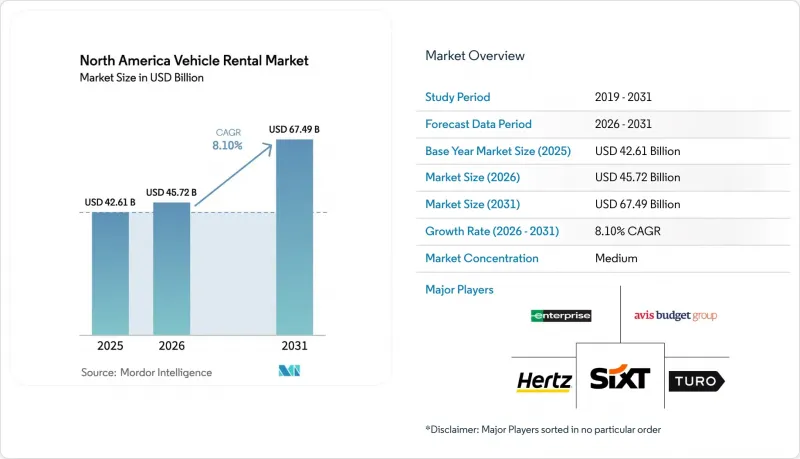
This report is Segmented by Vehicle Type (Luxury Cars, and More), Application Type (Leisure Travel, and More), Rental Duration (Short-Term and Long-Term), Booking Type (Online and Offline), Customer Type (Individual and More), Rental Location (On-Airport and Off-Airport), Fuel Type (Internal Combustion Engine and More), and Country. Market Forecasts are in Value (USD).
North America Vehicle Rental Market Trends and Insights
Rise in Inbound Leisure Travel Post-COVID-19
Passenger throughput at Transportation Security Administration checkpoints reached 904 million in 2024, the highest annual total on record. The surge restored confidence in airport rentals and maintained leisure's 53.62% share of the North America vehicle rental market, with a projected 11.92% CAGR through 2031. Gateway airports such as Los Angeles, Miami, and Orlando benefited disproportionately from recovering trans-Atlantic and Latin American traffic, translating to higher multi-day sport utility vehicle (SUV) bookings. Canadian destinations also logged double-digit growth in overnight visitors during the 2024 summer peak. Extended "bleisure" stays among millennial and Gen Z travelers lengthened average rental durations and supported yield improvements.
Strong Rebound of Corporate Road-Warrior Segment
Corporate travel volumes reached about 90% of 2019 benchmarks by Q4 2024. High-frequency road warriors chose premium sedans and loyalty perks, enabling operators to deploy dynamic pricing and earn higher ancillary revenue. Enterprise Holdings and Avis Budget Group reported sequential gains in corporate account bookings during 2024. Large conventions such as CES 2025 drove short-notice spikes that AI-based pricing captured, lifting revenue per available car even with modest fleet growth.
OEM Vehicle Supply Constraints and High Acquisition Costs
Semiconductor shortages curbed 2024 fleet deliveries, forcing operators to extend holding periods and negotiate residual-value guarantees. Average new-vehicle transaction prices in the United States hovered near USD 48,000 in 2024, increasing capital requirements. Operators narrowed depreciation per unit by replacing aging sedans with customer-preferred sport utility vehicles, yet acquisition costs remain a drag while original equipment manufacturers retool for electrification.
Other drivers and restraints analyzed in the detailed report include:
- Airport Infrastructure Modernization Boosting On-Airport Rentals
- EV-Focused Fleet Incentives Under United States Inflation Reduction Act (IRA) and the Canadian Zero-Emission Vehicle (ZEV) Mandates
- Rising Insurance Premiums and Liability-Claims Inflation
For complete list of drivers and restraints, kindly check the Table Of Contents.
Segment Analysis
Economy vehicles hold a significant position in North America's vehicle rental market, accounting for a 45.18% share in 2025. This dominance is primarily driven by corporate contracts and the demand from cost-sensitive leisure travelers. However, sport utility vehicles and crossovers are rapidly gaining traction as the fastest-growing segment. They are projected to grow at a 10.68% CAGR through 2031, fueled by the preferences of families and inbound tourists who prioritize space, comfort, and all-weather reliability.
Operators are increasingly adjusting their fleet composition to include more sport utility vehicles, despite the higher costs associated with acquisition and insurance. These vehicles offer better utilization rates and command higher average daily rates, making them a lucrative choice. Premium and luxury vehicles, although representing a smaller share of the market, deliver higher margins, particularly in urban and resort areas. Additionally, multi-purpose vehicles and light vans continue to address the specific needs of group travel and commercial mobility niches.
Leisure travel has established itself as the leading segment in the market, holding a significant 53.62% share in 2025. This segment is anticipated to grow at an impressive 11.92% CAGR through 2031, driven by robust inbound tourism and the increasing trend of extended holiday travel. Additionally, the rise of "bleisure" travel, which combines business and leisure, is further extending rental durations and directly enhancing revenue per transaction.
On the other hand, business travel has stabilised as a reliable secondary demand pillar, contributing steady weekday volumes and generating a higher yield per rental. Although corporate travel levels remain below pre-pandemic peaks, operators benefit from margin stability supported by negotiated accounts and loyalty-driven repeat usage.
In 2025, short-term rentals commanded a significant 79.94% share of the market, underscoring their appeal to both leisure and business travelers, who favor daily and weekly bookings. These rentals adeptly leverage dynamic pricing, capitalizing on seasonal peaks and surges driven by major events. The dominance of short-term rentals is further supported by their ability to cater to last-minute bookings and provide a wide range of options, from economy cars to premium vehicles, making them a preferred choice for diverse traveler needs.
Long-term rentals, alongside subscription models, are set to expand at a robust 13.35% CAGR. This growth is fueled by a consumer shift towards valuing flexibility over traditional ownership and a rising demand from the gig economy. Additionally, the increasing adoption of remote work has amplified the demand for long-term rental solutions, as individuals and families seek adaptable living arrangements. Furthermore, operators are enhancing customer retention and securing stable, recurring revenue through bundled pricing that encompasses insurance and maintenance services, which also adds convenience and value for consumers.
Complete Report Scope:
- By Vehicle Type
- Luxury Cars
- Economy Cars
- SUVs and Crossovers
- Multi-Purpose Vehicles (MPV)
- Light Commercial Vans
- By Application Type
- Leisure Travel
- Business/Commercial Travel
- Local Usage (In-city)
- Outstation/Inter-city
- By Rental Duration
- Short-Term (Under 30 days)
- Long-Term/Subscription (30 days or more)
- By Booking Type
- Online
- Offline
- By Customer Type
- Individual
- Corporate Fleet Accounts
- By Rental Location
- On-Airport
- Off-Airport
- By Fuel Type
- Internal Combustion Engine (ICE)
- Hybrid
- Battery Electric Vehicle (BEV)
- By Country
- United States
- Canada
- Rest of North America
List of Companies Covered in this Report:
- Enterprise Holdings, Inc.
- Avis Budget Group, Inc.
- Hertz Global Holdings, Inc.
- Sixt SE
- Europcar Mobility Group
- Turo Inc.
- Getaround, Inc.
- Kyte Systems Inc.
- Flexcar, Inc.
- HyreCar Inc.
- Routes Car Rental
Additional Benefits:
- The market estimate (ME) sheet in Excel format
- 3 months of analyst support
TABLE OF CONTENTS
1 Introduction
- 1.1 Study Assumptions and Market Definition
- 1.2 Scope of the Study
2 Research Methodology
3 Executive Summary
4 Market Landscape
- 4.1 Market Overview
- 4.2 Market Drivers
- 4.2.1 Rise in Inbound Leisure Travel Post-COVID-19
- 4.2.2 Strong Rebound of Corporate Road-Warrior Segment
- 4.2.3 Airport Infrastructure Modernisation Boosting On-Airport Rentals
- 4.2.4 EV-Focused Fleet Incentives Under United States Inflation Reduction Act (IRA) and the Canadian Zero-Emission Vehicle (ZEV) Mandates
- 4.2.5 Peer-to-Peer Car-Sharing Platforms Unlocking Latent Supply
- 4.2.6 AI-Driven Dynamic Pricing Lifting Revenue per Available Car (RevPAC)
- 4.3 Market Restraints
- 4.3.1 OEM Vehicle Supply Constraints and High Acquisition Costs
- 4.3.2 Rising Insurance Premiums and Liability-Claims Inflation
- 4.3.3 Urban Modal Shift Toward Ride-Hailing and Micro-Mobility
- 4.3.4 Airport Surcharges and Environmental Levies Squeezing Margins
- 4.4 Value/Supply-Chain Analysis
- 4.5 Regulatory Landscape
- 4.6 Technological Outlook
- 4.7 Porter's Five Forces
- 4.7.1 Threat of New Entrants
- 4.7.2 Bargaining Power of Buyers/Consumers
- 4.7.3 Bargaining Power of Suppliers
- 4.7.4 Threat of Substitute Products
- 4.7.5 Intensity of Competitive Rivalry
5 Market Size and Growth Forecasts (Value (USD))
- 5.1 By Vehicle Type
- 5.1.1 Luxury Cars
- 5.1.2 Economy Cars
- 5.1.3 SUVs and Crossovers
- 5.1.4 Multi-Purpose Vehicles (MPV)
- 5.1.5 Light Commercial Vans
- 5.2 By Application Type
- 5.2.1 Leisure Travel
- 5.2.2 Business/Commercial Travel
- 5.2.3 Local Usage (In-city)
- 5.2.4 Outstation/Inter-city
- 5.3 By Rental Duration
- 5.3.1 Short-Term (Under 30 days)
- 5.3.2 Long-Term/Subscription (30 days or more)
- 5.4 By Booking Type
- 5.4.1 Online
- 5.4.2 Offline
- 5.5 By Customer Type
- 5.5.1 Individual
- 5.5.2 Corporate Fleet Accounts
- 5.6 By Rental Location
- 5.6.1 On-Airport
- 5.6.2 Off-Airport
- 5.7 By Fuel Type
- 5.7.1 Internal Combustion Engine (ICE)
- 5.7.2 Hybrid
- 5.7.3 Battery Electric Vehicle (BEV)
- 5.8 By Country
- 5.8.1 United States
- 5.8.2 Canada
- 5.8.3 Rest of North America
6 Competitive Landscape
- 6.1 Market Concentration
- 6.2 Strategic Moves and Funding
- 6.3 Market Share Analysis
- 6.4 Company Profiles (Includes Global level Overview, Market level Overview, Core Segments, Financials as Available, Strategic Information, Market Rank/Share for Key Companies, Products and Services, SWOT Analysis, and Recent Developments)
- 6.4.1 Enterprise Holdings, Inc.
- 6.4.2 Avis Budget Group, Inc.
- 6.4.3 Hertz Global Holdings, Inc.
- 6.4.4 Sixt SE
- 6.4.5 Europcar Mobility Group
- 6.4.6 Turo Inc.
- 6.4.7 Getaround, Inc.
- 6.4.8 Kyte Systems Inc.
- 6.4.9 Flexcar, Inc.
- 6.4.10 HyreCar Inc.
- 6.4.11 Routes Car Rental
7 Market Opportunities and Future Outlook
- 7.1 White-space and Unmet-Need Assessment

