PUBLISHER: Mordor Intelligence | PRODUCT CODE: 2116661

PUBLISHER: Mordor Intelligence | PRODUCT CODE: 2116661
Malaysia Car Rental - Market Share Analysis, Industry Trends & Statistics, Growth Forecasts (2026 - 2031)
According to Mordor Intelligence, the malaysian car rental market size is expected to grow from USD 0.62 billion in 2025 to USD 0.67 billion in 2026 and is forecast to reach USD 1.01 billion by 2031 at 8.42% CAGR over 2026-2031.
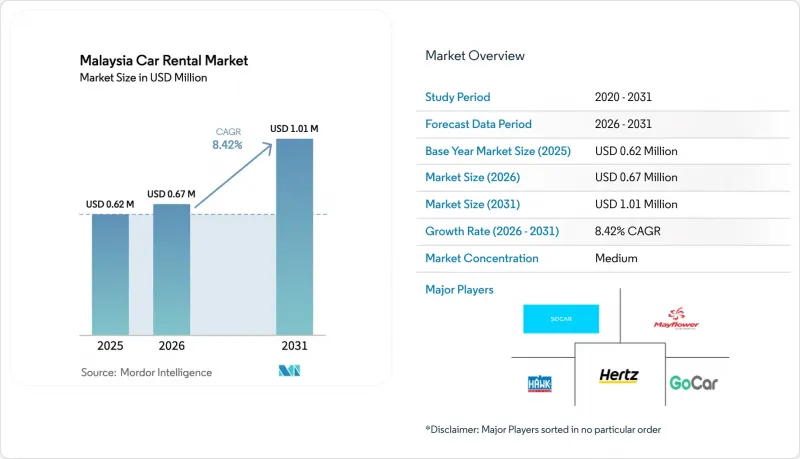
This report is Segmented by Booking Type (Online Booking and Offline Booking), Rental Duration (Short-Term and Long-Term/Leasing), Vehicle Type (Hatchback/Economy, Sedan, SUV, and MPV), Rental Channel (On-Airport and Off-Airport), Application (Tourism and Leisure and Commuting/Business), and Customer Type (Individual and Corporate/Fleet). The Market Forecasts are Provided in Terms of Value (USD).
Malaysia Car Rental Market Trends and Insights
Rising Inbound and Domestic Tourism Rebound
Malaysia welcomed 38 million visitors in 2024, a 31% jump over earlier targets and a clear signal of pent-up travel demand. The government's Visit Malaysia 2026 campaign now targets 35.6 million arrivals, underpinning a solid pipeline for mobility services. Passenger throughput across Malaysia Airports Holdings Berhad assets reached 77.8% of 2019 levels in 2023, with new routes from Shanghai and Phnom Penh restoring international connectivity. These trends reinforce the Malaysian car rental market as tourists extend stays into secondary cities where public transport density remains thin. Off-airport outlets that already command the majority of rental transactions stand to harvest additional volumes as travelers search for cost-efficient options outside terminals.
SUV Preference Boosting Higher-Margin Fleet Mix
SUVs' share in Malaysia's new-car sales accounts for nearly one-third of total sales, reflecting consumer appetite for higher seating positions and multipurpose cargo space. Rental agencies benefit because SUVs yield 40 to 60% higher daily rates yet sustain strong utilization. Proton and Perodua plan several budget SUVs for 2025, including an electric crossover priced between RM50,000 and RM90,000 (USD 10,700-19,300), allowing operators to offer greener options without sacrificing the SUV flavor. Superior profit margins should keep this body style growing through 2030.
Intensifying Competition from Ride-Hailing and E-Hailing
Grab's ubiquity in urban corridors removes many friction points of self-drive rentals, such as parking and insurance. Price bundling with hotels and airlines lets platforms siphon spontaneous demand. Traditional agencies now focus on multi-day leisure trips, family tours, and specialty vehicles where ride-hailing is less cost-effective, yet the competitive overhang trims near-term pricing power.
Other drivers and restraints analyzed in the detailed report include:
- Accelerating Shift to Online-First Booking Platforms
- Corporate Gig-Mobility Demand (Ride-Hailing Driver Leasing)
- Persistent Fuel-Price Volatility
For complete list of drivers and restraints, kindly check the Table Of Contents.
Segment Analysis
Offline channels controlled 56.48% of the Malaysian car rental market share in 2025 due to entrenched travel-agency relationships and walk-in hotel counters. Investments in mobile booking engines and contactless kiosks let these incumbents keep clients inside proprietary ecosystems while boosting upsell rates. The Malaysian car rental market size for online reservations is projected to expand at a 11.68% CAGR as operators integrate QR-code payments and real-time fleet tracking. Purely online portals face rising acquisition costs as search advertising grows crowded. Operators converge on omnichannel models, blending physical touchpoints with cloud-native inventory so customers can toggle seamlessly between app, call center, and counter.
Digital-first brands retain a data advantage because granular telematics feed dynamic-pricing engines that maximize yield per vehicle. Indoor-mapping APIs also shorten pick-up times at malls and airports, improving user satisfaction. Over the forecast horizon, online portals will deepen ties with airlines and travel-super-apps to widen funnel reach, yet mature growth curves suggest incremental share gains will be moderate. Offline operators that finish their digital overhaul could erode the perceived edge of pure-play platforms, especially among repeat domestic travelers.
Short-term hires under 30 days generated 69.62% of the Malaysian car rental market share in 2025, leveraging the tourism upswing and spontaneous domestic weekend trips. Peak-season daily rates can climb 30% above shoulder months, giving agencies a revenue hedge. The Malaysian car rental market size for short-term contracts will grow in line with inbound traffic, though its CAGR trails the long-term segment. Corporations and expatriates now view leasing as an OPEX lever, pushing long-term and subscription models toward a 9.31% CAGR. These plans trim paperwork and bundle maintenance, making them attractive for HR departments managing rotating project teams.
Subscription customers show lower churn than day-to-day renters, yielding predictable fleet-utilization ratios that support financing agreements with banks. Long-term demand is also linked to the gig-mobility boom as ride-hailing drivers prefer hassle-free leases over vehicle ownership. Operators diversifying into 3-to-24-month contracts can smooth seasonality and shield against tourism shocks, anchoring a balanced portfolio across tenure buckets.
Complete Report Scope:
- By Booking Type
- Online Booking
- Offline Booking
- By Rental Duration
- Short-Term (Less than 30 days)
- Long-Term/Leasing (>=30 days)
- By Vehicle Type
- Hatchback/Economy
- Sedan
- Sport-Utility Vehicles (SUV)
- Multi-Purpose Vehicles (MPV)
- By Rental Channel
- On-Airport
- Off-Airport
- By Application
- Tourism and Leisure
- Commuting / Business
- By Customer Type
- Individual
- Corporate / Fleet
List of Companies Covered in this Report:
- The Hertz Corporation
- Hawk Rent A Car
- Mayflower Car Rental Sdn. Bhd.
- SOCAR Malaysia
- GoCar Malaysia
- Europcar Mobility Group
- Avis Budget Group
- SIXT SE
- Galaxy Asia Car Rental
- Paradise Rent-A-Car
- Orix Leasing Malaysia Berhad
- Green Matrix Rental Car
- Drive MY
- Insas Pacific Rent-A-Car Sdn. Bhd
- Agtran Rent a Car
- Kasina Baru (M) Sdn Bhd
Additional Benefits:
- The market estimate (ME) sheet in Excel format
- 3 months of analyst support
TABLE OF CONTENTS
1 Introduction
- 1.1 Study Assumptions & Market Definition
- 1.2 Scope of the Study
2 Research Methodology
3 Executive Summary
4 Market Landscape
- 4.1 Market Overview
- 4.2 Market Drivers
- 4.2.1 Rising Inbound and Domestic Tourism Rebound
- 4.2.2 SUV Preference Boosting Higher-Margin Fleet Mix
- 4.2.3 Accelerating Shift to Online-First Booking Platforms
- 4.2.4 Corporate Gig-Mobility Demand (Ride-Hailing Driver Leasing)
- 4.2.5 Government EV Incentives Catalyzing Electric Rental Fleets
- 4.2.6 Emergence of Subscription-Based Rental Plans for Expatriates and Digital Nomads
- 4.3 Market Restraints
- 4.3.1 Intensifying Competition from Ride-Hailing and E-Hailing
- 4.3.2 Persistent Fuel-Price Volatility
- 4.3.3 Rising Insurance and Excess-Waiver Cost Burden
- 4.3.4 Urban Parking Shortages Inflating Operating Costs
- 4.4 Value / Supply-Chain Analysis
- 4.5 Regulatory Landscape
- 4.6 Technological Outlook (Telematics, AI fleet-management)
- 4.7 Porter's Five Forces
- 4.7.1 Threat of New Entrants
- 4.7.2 Bargaining Power of Buyers/Consumers
- 4.7.3 Bargaining Power of Suppliers
- 4.7.4 Threat of Substitutes
- 4.7.5 Intensity of Competitive Rivalry
5 Market Size & Growth Forecasts (Value (USD))
- 5.1 By Booking Type
- 5.1.1 Online Booking
- 5.1.2 Offline Booking
- 5.2 By Rental Duration
- 5.2.1 Short-Term (Less than 30 days)
- 5.2.2 Long-Term/Leasing (>=30 days)
- 5.3 By Vehicle Type
- 5.3.1 Hatchback/Economy
- 5.3.2 Sedan
- 5.3.3 Sport-Utility Vehicles (SUV)
- 5.3.4 Multi-Purpose Vehicles (MPV)
- 5.4 By Rental Channel
- 5.4.1 On-Airport
- 5.4.2 Off-Airport
- 5.5 By Application
- 5.5.1 Tourism and Leisure
- 5.5.2 Commuting / Business
- 5.6 By Customer Type
- 5.6.1 Individual
- 5.6.2 Corporate / Fleet
6 Competitive Landscape
- 6.1 Market Concentration
- 6.2 Strategic Moves
- 6.3 Market Share Analysis
- 6.4 Company Profiles (Includes Global Level Overview, Market Level Overview, Core Segments, Financials as Available, Strategic Information, Market Rank/Share for Key Companies, Products and Services, SWOT Analysis, and Recent Developments)
- 6.4.1 The Hertz Corporation
- 6.4.2 Hawk Rent A Car
- 6.4.3 Mayflower Car Rental Sdn. Bhd.
- 6.4.4 SOCAR Malaysia
- 6.4.5 GoCar Malaysia
- 6.4.6 Europcar Mobility Group
- 6.4.7 Avis Budget Group
- 6.4.8 SIXT SE
- 6.4.9 Galaxy Asia Car Rental
- 6.4.10 Paradise Rent-A-Car
- 6.4.11 Orix Leasing Malaysia Berhad
- 6.4.12 Green Matrix Rental Car
- 6.4.13 Drive MY
- 6.4.14 Insas Pacific Rent-A-Car Sdn. Bhd
- 6.4.15 Agtran Rent a Car
- 6.4.16 Kasina Baru (M) Sdn Bhd
7 Market Opportunities & Future Outlook
- 7.1 White-space & Unmet-Need Assessment

