PUBLISHER: Mordor Intelligence | PRODUCT CODE: 2116660

PUBLISHER: Mordor Intelligence | PRODUCT CODE: 2116660
Europe Less-Than Container Load - Market Share Analysis, Industry Trends & Statistics, Growth Forecasts (2026 - 2031)
According to Mordor Intelligence, the Europe less-Than container load market size is expected to grow from USD 23.23 billion in 2025 to USD 24.17 billion in 2026 and is forecast to reach USD 29.45 billion by 2031 at 4.03% CAGR over 2026-2031.
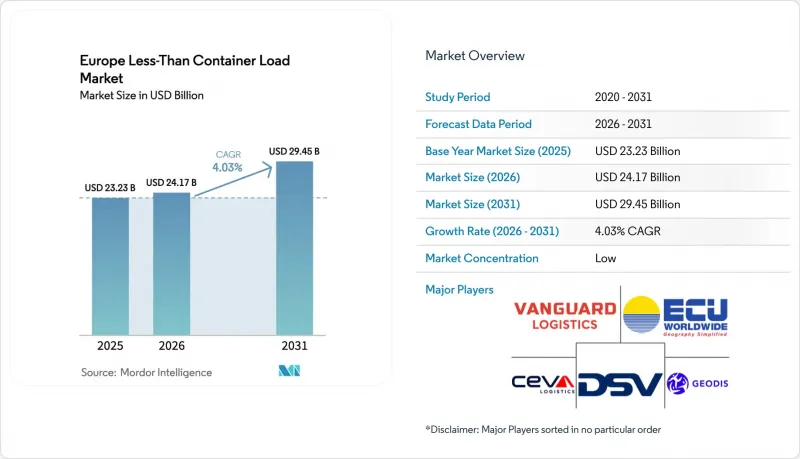
This report is Segmented by Service Type (Consolidation Services, De-Consolidation & Distribution), Destination (Domestic, International), Nature of Business (Freight Forwarding, Nvoccs), End User (Manufacturing and Automotive, Retail & E-Commerce, Healthcare & Pharmaceuticals, and More), and Geography (Germany, and More). The Market Forecasts are Provided in Terms of Value (USD).
Europe Less-Than Container Load Market Trends and Insights
E-commerce Parcel Surge Propels LCL Consolidation Demand
European parcel carriers moved 6.2 billion shipments during the 2024 holiday peak, a 9% jump that gave freight forwarders rich opportunities to aggregate smaller orders into containerized loads. Roughly 70% of that volume required direct-to-consumer delivery, encouraging providers to apply algorithmic matching that raises container fill rates and lowers handling costs. Chinese platforms alone sent 4.6 billion packets into Europe in 2024, magnifying the need for reliable LCL consolidation that can clear customs at scale. The EU plan to withdraw the EUR 150 duty-free threshold in 2025 will standardize declarations, strengthening the competitive position of LCL operators that already run integrated brokerage capabilities. Together these forces add structural tailwinds to the Europe less than container load (LCL) market.
Digital Freight Platforms Transform LCL Booking Infrastructure
Platforms such as Cargoboard and Shypple compress traditional quote cycles from several days to a few minutes, giving shippers on-demand price discovery and slot confirmation. Kuehne + Nagel's myKN expands this capability with CO2-neutral options and real-time tracking, contributing to the forwarder's 15% revenue increase in Q1 2025. Algorithmic route design and machine-learning-driven capacity pooling consistently lift container utilization 20-30 percentage points above manual methods. Maersk flags digitalization as a top logistics theme for 2025, highlighting how automated workflows are redefining freight forwarding complexity. These advancements widen adoption of Europe less than container load (LCL) market solutions among small and midsized shippers that previously lacked purchasing leverage.
Port Congestion Crisis Disrupts LCL Transit Reliability
Vessel wait times of 7-10 days at key consolidation hubs reflect yard utilization beyond 92%, pushing container dwell at Rotterdam past 9 days and stretching barge delays in Antwerp to 96-120 hours. Belgian strikes in early 2025 shut port access for 36 hours, cascading backlogs across Northern Europe. End-to-end lanes that once delivered in 45 days now require up to 90 days, pressuring inventory planning for users of the Europe less than container load (LCL) market.
Other drivers and restraints analyzed in the detailed report include:
- EU ETS Implementation Accelerates Modal Shift to LCL Services
- Asia-Europe Green Shipping Corridors Enhance Sailing Frequency
- Carbon-Compliance Surcharges Tighten Cost Parity
For complete list of drivers and restraints, kindly check the Table Of Contents.
Segment Analysis
Consolidation services captured 54.40% of 2025 revenue within the Europe less than container load (LCL) market, reflecting the core economics of aggregating multiple consignments into a single container move. Sophisticated matching engines on platforms including Ship4wd raise load factors, allowing forwarders to distribute cost savings to small and midsize exporters. The Europe less than container load (LCL) market size for consolidation is projected to expand steadily as algorithms cut empty slots and reduce manual planning time. De-consolidation and distribution, though smaller, post the fastest 4.67% CAGR thanks to the surge in last-mile e-commerce fulfillment that needs break-bulk capability close to consumption centers.
The segment's evolution now incorporates AI-driven stowage plans that respect cargo affinity rules while squeezing every cubic meter, a capability especially attractive to high-value healthcare and temperature-sensitive loads. Import Control System 2, rolling to road and rail legs in 2025, raises data-quality thresholds, tilting business toward providers with seamless digital compliance. As carbon pricing tightens, consolidated voyages spread ETS costs across more shippers, strengthening the dominance of consolidation services in the Europe less than container load (LCL) industry.
International lanes represented 70.55% of 2025 turnover, underlining Europe's deep cross-border trade integration. The Europe less than container load (LCL) market size for international moves is forecast to grow at a 4.26% CAGR, buoyed by trade liberalization with Asia-Pacific and corridor diversification around the Red Sea disruption. Post-Brexit customs procedures add documentation layers that make consolidated services more cost-effective on UK-EU corridors.
Longer transit distances embedded in international moves command better margins and support premium add-ons such as CO2-neutral offerings and time-definite agreements. Domestic LCL retains relevance in feeding hub ports and balancing inland distribution loops, yet its shorter haul and competitive truckload rates restrain expansion. As EU decarbonization turns road transport costlier, some intra-EU freight will convert to short-sea LCL, creating incremental upside for international-style operations inside the Europe less than container load (LCL) market.
Complete Report Scope:
- By Service Type
- Consolidation Services
- De-consolidation and Distribution
- By Destination
- Domestic
- International
- By Nature of Business
- Freight Forwarding
- NVOCCs
- By End User
- Manufacturing and Automotive
- Retail and E-commerce
- Healthcare and Pharmaceuticals
- Agriculture and Forestry
- Other End Users
- Geography
- Germany
- United Kingdom
- France
- Italy
- Spain
- Netherlands
- Poland
- Scandinavia (Denmark, Sweden, Norway, Finland)
- Central and Eastern Europe (Czechia, Slovakia, Hungary)
- Russia
- Rest of Europe
List of Companies Covered in this Report:
- ECU Worldwide (Part of All Cargo Logistics)
- Vanguard Logistics
- DSV
- Geodis
- CEVA Logistics
- DHL Global Forwarding
- Rhenus Logistics
- Kuehne + Nagel
- Yusen Logistics (Part of NYK Line)
- Rohlig Logistics
- Dachser
- JAS Worldwide
- Scan Global Logistics
- Hellmann Worldwide Logistics
- Savino Del Bene
- Nippon Express
- Expeditors
- Kintetsu World Express
- CWT Globelink (Operating as Globelink Fallow Ltd)
- Amass Global
Additional Benefits:
- The market estimate (ME) sheet in Excel format
- 3 months of analyst support
TABLE OF CONTENTS
1 Introduction
- 1.1 Study Assumptions and Market Definition
2 Research Methodology
3 Executive Summary
4 Market Landscape
- 4.1 Market Overview
- 4.2 Market Drivers
- 4.2.1 E-commerce parcel surge boosts LCL demand
- 4.2.2 Digital freight platforms enable instant LCL booking
- 4.2.3 EU ETS / Med-ECA compliance shifts freight from air and road to LCL
- 4.2.4 Post-Brexit customs complexity diverts UK flows to LCL services
- 4.2.5 Asia-Europe green shipping corridors increase sailing frequency
- 4.2.6 Resilience strategies after Red-Sea rerouting diversify entry ports
- 4.3 Market Restraints
- 4.3.1 Port congestion and container shortages elevate transit variability
- 4.3.2 Fragmented CFS infrastructure in Eastern Europe
- 4.3.3 Carbon-compliance surcharges narrow LCL price advantage
- 4.3.4 Rising insurance/security costs on high-risk routes
- 4.4 Value / Supply-Chain Analysis
- 4.5 Regulatory Landscape (EU ETS, Fit-for-55, Med-ECA)
- 4.6 Technological Outlook (platformisation, IoT tracking, AI routing)
- 4.7 Porter's Five Forces
- 4.7.1 Threat of New Entrants
- 4.7.2 Bargaining Power of Buyers
- 4.7.3 Bargaining Power of Suppliers
- 4.7.4 Threat of Substitutes
- 4.7.5 Intensity of Competitive Rivalry
- 4.8 Pricing Analysis
5 Market Size and Growth Forecasts (Value)
- 5.1 By Service Type
- 5.1.1 Consolidation Services
- 5.1.2 De-consolidation and Distribution
- 5.2 By Destination
- 5.2.1 Domestic
- 5.2.2 International
- 5.3 By Nature of Business
- 5.3.1 Freight Forwarding
- 5.3.2 NVOCCs
- 5.4 By End User
- 5.4.1 Manufacturing and Automotive
- 5.4.2 Retail and E-commerce
- 5.4.3 Healthcare and Pharmaceuticals
- 5.4.4 Agriculture and Forestry
- 5.4.5 Other End Users
- 5.5 Geography
- 5.5.1 Germany
- 5.5.2 United Kingdom
- 5.5.3 France
- 5.5.4 Italy
- 5.5.5 Spain
- 5.5.6 Netherlands
- 5.5.7 Poland
- 5.5.8 Scandinavia (Denmark, Sweden, Norway, Finland)
- 5.5.9 Central and Eastern Europe (Czechia, Slovakia, Hungary)
- 5.5.10 Russia
- 5.5.11 Rest of Europe
6 Competitive Landscape
- 6.1 Market Concentration
- 6.2 Strategic Moves
- 6.3 Market Share Analysis
- 6.4 Company Profiles (includes Global level Overview, Market level overview, Core Segments, Financials as available, Strategic Information, Market Rank/Share, Products and Services, Recent Developments)
- 6.4.1 ECU Worldwide (Part of All Cargo Logistics)
- 6.4.2 Vanguard Logistics
- 6.4.3 DSV
- 6.4.4 Geodis
- 6.4.5 CEVA Logistics
- 6.4.6 DHL Global Forwarding
- 6.4.7 Rhenus Logistics
- 6.4.8 Kuehne + Nagel
- 6.4.9 Yusen Logistics (Part of NYK Line)
- 6.4.10 Rohlig Logistics
- 6.4.11 Dachser
- 6.4.12 JAS Worldwide
- 6.4.13 Scan Global Logistics
- 6.4.14 Hellmann Worldwide Logistics
- 6.4.15 Savino Del Bene
- 6.4.16 Nippon Express
- 6.4.17 Expeditors
- 6.4.18 Kintetsu World Express
- 6.4.19 CWT Globelink (Operating as Globelink Fallow Ltd)
- 6.4.20 Amass Global
7 Market Opportunities and Future Outlook
- 7.1 White-space and Unmet-Need Assessment

