PUBLISHER: Mordor Intelligence | PRODUCT CODE: 2114419

PUBLISHER: Mordor Intelligence | PRODUCT CODE: 2114419
Texas Freight And Logistics - Market Share Analysis, Industry Trends & Statistics, Growth Forecasts (2026 - 2031)
According to Mordor Intelligence, the texas freight and logistics market size was valued at USD 139.19 billion in 2025 and estimated to grow from USD 144.23 billion in 2026 to reach USD 172.24 billion by 2031, at a CAGR of 3.62% during the forecast period (2026-2031).
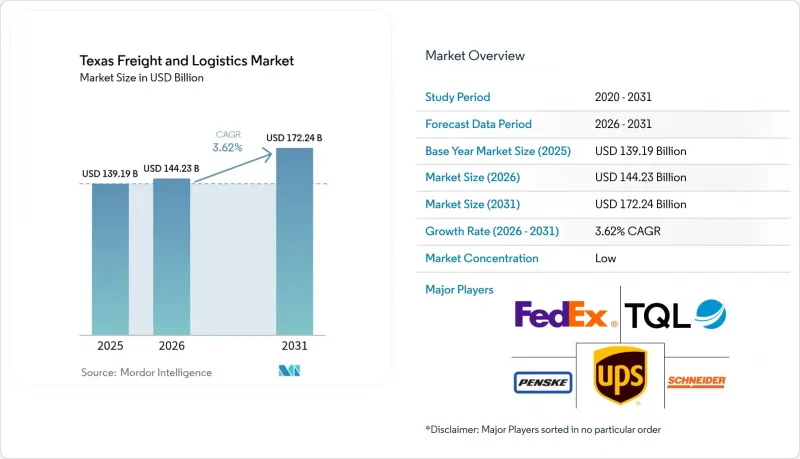
This report is Segmented by End User Industry (Agriculture, Fishing, and Forestry, Construction, Manufacturing, Wholesale and Retail Trade, Oil and Gas, Mining and Quarrying, and Others), and by Logistics Function (Courier, Express, and Parcel (CEP), Freight Forwarding, Freight Transport, Warehousing and Storage, and Other Services). The Market Forecasts are Provided in Terms of Value (USD).
Texas Freight And Logistics Market Trends and Insights
E-commerce Fulfillment Boom Reshaping Distribution Footprints
Amazon's statewide rollout of large-package delivery capabilities signals a decisive shift toward handling bulkier items that dominate e-commerce growth. Texas distribution centers are reconfiguring dock space and adopting automated sortation to process furniture, appliances, and home-improvement goods more efficiently. Cold-storage landlords are retrofitting facilities for rapid grocery fulfillment as online food orders climb. Robotics providers report double-digit throughput gains when AI-driven inventory systems replace manual picking, accelerating turnover rates in key Dallas-Fort Worth and Houston submarkets. These productivity improvements reinforce Texas freight and logistics market competitiveness by compressing delivery windows and reducing labor costs.
Near-shoring Flows from Mexico Boosting Cross-Border Truckload
Mexico surpassed China as America's top trade partner, driving a sharp rise in truck crossings at Laredo, Pharr, and El Paso. Automotive and electronics parts now traverse the I-35 corridor at volumes that strain existing rest-area and bridge capacity. To preserve cycle times, brokers deploy predictive analytics to pre-clear customs data and schedule off-peak staging. Carriers with bilingual dispatch teams and C-TPAT certifications gain an edge in winning multiyear contracts from nearshoring manufacturers. These developments elevate the strategic importance of the Texas freight and logistics market for nationwide supply-chain managers seeking resilient regional networks.
Severe Truck-Parking Deficit Along I-35 and I-10 Corridors
Truck stops on the Laredo-to-Dallas stretch operate at over 100% of design capacity during peak evenings, forcing drivers to stage on highway shoulders. Lost time securing legal parking erodes productivity and inflates detention costs. Hours-of-service limits, unchanged since the pandemic, magnify the operational hit when safe parking is scarce. State grants for new rest-area construction remain years away from delivery, meaning carriers must bake larger time buffers into schedules-an inefficiency that drags on the Texas freight and logistics market CAGR.
Other drivers and restraints analyzed in the detailed report include:
- Energy Transition Investments Spiking Oversized Cargo
- Connected-Freight Corridor Tech Pilots Improving Asset Turns
- Gulf-Coast Extreme-Weather Disruptions Raising Insurance and Re-Routing Costs
For complete list of drivers and restraints, kindly check the Table Of Contents.
Segment Analysis
Wholesale and retail trade captured 27.10% of the Texas freight and logistics market size in 2025 and is posting the highest 4.32% CAGR (2026-2031). Expansion of mega-fulfillment centers by both Amazon and traditional big-box retailers positions Texas as a national inventory staging point.
Manufacturing ranks second as semiconductor, aerospace, and machinery makers increase output destined for domestic and export customers. Energy extraction and processing remain core, but diversification into renewables tilts freight mix toward oversized turbines and hydrogen modules. Construction logistics stay robust on industrial capex cycles, while agricultural exports of beef, cotton, and grains sustain a meaningful baseline of specialized reefer and bulk freight.
Freight transport generated 61.85% of the Texas freight and logistics market size in 2025, underscoring the state's function as a continental transit hub linking Mexican factories, Gulf Coast refineries, and inland consumption centers. Robust intermodal connectivity enables carriers to shift seamlessly among road, rail, and waterway options, supporting commodity flows ranging from refined fuels to retail merchandise. Established 3PLs leverage economies of scale to lock in contract rates, while specialized heavy-haul operators capture premiums on equipment destined for semiconductor fabs and hydrogen plants.
The outlook through 2031 shows freight forwarding expanding at a 3.87% CAGR as nearshoring raises demand for customs brokerage, trade-compliance consulting, and multimodal coordination. Courier, express, and parcel (CEP) specialists face intensifying competition from retailer-controlled delivery networks, pushing them to differentiate via regional sort-center density and real-time visibility. Warehousing and storage providers use automation to trim operating ratios, while value-added "other services" such as sustainability audits and supply-chain risk modeling gain traction among ESG-focused shippers.
Complete Report Scope:
- By Logistics Function
- Courier, Express, and Parcel (CEP)
- By Destination Type
- Domestic
- International
- By Destination Type
- Freight Forwarding
- By Mode of Transport
- Air
- Sea and Inland Waterways
- Others
- By Mode of Transport
- Freight Transport
- By Mode of Transport
- Air
- Rail
- Road
- Sea and Inland Waterways
- Pipelines
- By Mode of Transport
- Warehousing and Storage
- By Temperature Control
- Non-Temperatured Control
- Temperatured Control
- By Temperature Control
- Other Services
- Courier, Express, and Parcel (CEP)
- By End User Industry
- Agriculture, Fishing, and Forestry
- Construction
- Manufacturing
- Oil and Gas, Mining and Quarrying
- Wholesale and Retail Trade
- Others
List of Companies Covered in this Report:
- FedEx Corporation
- UPS Inc.
- Total Quality Logistics
- Schneider
- Penske Logistics
- DHL Group
- CH Robinson Worldwide
- XPO Logistics
- J.B. Hunt Transport Services
- Ryder System
- Landstar System
- Werner Enterprises
- Ceva Logistics
- DSV A/S
- Kuehne + Nagel
- Americold Logistics
- Lineage Logistics
- Texas Logistic & Fulfillment Service
- Arrive Logistics
- Redwood Logistics
Additional Benefits:
- The market estimate (ME) sheet in Excel format
- 3 months of analyst support
TABLE OF CONTENTS
1 Introduction
- 1.1 Study Assumptions & Market Definition
- 1.2 Scope of the Study
2 Research Methodology
3 Executive Summary
4 Market Landscape
- 4.1 Market Overview
- 4.2 Market Drivers
- 4.2.1 E-Commerce Fulfilment Boom Reshaping Distribution Footprints
- 4.2.2 Near-Shoring Flows from Mexico Boosting Cross-Border Truckload
- 4.2.3 Energy Transition Investments (Hydrogen, CCS) Spiking Oversized Cargo
- 4.2.4 Connected-Freight Corridor Tech Pilots (Texas Triangle) Improving Asset Turns
- 4.2.5 Rapid Warehouse Automation Cutting Dwell Times
- 4.2.6 Federal CHIPS/IRA Subsidies Fuelling Semiconductor-Related Inbound Freight
- 4.3 Market Restraints
- 4.3.1 Severe Truck-Parking Deficit Along I-35 & I-10 Corridors
- 4.3.2 Rail Network Capacity Pinch-Points at Houston & DFW Intermodal Hubs
- 4.3.3 Gulf-Coast Extreme-Weather Disruptions Raising Insurance & Re-Routing Costs
- 4.3.4 Driver & Warehouse Labour Shortages Outside Metros
- 4.4 Value / Supply-Chain Analysis
- 4.5 Regulatory Landscape
- 4.6 Technological Outlook
- 4.7 Porter's Five Forces
- 4.7.1 Threat of New Entrants
- 4.7.2 Bargaining Power of Buyers
- 4.7.3 Bargaining Power of Suppliers
- 4.7.4 Threat of Substitutes
- 4.7.5 Intensity of Competitive Rivalry
- 4.8 Impact of E-commerce
- 4.9 Insights into Major Ports
- 4.10 Impact of COVID-19
5 Market Size & Growth Forecasts
- 5.1 By Logistics Function
- 5.1.1 Courier, Express, and Parcel (CEP)
- 5.1.1.1 By Destination Type
- 5.1.1.1.1 Domestic
- 5.1.1.1.2 International
- 5.1.1.1 By Destination Type
- 5.1.2 Freight Forwarding
- 5.1.2.1 By Mode of Transport
- 5.1.2.1.1 Air
- 5.1.2.1.2 Sea and Inland Waterways
- 5.1.2.1.3 Others
- 5.1.2.1 By Mode of Transport
- 5.1.3 Freight Transport
- 5.1.3.1 By Mode of Transport
- 5.1.3.1.1 Air
- 5.1.3.1.2 Rail
- 5.1.3.1.3 Road
- 5.1.3.1.4 Sea and Inland Waterways
- 5.1.3.1.5 Pipelines
- 5.1.3.1 By Mode of Transport
- 5.1.4 Warehousing and Storage
- 5.1.4.1 By Temperature Control
- 5.1.4.1.1 Non-Temperatured Control
- 5.1.4.1.2 Temperatured Control
- 5.1.4.1 By Temperature Control
- 5.1.5 Other Services
- 5.1.1 Courier, Express, and Parcel (CEP)
- 5.2 By End User Industry
- 5.2.1 Agriculture, Fishing, and Forestry
- 5.2.2 Construction
- 5.2.3 Manufacturing
- 5.2.4 Oil and Gas, Mining and Quarrying
- 5.2.5 Wholesale and Retail Trade
- 5.2.6 Others
6 Competitive Landscape
- 6.1 Market Concentration
- 6.2 Strategic Moves
- 6.3 Market Share Analysis
- 6.4 Company Profiles (includes Global level Overview, Market level overview, Core Segments, Financials as available, Strategic Information, Market Rank/Share for key companies, Products & Services, and Recent Developments)
- 6.4.1 FedEx Corporation
- 6.4.2 UPS Inc.
- 6.4.3 Total Quality Logistics
- 6.4.4 Schneider
- 6.4.5 Penske Logistics
- 6.4.6 DHL Group
- 6.4.7 CH Robinson Worldwide
- 6.4.8 XPO Logistics
- 6.4.9 J.B. Hunt Transport Services
- 6.4.10 Ryder System
- 6.4.11 Landstar System
- 6.4.12 Werner Enterprises
- 6.4.13 Ceva Logistics
- 6.4.14 DSV A/S
- 6.4.15 Kuehne + Nagel
- 6.4.16 Americold Logistics
- 6.4.17 Lineage Logistics
- 6.4.18 Texas Logistic & Fulfillment Service
- 6.4.19 Arrive Logistics
- 6.4.20 Redwood Logistics
7 Market Opportunities & Future Outlook
- 7.1 White-space & Unmet-need Assessment

