PUBLISHER: Mordor Intelligence | PRODUCT CODE: 2121787

PUBLISHER: Mordor Intelligence | PRODUCT CODE: 2121787
Philippines Freight And Logistics - Market Share Analysis, Industry Trends & Statistics, Growth Forecasts (2026 - 2031)
According to Mordor Intelligence, the Philippines freight and logistics market size was valued at USD 15.26 billion in 2025 and is estimated to grow from USD 16.20 billion in 2026 to reach USD 21.60 billion by 2031, at a CAGR of 5.93% during the forecast period (2026-2031).
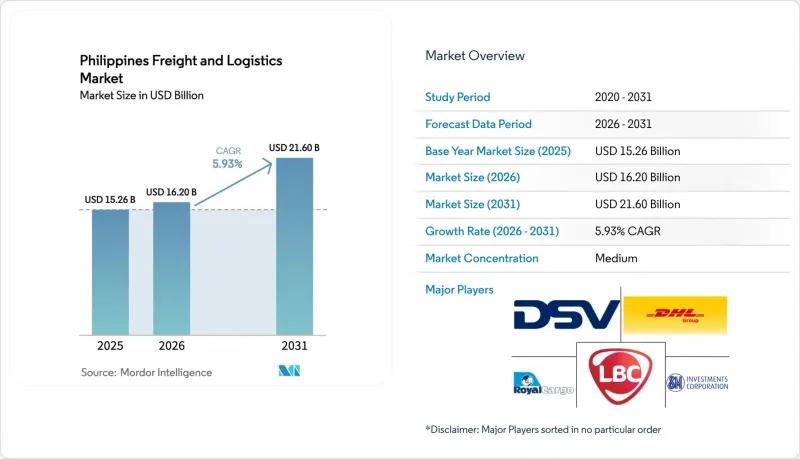
This report is Segmented by End User Industry (Agriculture, Fishing, and Forestry, Construction, Manufacturing, Oil and Gas, Mining and Quarrying, Wholesale and Retail Trade, and More) and by Logistics Function (Courier, Express, and Parcel (CEP), Freight Forwarding, Freight Transport, Warehousing and Storage, and Other Services). The Market Forecasts are Provided in Terms of Value (USD).
Philippines Freight And Logistics Market Trends and Insights
Surge in B2C E-Commerce Parcel Volumes
E-commerce gross merchandise value climbed to USD 21 billion in 2025 as 73% of adult Filipinos shopped online, generating a step-change in last-mile activity. Ninja Van's 2025 tie-up with Universal Robina embeds scan-to-print fulfillment inside fast-moving consumer-goods channels, cutting South Luzon order cycles to under 24 hours. Domestic CEP held 64.98% of 2025 parcels, yet cross-border flows are expanding faster because Clark and Manila gateways now clear most ASEAN parcels within a single day under the National Single Window. Integrated operators that combine warehouse management, sortation, and delivery on a unified software stack capture price premiums and higher asset turns. Pure-play couriers without warehousing depth face commoditization as shippers demand bundled solutions.
Build Better More Infrastructure Pipeline
The PHP 8.3 trillion (USD 143.23 billion) Build Better More program has locked in infrastructure spending near 6% of GDP, with 83% of its 194 flagship projects targeting roads, bridges, ports, and airports. The New Manila International Airport, due in 2028, will handle up to 5 million tons of freight a year, creating a multimodal node that rivals Bangkok and Ho Chi Minh City. Subic Bay's berth expansion and the Mindanao Railway ring will divert cargo away from Metro Manila choke points, reducing long-haul domestic ton-kilometer costs by up to 18%. These corridors improve equipment utilization for trucking fleets and unlock backhaul opportunities for domestic forwarders, while coastal shippers must lower tariffs to remain competitive.
Chronic Road Congestion in Metro Manila
Peak-hour speeds of 12-15 kilometers per hour in 2024 impose PHP 3.5 billion (USD 60.39 million) in daily economic losses, with cold-chain breaches costing pharma distributors up to PHP 200,000 (USD 3,451) per incident. Operators are repositioning hubs to Clark and Laguna, lowering land costs by as much as 60% and raising average speeds to 60 kilometers per hour. Cabotage relaxation aims to divert 15% of inter-regional freight to coastal shipping, yet domestic shipowner resistance has delayed full roll-out. Until the Metro Manila Subway becomes operational post-2028, the congestion premium on urban deliveries will persist.
Other drivers and restraints analyzed in the detailed report include:
- Growth in Temperature-Controlled Food and Pharma Flows
- Nickel-Ore Exports for EV Battery Supply Chains
- Typhoon-Induced Supply-Chain Disruptions
For complete list of drivers and restraints, kindly check the Table Of Contents.
Segment Analysis
Wholesale and Retail Trade generated 30.91% of 2025 demand and grew at a 6.52% CAGR (2026-2031), lifted by modern grocery chains spreading into Visayas and Mindanao. Manufacturing follows, buoyed by a PMI above 53 since 2024 and USD 42 billion in electronics exports.
Oil, gas, and mining carry outsize logistics intensity, particularly nickel-ore lanes that require inbound reagents and spare parts. Construction demand remains stable, keyed to USD-indexed steel and cement inflows for 194 flagship projects. Agriculture freight will climb as cold-chain coverage lowers spoilage on high-value perishables.
Courier, Express, and Parcel activity is expected to rise at 6.82% CAGR between 2026-2031, while Freight Transport still commanded a 63.27% Philippines freight and logistics market share in 2025. The Philippines freight and logistics market size for CEP will climb as integrated sortation-fulfillment models truncate delivery windows and bundle value-added services. Partnerships like Ninja Restock demonstrate that embedding logistics inside consumer-goods distribution compresses the delivery curve and raises parcel density. Non-temperature-controlled warehousing still hosts 91.59% of inventory, yet cold-chain nodes capture outsized capital because food spoilage and pharma compliance impose hard cost ceilings on service lapses. Digital freight platforms are steering customs brokerage and freight insurance toward single-click transactions, lowering administrative overheads and giving SMEs direct access to multicarrier networks.
Temperature-controlled warehousing capacity, while representing a modest 8.41% share, is expanding at 6.69% as the Department of Agriculture backs 99 new cold rooms and private investors add pallet positions in Navotas, Bulacan, and Cebu. The Philippines freight and logistics market size devoted to cold chain is therefore widening its share faster than ambient space, supported by pharmaceutical supply chains aligned under ASEAN regulations. Freight Forwarding volumes reflect the archipelago's reliance on sea channels, but the fastest lane growth now flows through air as electronics and biologics shippers buy speed to protect value.
Complete Report Scope:
- By End-User Industry
- Agriculture, Fishing, and Forestry
- Construction
- Manufacturing
- Oil and Gas, Mining, and Quarrying
- Wholesale and Retail Trade
- Others
- By Logistics Function
- Courier, Express, and Parcel (CEP)
- By Destination Type
- Domestic
- International
- By Destination Type
- Freight Forwarding
- By Mode of Transport
- Air
- Sea and Inland Waterways
- Others
- By Mode of Transport
- Freight Transport
- By Mode of Transport
- Air
- Pipelines
- Rail
- Road
- Sea and Inland Waterways
- By Mode of Transport
- Warehousing and Storage
- By Temperature Control
- Non-Temperature-Controlled
- Temperature-Controlled
- By Temperature Control
- Other Services
- Courier, Express, and Parcel (CEP)
List of Companies Covered in this Report:
- SM Investments Corp. (including 2GO Group)
- A.P. Moller - Maersk
- AAI Worldwide Logistics
- Air21 Global Inc.
- AP Cargo
- CMA CGM Group (Including CEVA Logistics)
- DHL Group
- DSV A/S (Including DB Schenker)
- Fast Logistics
- FedEx
- JRS Business Corporation
- Kuehne+Nagel
- LBC Express Holdings, Inc.
- LF Global Logistics Solutions, Inc.
- Mitsui O.S.K. Lines, Ltd.
- Ninja Van Group (Including Ninja Van Philippines)
- NYK (Nippon Yusen Kaisha) Line
- Orient Freight
- Royal Cargo
- United Parcel Service of America, Inc. (UPS)
Additional Benefits:
- The market estimate (ME) sheet in Excel format
- 3 months of analyst support
TABLE OF CONTENTS
1 Introduction
- 1.1 Study Assumptions and Market Definition
- 1.2 Scope of the Study
2 Research Methodology
3 Executive Summary
4 Market Landscape
- 4.1 Market Overview
- 4.2 Demographics
- 4.3 GDP Distribution by Economic Activity
- 4.4 GDP Growth by Economic Activity
- 4.5 Inflation
- 4.6 Economic Performance and Profile
- 4.6.1 Trends in E-Commerce Industry
- 4.6.2 Trends in Manufacturing Industry
- 4.7 Transport and Storage Sector GDP
- 4.8 Export Trends
- 4.9 Import Trends
- 4.10 Fuel Price
- 4.11 Trucking Operational Costs
- 4.12 Trucking Fleet Size by Type
- 4.13 Logistics Performance
- 4.14 Modal Share
- 4.15 Maritime Fleet Load Carrying Capacity
- 4.16 Liner Shipping Connectivity
- 4.17 Port Calls and Performance
- 4.18 Freight Pricing Trends
- 4.19 Freight Tonnage Trends
- 4.20 Infrastructure
- 4.21 Regulatory Framework (Road and Rail)
- 4.22 Regulatory Framework (Sea and Air)
- 4.23 Value Chain and Distribution Channel Analysis
- 4.24 Market Drivers
- 4.24.1 Surge in B2C E-Commerce Parcel Volumes
- 4.24.2 Build Better More Infrastructure Pipeline
- 4.24.3 Manufacturing Re-Shoring within ASEAN
- 4.24.4 Growth in Temperature-Controlled Food and Pharma Flows
- 4.24.5 Expansion of Digital Freight-Matching Platforms
- 4.24.6 Nickel-Ore Exports For EV Battery Supply Chains
- 4.25 Market Restraints
- 4.25.1 Chronic Road Congestion in Metro Manila
- 4.25.2 High Domestic Shipping Costs Across Islands
- 4.25.3 Typhoon-Induced Supply-Chain Disruptions
- 4.25.4 Limited Uptake of Cargo Insurance Among SMEs
- 4.26 Technological Outlook
- 4.27 Porter's Five Forces Analysis
- 4.27.1 Threat of New Entrants
- 4.27.2 Bargaining Power of Buyers
- 4.27.3 Bargaining Power of Suppliers
- 4.27.4 Threat of Substitutes
- 4.27.5 Competitive Rivalry
5 Market Size and Growth Forecasts (Value in USD)
- 5.1 By End-User Industry
- 5.1.1 Agriculture, Fishing, and Forestry
- 5.1.2 Construction
- 5.1.3 Manufacturing
- 5.1.4 Oil and Gas, Mining, and Quarrying
- 5.1.5 Wholesale and Retail Trade
- 5.1.6 Others
- 5.2 By Logistics Function
- 5.2.1 Courier, Express, and Parcel (CEP)
- 5.2.1.1 By Destination Type
- 5.2.1.1.1 Domestic
- 5.2.1.1.2 International
- 5.2.1.1 By Destination Type
- 5.2.2 Freight Forwarding
- 5.2.2.1 By Mode of Transport
- 5.2.2.1.1 Air
- 5.2.2.1.2 Sea and Inland Waterways
- 5.2.2.1.3 Others
- 5.2.2.1 By Mode of Transport
- 5.2.3 Freight Transport
- 5.2.3.1 By Mode of Transport
- 5.2.3.1.1 Air
- 5.2.3.1.2 Pipelines
- 5.2.3.1.3 Rail
- 5.2.3.1.4 Road
- 5.2.3.1.5 Sea and Inland Waterways
- 5.2.3.1 By Mode of Transport
- 5.2.4 Warehousing and Storage
- 5.2.4.1 By Temperature Control
- 5.2.4.1.1 Non-Temperature-Controlled
- 5.2.4.1.2 Temperature-Controlled
- 5.2.4.1 By Temperature Control
- 5.2.5 Other Services
- 5.2.1 Courier, Express, and Parcel (CEP)
6 Competitive Landscape
- 6.1 Market Concentration
- 6.2 Strategic Moves
- 6.3 Market Share Analysis
- 6.4 Company Profiles (includes Global Level Overview, Market Level Overview, Core Segments, Financials as Available, Strategic Information, Market Rank/Share for Key Companies, Products and Services, and Recent Developments)
- 6.4.1 SM Investments Corp. (including 2GO Group)
- 6.4.2 A.P. Moller - Maersk
- 6.4.3 AAI Worldwide Logistics
- 6.4.4 Air21 Global Inc.
- 6.4.5 AP Cargo
- 6.4.6 CMA CGM Group (Including CEVA Logistics)
- 6.4.7 DHL Group
- 6.4.8 DSV A/S (Including DB Schenker)
- 6.4.9 Fast Logistics
- 6.4.10 FedEx
- 6.4.11 JRS Business Corporation
- 6.4.12 Kuehne+Nagel
- 6.4.13 LBC Express Holdings, Inc.
- 6.4.14 LF Global Logistics Solutions, Inc.
- 6.4.15 Mitsui O.S.K. Lines, Ltd.
- 6.4.16 Ninja Van Group (Including Ninja Van Philippines)
- 6.4.17 NYK (Nippon Yusen Kaisha) Line
- 6.4.18 Orient Freight
- 6.4.19 Royal Cargo
- 6.4.20 United Parcel Service of America, Inc. (UPS)
7 Market Opportunities and Future Outlook
- 7.1 White-Space and Unmet-Need Assessment

