PUBLISHER: Mordor Intelligence | PRODUCT CODE: 2116671

PUBLISHER: Mordor Intelligence | PRODUCT CODE: 2116671
Germany Computed Tomography - Market Share Analysis, Industry Trends & Statistics, Growth Forecasts (2026 - 2031)
According to Mordor Intelligence, the Germany computed tomography market size is expected to grow from USD 541.88 million in 2025 to USD 575.26 million in 2026 and is forecast to reach USD 775.03 million by 2031 at 6.16% CAGR over 2026-2031.
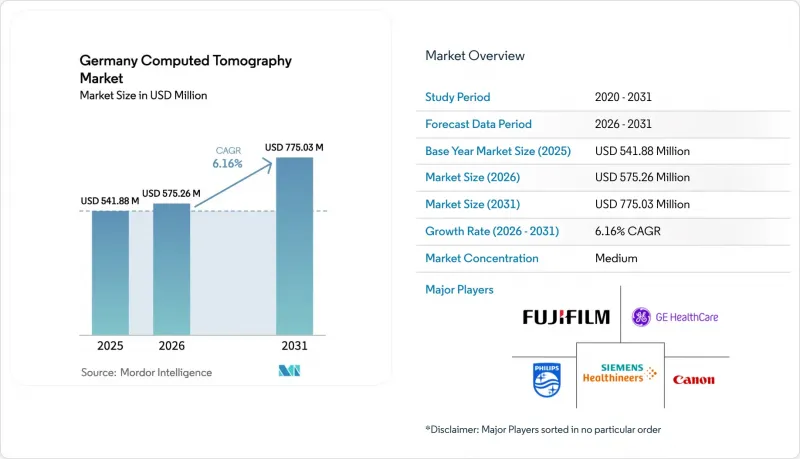
This report is Segmented by Product Type (Low Slice, Medium Slice, and High Slice), Application (Oncology, Neurology, and More), Mobility (Fixed Systems and Mobile Systems), and End User (Hospitals, Diagnostic Imaging Centers, and Others). The Market and Forecasts are Provided in Terms of Value (USD).
Germany Computed Tomography Market Trends and Insights
Chronic-Disease Burden & Ageing Population
Germany computed tomography market volumes climb steadily as 15.3 million residents live with cardiovascular disease and annual cancer incidence reaches 500,000 cases . Each oncology patient undergoes an average of 4-6 scans during therapy, forming a predictable revenue stream for imaging providers. The demographic shift is more pronounced in sparsely populated eastern states where hospital consolidation raises concern over access. To maintain throughput amid staffing gaps, providers invest in automation tools that shorten exam times and standardize image quality. Hospitals use these efficiency gains to accommodate a growing share of chronic-care follow-ups without lengthening wait lists.
Continuous Detector, AI & Photon-Counting Breakthroughs
Photon-counting CT delivers sub-0.2 mm spatial resolution and 45% lower dose relative to conventional detectors . University Hospital Augsburg has already completed more than 8,000 clinical cases, validating spectral imaging benefits in complex cardiovascular and orthopedic evaluations. AI-based reconstruction drives a further 50-80% dose reduction while tripling daily scan capacity, helping radiology departments mitigate workforce shortages. As Germany computed tomography market participants bundle detectors, AI and workflow software, competitive focus shifts from hardware alone to integrated platforms that optimize room utilization.
High Scanner CAPEX & OPEX
A state-of-the-art 128-slice CT costs up to USD 3 million, and annual service contracts add 8-12% of purchase value. Under Germany's diagnosis related group (DRG) financing, hospitals face fixed reimbursements that rarely cover high-end equipment lifecycle costs. Providers need a minimum of 1,065 scans per year to reach breakeven for a dedicated radiology unit, pushing smaller facilities toward teleradiology partnerships. Capital constraints slow uptake of photon-counting systems despite their clinical upside, reinforcing the preference for mid-range platforms that balance capability and cost.
Other drivers and restraints analyzed in the detailed report include:
- Reimbursement of Cardiac CT Angiography from 2025
- Growth of Low-Dose Lung-Cancer Screening Programs
- Stringent BfArM / CE-MDR Approval Timelines
For complete list of drivers and restraints, kindly check the Table Of Contents.
Segment Analysis
Medium Slice platforms capture buyers seeking advanced functionality at sustainable prices, and this category is forecast to grow at a 6.71% CAGR, outpacing the overall Germany computed tomography market. High Slice units retained a 35.88% Germany computed tomography market share in 2025 on the strength of premium cardiac and oncology applications. University hospitals prefer >=256-slice or photon-counting scanners for ultra-high-resolution cases, whereas regional clinics migrate to 64-slice systems that cover most diagnostic pathways without exceeding budget ceilings.
Rapid detector improvements enable Medium Slice devices to deliver near-isotropic imaging and spectral post-processing once reserved for flagship models. This democratization aligns with procurement policies emphasizing value-based care. The Germany computed tomography market size for Medium Slice systems is projected to advanced steadily as outpatient imaging chains refurbish ageing fleets to meet cardiac CT reimbursement demand. Conversely, Low Slice scanners remain niche, serving emergency backups and small trauma centers where acquisition cost trumps advanced features.
Neurology is projected to register a 6.62% CAGR, the fastest within the Germany computed tomography market, driven by nationwide stroke pathways and expanding endovascular therapy capacity. Berlin's STEMO ambulances demonstrate how on-board CT raises thrombolysis rates above 30%, underscoring clinical and economic payoffs of pre-hospital imaging. Oncology preserved the largest 31.78% slice of Germany computed tomography market size in 2025 as comprehensive cancer centers rely on serial CT for staging, treatment planning and surveillance.
Cardiovascular imaging will benefit most directly from the 2025 reimbursement change. As payers encourage non-invasive coronary pathways, mid-tier hospitals invest in dual-source systems that deliver one-beat cardiac studies. Musculoskeletal and trauma indications remain steady, sustained by high road-traffic and workplace injury volumes. AI decision-support tools shorten neurological scan interpretation times, freeing radiologists to handle surging demand without sacrificing diagnostic accuracy.
Complete Report Scope:
- By Product Type
- Low Slice
- Medium Slice
- High Slice
- By Application
- Oncology
- Neurology
- Cardiovascular
- Musculoskeletal
- Other Applications
- By Mobility
- Fixed Systems
- Mobile Systems
- By End User
- Hospitals
- Diagnostic Imaging Centers
- Others
List of Companies Covered in this Report:
- Siemens Healthineers
- GE Healthcare
- Koninklijke Philips
- Canon
- Fujifilm Holdings Corp.
- Samsung Group
- Neusoft
- United Imaging Healthcare
- Shimadzu
- Carestream Health
- Planmeca Group (Planmed Oy)
- Ziehm Imaging
- Brain Lab
- Stryker
- Koning Corp.
- Xoran Technologies LLC
- SternMed
- Imalogix Inc.
Additional Benefits:
- The market estimate (ME) sheet in Excel format
- 3 months of analyst support
TABLE OF CONTENTS
1 Introduction
- 1.1 Study Assumptions & Market Definition
- 1.2 Scope of the Study
2 Research Methodology
3 Executive Summary
4 Market Landscape
- 4.1 Market Overview
- 4.2 Market Drivers
- 4.2.1 Chronic-disease burden & ageing population
- 4.2.2 Continuous detector, AI & photon-counting breakthroughs
- 4.2.3 Reimbursement of cardiac CT angiography from 2025
- 4.2.4 Growth of low-dose lung-cancer screening programs
- 4.2.5 Outpatient imaging platform roll-ups
- 4.2.6 Rural teleradiology demand closing service gaps
- 4.3 Market Restraints
- 4.3.1 High scanner CAPEX & OPEX
- 4.3.2 Stringent BfArM / CE-MDR approval timelines
- 4.3.3 Radiographer & radiologist workforce shortages
- 4.3.4 Oversupply in metro areas compressing scan prices
- 4.4 Regulatory Landscape
- 4.5 Technological Outlook
- 4.6 Porters Five Forces Analysis
- 4.6.1 Threat of New Entrants
- 4.6.2 Bargaining Power of Buyers
- 4.6.3 Bargaining Power of Suppliers
- 4.6.4 Threat of Substitutes
- 4.6.5 Intensity of Competitive Rivalry
5 Market Size & Growth Forecasts (Value, USD)
- 5.1 By Product Type
- 5.1.1 Low Slice
- 5.1.2 Medium Slice
- 5.1.3 High Slice
- 5.2 By Application
- 5.2.1 Oncology
- 5.2.2 Neurology
- 5.2.3 Cardiovascular
- 5.2.4 Musculoskeletal
- 5.2.5 Other Applications
- 5.3 By Mobility
- 5.3.1 Fixed Systems
- 5.3.2 Mobile Systems
- 5.4 By End User
- 5.4.1 Hospitals
- 5.4.2 Diagnostic Imaging Centers
- 5.4.3 Others
6 Competitive Landscape
- 6.1 Market Concentration
- 6.2 Market Share Analysis
- 6.3 Company Profiles (includes Global level Overview, Market level overview, Core Segments, Financials as available, Strategic Information, Market Rank/Share for key companies, Products & Services, and Recent Developments)
- 6.3.1 Siemens Healthineers AG
- 6.3.2 GE Healthcare
- 6.3.3 Koninklijke Philips N.V.
- 6.3.4 Canon Medical Systems Corp.
- 6.3.5 Fujifilm Holdings Corp.
- 6.3.6 Samsung Electronics Co. Ltd (Samsung Medison)
- 6.3.7 Neusoft Medical Systems Co. Ltd
- 6.3.8 United Imaging Healthcare Co. Ltd
- 6.3.9 Shimadzu Corp.
- 6.3.10 Carestream Health
- 6.3.11 Planmeca Group (Planmed Oy)
- 6.3.12 Ziehm Imaging GmbH
- 6.3.13 Brainlab AG
- 6.3.14 Stryker Corp.
- 6.3.15 Koning Corp.
- 6.3.16 Xoran Technologies LLC
- 6.3.17 SternMed GmbH
- 6.3.18 Imalogix Inc.
7 Market Opportunities & Future Outlook
- 7.1 White-space & Unmet-Need Assessment

